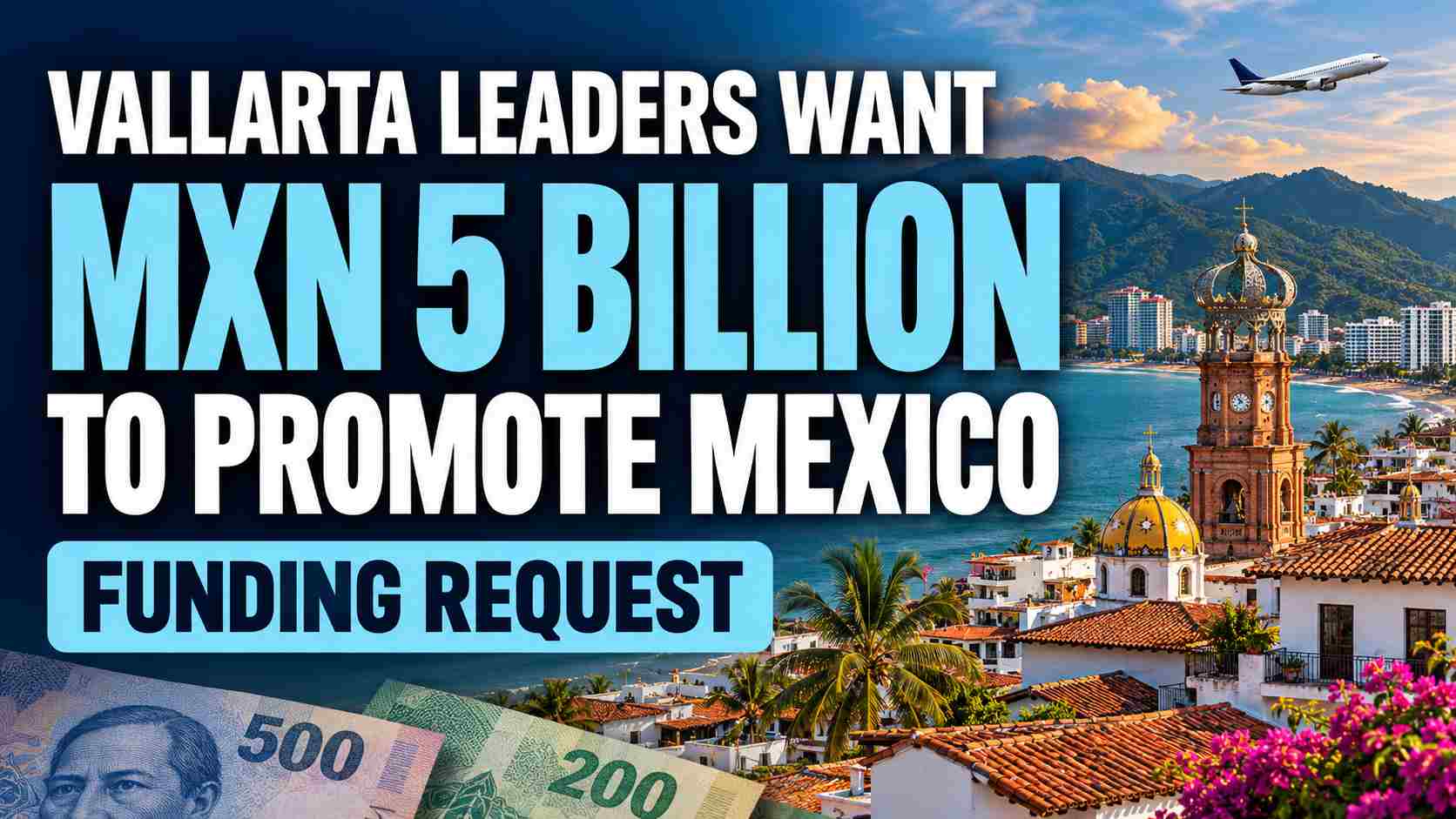
Puerto Vallarta, Jalisco, November 6, 2026 – Puerto Vallarta hotel and business groups called Thursday for MXN 5 billion in national tourism promotion funding in the 2027 federal budget.
The request is part of the Acuerdo de Puebla por la Promoción Turística de México, an industry initiative to redirect existing revenue into campaigns at home and abroad. It hasn’t been approved, and the published proposal doesn’t specify an allocation for Puerto Vallarta.
At the local presentation, supporters included Abel Villa Sánchez, president of the Asociación de Hoteles y Moteles de Puerto Vallarta; Lupita Bayardi González, president of the Consejo Coordinador Empresarial; and Javier Ruiz Hermoso, a local Skål México leader.
“We need to return to a promotion model that isn’t managed by the private sector,” Bayardi said, pointing to competition from other destinations.
The money would come from the Derecho de No Residente, or DNR, the immigration fee paid by foreign visitors. Organizers want to use part of roughly MXN 5.6 billion they say is headed to the Tesorería de la Federación without a specific spending designation.
Ruiz Hermoso described a distribution of DNR revenue that sends about 57% to the Secretaría de la Defensa Nacional, 15% to the Instituto Nacional de Migración and 28% to the treasury. The proposal would draw from the treasury’s portion while leaving the other two shares intact.
“We’re not asking for more taxes,” Ruiz Hermoso said.
The published reports don’t name an agency to administer the proposed fund. Ruiz Hermoso said a new organization wouldn’t be needed.
The plan calls for coordination among governments, destinations, tourism trusts and businesses. Its preliminary spending breakdown includes MXN 1.2 billion for partnerships with international tour operators and airlines, MXN 1.1 billion for digital campaigns abroad and another MXN 1.1 billion for domestic promotion with destinations.
Other proposed uses include Pueblos Mágicos, community tourism, market research, and responses to travel alerts or tourism-related crises.
For Puerto Vallarta and Riviera Nayarit, supporters see airline and tour-operator partnerships as a way to reach more customers and encourage travel during slower months. They also want to broaden the region’s markets through food, meetings, nature and cultural tourism.
The push comes after a sharp drop in international air traffic. As Vallarta Daily reported in October, international passenger traffic at Puerto Vallarta’s airport fell 19.4% from January through September compared with 2025, according to preliminary figures from Grupo Aeroportuario del Pacífico.
Ruiz Hermoso said the initiative had been presented to federal legislators and that organizers planned meetings with the governments of Jalisco and Nayarit to coordinate their efforts.
The proposed spending rules call for measurable targets and quarterly reports to Congress. Funds couldn’t cover payroll, travel expenses, or offices, and the plan rules out direct incentives to routes or airlines. Any money left unspent at year’s end would return to the Tesorería de la Federación.