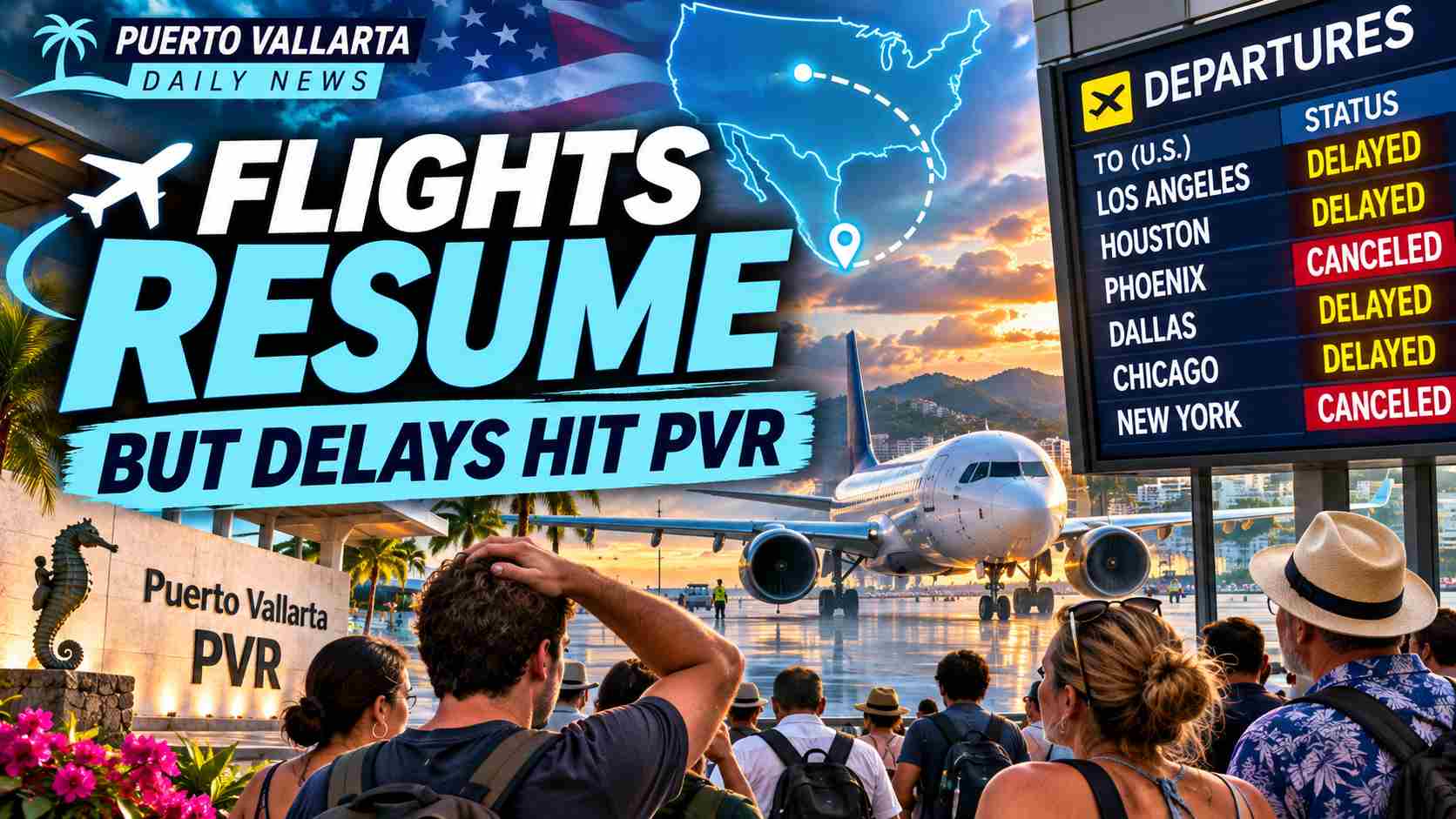
U.S. airspace reopened after Friday’s ground stop, but Puerto Vallarta still has canceled and delayed flights as airlines rebuild schedules.
Puerto Vallarta, Jalisco, November 14, 2026 – U.S. airspace reopened Friday night following a nationwide flight shutdown, but passengers traveling between Puerto Vallarta and the United States continued facing cancellations and delays Saturday as airlines worked to restore their schedules.
The U.S. Department of Transportation confirmed Saturday that American airspace is open and flights have resumed. Federal officials warned, however, that restoring normal operations would take time after Friday’s suspension disrupted thousands of flights across the country.
At Puerto Vallarta’s Gustavo Díaz Ordaz International Airport, the disruption was still visible Saturday afternoon.
A review of Flightradar24’s airport tracking data at approximately 2:45 p.m. local time showed 15 canceled flights and 37 delayed operations among 183 arrivals and departures listed for the day. Those represented roughly 8% and 20% of tracked flights, respectively.
The figures are a snapshot from an independent flight-tracking service, not an official cancellation report from Grupo Aeroportuario del Pacífico (GAP). They include domestic, Canadian and U.S. flights, and not every disruption can be attributed directly to Friday’s FAA shutdown.
Still, several affected U.S. routes were identifiable.
Which Puerto Vallarta flights were still affected Saturday?
The Puerto Vallarta departures board showed two United Airlines flights to Houston’s George Bush Intercontinental Airport canceled Saturday. Those were UA1503 and UA3917.
Alaska Airlines flight AS444 from Puerto Vallarta to Seattle was also listed as canceled.
The airport’s arrivals board showed cancellations affecting flights from several U.S. cities. They included American Airlines flight AA1976 from Chicago, Alaska Airlines flight AS447 from Portland and United Airlines flight UA2257 from Denver.
Delta Air Lines flights DL1865 from Los Angeles and DL1948 from Salt Lake City were also listed as canceled.
Those cancellations did not mean every flight on those routes had stopped operating. Other flights from U.S. destinations, including Denver, Los Angeles and Phoenix, were continuing to arrive in Puerto Vallarta.
Saturday’s disruptions extended beyond U.S. connections. Flight tracking also showed canceled service involving Edmonton, Canada, and Tijuana, Mexico. The available information does not establish whether those cancellations were connected to the FAA incident or resulted from separate airline scheduling decisions.
GAP had not provided a complete, publicly available breakdown of Saturday’s cancellations by U.S. destination in the information reviewed for this update.
GAP confirms flights are returning gradually
Grupo Aeroportuario del Pacífico, which operates Puerto Vallarta International Airport and Guadalajara International Airport, acknowledged the disruption Friday and subsequently announced that flights connecting its airports with the United States would resume gradually.
According to GAP’s update, airlines could continue adjusting departure and arrival schedules even after American authorities lifted their restrictions.
The airport operator urged passengers to confirm flight information directly with their airlines before traveling to the terminal.
That warning remains relevant. An airport reopening and an airline restoring its scheduled flights are two different things.
An aircraft scheduled to leave Puerto Vallarta on Saturday may depend on another aircraft first arriving from the United States. If that incoming flight was canceled or delayed, the next departure can also be affected.
Airlines also need available pilots and flight attendants, who must remain within federal working-hour limits. Flights that were disrupted Friday can therefore affect later schedules even when air traffic control systems are working normally.
Mexico recorded nearly 200 affected flights Friday
The disruption was not limited to travelers already inside the United States.
Mexico’s Agencia Federal de Aviación Civil (AFAC) instructed aircraft at Mexican airports scheduled to fly to the United States to remain on the ground while American authorities addressed the problem.
AFAC reported itinerary changes affecting 193 flights and approximately 18,002 passengers at Mexican airports during Friday’s disruption.
Those figures cover Mexico’s affected airports collectively, not Puerto Vallarta alone.
As VallartaDaily reported Friday, the Federal Aviation Administration ordered a nationwide ground stop after problems with communications systems used by air traffic controllers.
The restrictions prevented aircraft from departing U.S. airports while aviation authorities worked to determine whether air traffic could continue safely.
Flights already in the air were allowed to land.
The nationwide shutdown lasted more than four hours before the FAA began restoring departures Friday evening. By the end of the night, more than 8,000 flight operations had resumed, according to the Department of Transportation.
What caused the FAA shutdown?
Federal officials provided more detail Saturday about the technical failure behind the nationwide interruption.
Transportation Secretary Sean Duffy said the problem appeared during routine maintenance at a remote FAA telecommunications location. A contractor was replacing old copper communications lines with fiber-optic connections as part of an effort to update infrastructure used for decades.
During that work, a router began overwhelming other equipment across the air traffic control network.
Duffy said the malfunction produced more than 1,000 connection attempts every four to five seconds, interfering with communications and disrupting some radar feeds.
The FAA responded by stopping departures while technicians isolated the problem and checked the stability of the system.
Investigators had not determined whether the failure resulted from contractor error or faulty equipment. Duffy said authorities did not believe a cyberattack was responsible.
The incident renewed questions about the condition of the American air traffic control system, which still relies on aging communications infrastructure even as modernization work continues.
FAA Administrator Bryan Bedford said the system was stable Saturday, allowing airlines to focus on recovering their flight schedules.
Will Sunday flights from Puerto Vallarta operate normally?
Federal aviation officials expect most of the disruption to be resolved by the end of Sunday, November 15, but that does not guarantee every Sunday departure from Puerto Vallarta will operate on schedule.
Bedford said Saturday that airlines expected to restore their full schedules by Sunday evening, according to the Associated Press.
That forecast leaves room for additional cancellations and delays Sunday morning and afternoon, particularly for airlines still repositioning aircraft and crews.
No verified airport-wide forecast was available confirming that all Sunday flights between Puerto Vallarta and the United States would operate normally.
For travelers with Sunday departures, the airline’s flight status and rebooking notices remain the most useful sources of information. Checking the status of an incoming aircraft can also help explain why a departure is running late, although the airline must confirm the final schedule.
Passengers whose flights are canceled should also check their rebooking and refund options.
Under U.S. Department of Transportation refund rules, passengers on flights to or from the United States are entitled to a refund when an airline cancels their flight and they choose not to travel or accept the alternative arrangements offered. The rule applies even when the original ticket was nonrefundable.
Significant schedule changes or delays can also qualify for refunds under federal rules. Accepting a replacement flight generally means the passenger is choosing to continue the journey rather than receive a refund.
Travelers can consult the official GAP flight information page for Puerto Vallarta arrivals and departures, although GAP advises passengers to confirm details directly with their airlines.
For Sunday travelers, the central question is no longer whether the United States is allowing flights to operate. It is whether the airline has the aircraft, crew and confirmed schedule needed to operate a particular flight.
As of Saturday afternoon, canceled flights were still appearing on Puerto Vallarta’s boards. The FAA expects the national system to recover by Sunday evening, but passengers booked on earlier flights should verify their individual departures before heading to the airport.