More than 30 palm trees were removed for Puerto Vallarta airport roadwork. Here’s what drivers need to know and what’s still unanswered.
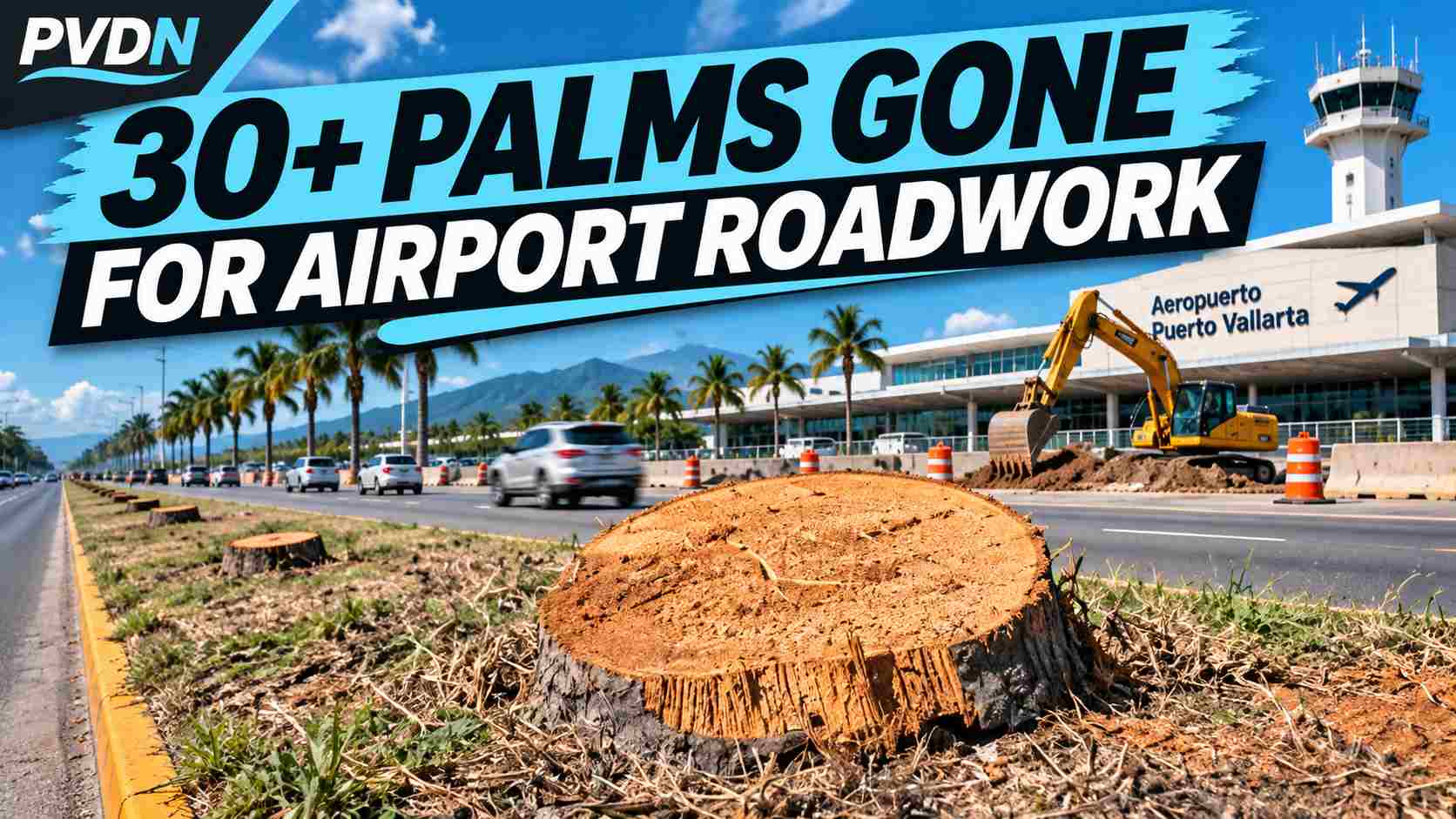
Puerto Vallarta, Jalisco, November 23, 2026 — Puerto Vallarta is getting a new elevated roadway near the airport, and while the project promises to make life easier for drivers, something familiar is disappearing from the landscape. More than 30 palm trees have been cut down along Avenida Francisco Medina Ascencio to make room for construction.
The removal was documented by Quadratín Jalisco in reporting published November 21, describing the loss of palms along both sides of the city’s main avenue.
It’s part of a much larger project to improve traffic around Puerto Vallarta International Airport, the new Terminal 2, and the busy northern entrance to the city.
And here’s the thing. Most anyone who regularly drives between Puerto Vallarta and Bahía de Banderas can appreciate the need for better roads. Traffic in that area can be frustrating, particularly when airport activity and regular commuter traffic collide.
But losing more than 30 palm trees raises a reasonable question. Couldn’t at least some of them have been saved or relocated?
That’s one part of the project that still needs a clearer public explanation.
What’s being built near the airport?
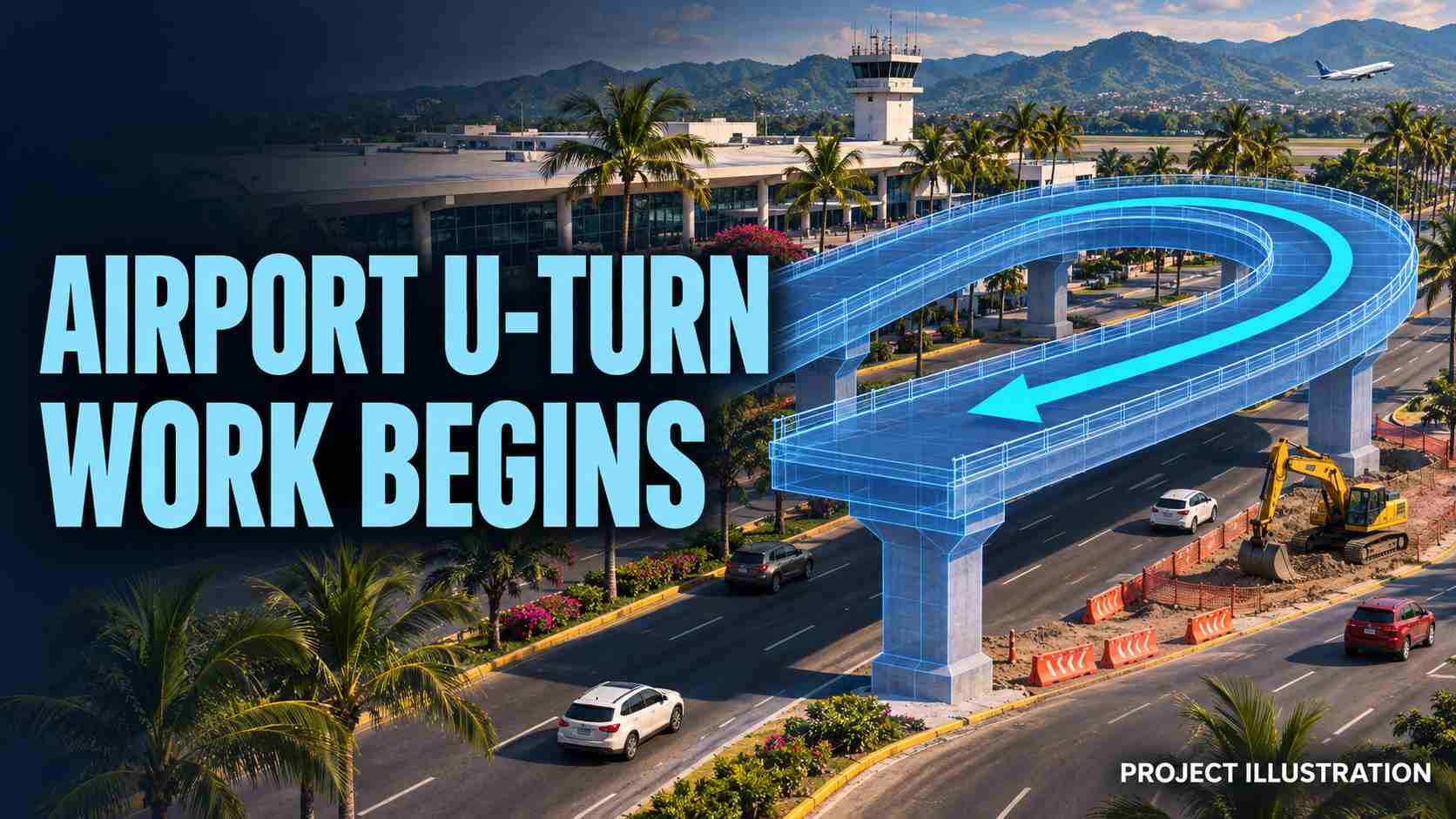
The project is an elevated U-turn, known locally as a retorno elevado, on Avenida Francisco Medina Ascencio near the airport and its new terminal.
Rather than sending vehicles through existing intersections, the new structure is designed to let motorists traveling from Bahía de Banderas make a continuous turn toward Avenida Palma Real and nearby roads.
The idea is to eliminate some of the delays caused by traffic lights and complicated turning movements.
As Vallarta Daily reported when construction began on November 13, the roadwork is part of Jalisco’s broader efforts to improve connections around the airport before expanded terminal operations add more traffic to the area.
The elevated roadway will have a horseshoe-shaped design and form part of the Nodo Las Juntas road system.
Jalisco’s Secretary of Infrastructure and Public Works, David Zamora Bueno, previously confirmed that construction started with 46 reinforced-concrete foundation piles.
According to the state government’s construction announcement, the new connection is intended to improve travel between Puerto Vallarta, Bahía de Banderas, State Highway 544, and roads serving the airport and Central Bus Station.
The state has described the project as an investment in the region’s long-term transportation needs.
And it is a substantial investment.
In an interview reported Monday, Jalisco infrastructure official José María Goya put the projected cost at approximately 200 million pesos and said the elevated return is expected to be completed in May 2027.
The design includes two elevated traffic lanes, with vehicles continuing to travel along Medina Ascencio beneath the structure. Plans also include pedestrian improvements, including a bridge and sidewalk work.
That’s a significant change for one of the city’s busiest transportation corridors.
More than 30 palms have already disappeared
While the roadway is still in its early construction stages, the environmental changes are already visible.
The original report by Javier Frías for Quadratín Jalisco documented the cutting of more than 30 palm trees in the construction area.
The palms had been part of the landscaping along the main avenue, helping give the northern entrance to Puerto Vallarta its familiar tropical appearance.
For a tourism destination, landscaping isn’t simply decoration. It’s part of the city’s identity.
And for residents who have watched Puerto Vallarta grow, the disappearance of mature trees is becoming a familiar part of discussions about new roads, commercial development, and public infrastructure.
The question isn’t necessarily whether Puerto Vallarta should build better roads. The question is how the city balances that growth with the environment that makes it attractive in the first place.
There is also an important distinction between removing trees and relocating them.
A tree that is carefully transplanted and survives somewhere else is a different outcome from one that is cut down and permanently lost.
So far, the publicly available reporting has not established a complete inventory of the removed palms, whether any were successfully relocated, or what replacement planting may be planned.
That doesn’t mean there is no environmental plan. It means the details have not been established in the reporting available for this story.
Were the palm trees approved for removal?
This is where the paperwork becomes important.
Puerto Vallarta has environmental regulations governing the removal, pruning, and transplantation of trees.
The municipality’s published Ecology Regulation includes provisions requiring express written authorization for tree removal.
Because this particular project involves the Jalisco state government and a major road corridor near the airport, determining the applicable jurisdiction and which agency authorized the work is essential.
That leaves several practical questions.
How many palms were included in the project’s original environmental assessment? Were alternatives to cutting considered? Which authority authorized their removal? And is there a plan to replace the trees elsewhere?
Those answers matter because the work is being carried out as a public infrastructure project.
The Jalisco infrastructure department’s published contracting records identify the roadway construction, foundation work, and related improvements. They provide a starting point for examining how the project was planned and awarded.
But construction documents alone don’t answer every environmental question.
There is no verified basis in the information reviewed to conclude that the removal was illegal, and no such finding has been established.
The unanswered issue is whether the complete authorization and mitigation details will be made available so residents can understand what happened to the trees.
This isn’t the first time road construction has cost Vallarta trees
The airport roadway is not the first major infrastructure project to affect vegetation around Puerto Vallarta’s northern entrance.
During work on the final stretch of the Guadalajara–Puerto Vallarta highway connection, 257 trees were expected to be affected by construction near Las Juntas.
At the time, authorities said at least 83 trees would be transplanted to Avenida Las Palmas.
That was a separate project, with its own construction plans and environmental questions.
Still, it illustrates how the northern entrance to Puerto Vallarta has been changing as the city invests in highways, bridges, and airport connections.
The improvements may ultimately reduce traffic and make travel easier. But each project also changes the physical landscape.
And once a mature tree is gone, planting a small replacement doesn’t immediately restore what was lost.
Drivers should expect more traffic disruptions
While the tree removal raises environmental questions, motorists have a more immediate concern: getting through the construction zone.
The work is taking place along Francisco Medina Ascencio near the airport, in the corridor serving Villa Las Flores, Las Juntas, and surrounding neighborhoods.
According to local reporting on the traffic restrictions, construction has already reduced road capacity in the direction toward Bahía de Banderas.
Drivers have reported congestion and concerns about insufficient advance warning before lane reductions.
The state government has said it does not anticipate completely closing the avenue during the initial construction phase.
Instead, traffic will continue through reduced lanes while workers build the foundations and other components of the elevated roadway.
However, that does not mean every trip will move smoothly.
Anyone traveling to the airport, heading to Nayarit, or commuting along the northern end of Medina Ascencio should allow extra time, particularly during busy periods.
The construction schedule and traffic arrangements may change as the project advances.
For airport passengers, it’s especially worth checking current road conditions before leaving home rather than assuming the drive will take its usual amount of time.
A better road comes with a trade-off
Puerto Vallarta has needed transportation improvements for years.
The airport continues expanding, development is spreading across the bay, and the daily movement of people between Jalisco and Nayarit has made the northern entrance increasingly important.
A properly designed elevated return could make a real difference once completed.
But the loss of more than 30 palm trees brings another side of that progress into focus.
Puerto Vallarta is known for its beaches, mountains, greenery, and tropical streets. Those things are part of what people come here to enjoy, and what residents value about living here.
As new infrastructure takes shape, protecting those qualities deserves as much attention as finishing the concrete and asphalt.
The next meaningful development in this story won’t simply be another construction milestone.
It will be learning exactly how the removal of the palms was authorized, what happened to the trees, and whether Jalisco and Puerto Vallarta have a plan to restore the greenery lost along the airport corridor.
The elevated road is expected to be finished in May 2027. Whether the surrounding landscape receives the same attention remains an open question.