Puerto Vallarta’s mayor missed a council meeting deadline as questions grow over city finances, garbage service and delayed pay.
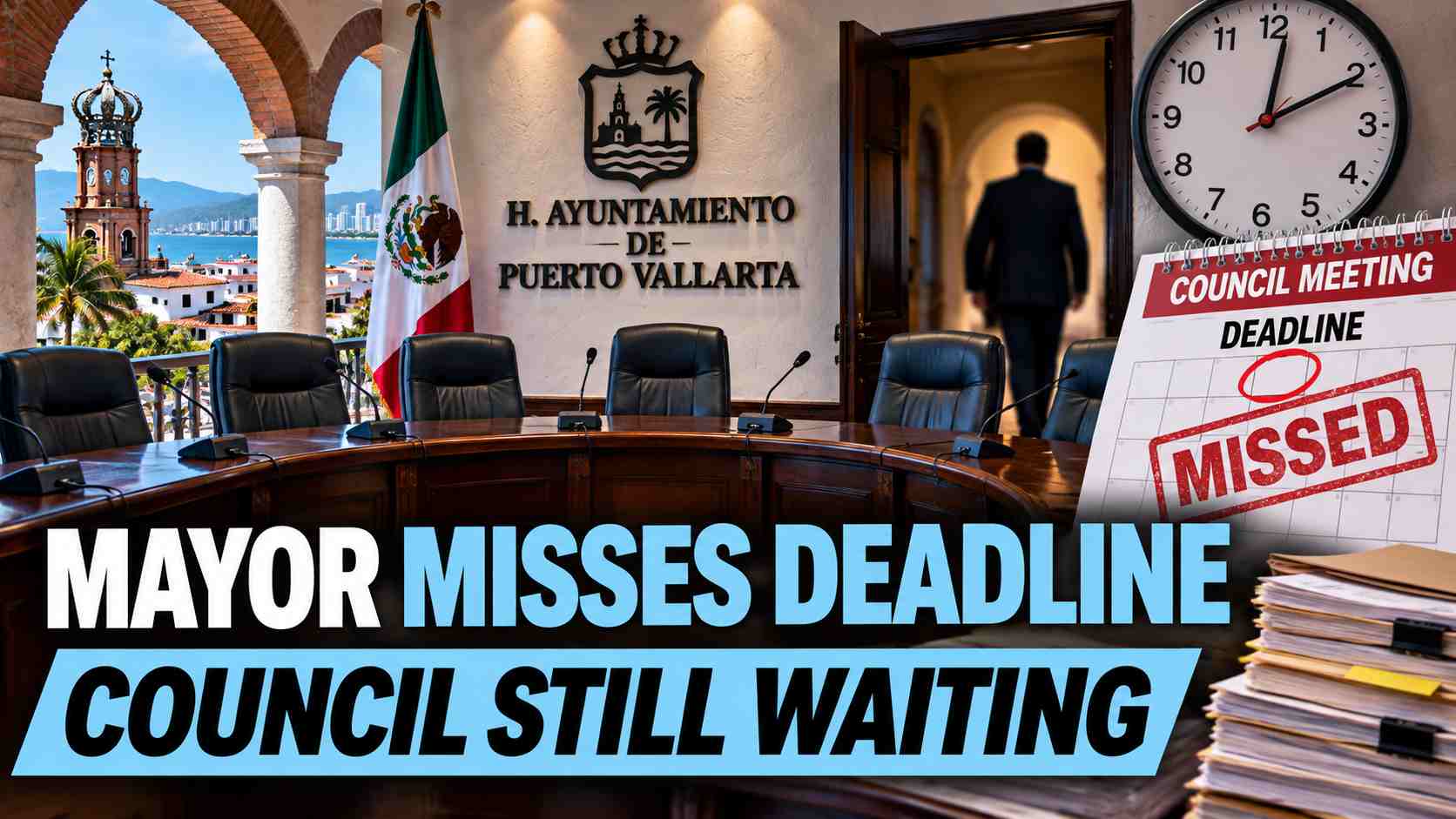
Puerto Vallarta, Jalisco, November 23, 2026 — Puerto Vallarta’s mayor was given 24 hours to call a City Council meeting. That deadline came and went over the weekend, and by Monday morning, council members were still waiting.
Mayor Luis Ernesto Munguía González has not publicly issued the requested meeting notice, according to new reporting published Monday by NNC.
It’s the latest development in a political standoff that has left Puerto Vallarta’s City Council without an ordinary meeting for more than two months, even as the municipality struggles with garbage collection, delayed employee payments, and growing questions about its finances.
And if this sounds familiar, it should.
On Saturday, Vallarta Daily reported that the mayor had been given 24 hours to call a meeting. That deadline was set by eight municipal officials who say the city has too many unresolved problems to continue waiting.
Now the deadline has passed, and the questions haven’t gone away.
The 24-hour deadline expired Saturday afternoon
The latest confrontation began Friday, November 20, when Puerto Vallarta’s municipal síndico, José Francisco Sánchez Peña, and seven council members delivered a formal written demand to the mayor’s office.
The document was received by the municipal Secretary General at 3:50 p.m.
The officials gave Munguía 24 hours to issue a formal notice calling an ordinary City Council meeting. That put their deadline at approximately 3:50 p.m. Saturday.
Saturday passed. So did Sunday.
By Monday morning, the mayor had not responded to the group’s demand.
This was not the first request.
The same group had delivered an earlier demand on November 13, asking for a meeting within two business days. That request also went unanswered within the period specified by the councilors.
At this point, the dispute is about more than scheduling a meeting.
The council members want answers about how Puerto Vallarta is spending money, whether the city can meet its financial obligations, and what is being done to address deteriorating municipal services.
Those questions are becoming harder to ignore as the year draws to a close.
The mayor said a meeting was coming
To be fair, Munguía hasn’t said the council will never meet.
During a November 18 interview, the mayor said he expected the council to meet on Monday, Tuesday, or Wednesday of this week.
That would put the expected meeting sometime between November 23 and 25.
The mayor also tried to downplay the political tensions, describing the councilors as friends and emphasizing the importance of working together.
But the group asking for a meeting clearly wasn’t satisfied with that timetable.
Two days later, they delivered their second written demand, this time with a 24-hour deadline for issuing the official notice.
There’s an important distinction here.
The councilors weren’t demanding that the entire meeting take place within 24 hours. They wanted the mayor to formally call one.
That matters because an official council meeting requires advance notice, an agenda, and the opportunity for members to review the business they will be asked to consider.
A verbal promise that a meeting will happen sometime during the week isn’t the same thing as a formal summons.
And as of Monday morning, the promised meeting had not been publicly confirmed.
City Council meetings aren’t optional
Here’s something that gets lost in the political back-and-forth.
Under Article 31 of Jalisco’s municipal government law, municipal councils are required to meet at least once every month.
Puerto Vallarta’s own municipal government regulations reinforce that requirement. Article 41 also requires councilors to receive the agenda and supporting documents at least 48 hours before an ordinary meeting.
These rules exist for a reason.
City councils are responsible for reviewing and approving decisions that affect public spending, municipal policies, agreements, and other important government business.
The mayor runs the administration, but the full council has responsibilities that cannot simply be replaced by decisions made in the mayor’s office.
There’s also a difference between the legal requirement to hold monthly meetings and the 24-hour deadline issued by the councilors.
Missing the councilors’ deadline does not automatically establish a separate legal violation. Any formal legal finding would require examining the applicable provisions and the municipality’s official meeting records.
The longer-running absence of ordinary meetings raises a different and potentially more serious question about compliance with the monthly requirement.
The city’s public transparency records list an ordinary session on September 10 and a ceremonial session on September 15. Some local reports have instead identified September 13 as the last ordinary meeting, a discrepancy municipal officials should clarify.
What is not in dispute among the councilors making the complaint is that October passed without the ordinary meeting they say the city was required to hold.
And now November is approaching its final week.
Meanwhile, Puerto Vallarta has some expensive problems
The timing of this political fight couldn’t be much worse.
Puerto Vallarta is heading into the final weeks of 2026 with questions about whether it has enough money to cover all its obligations.
Earlier this month, Vallarta Daily reported that some municipal employees were experiencing another delay in receiving their wages.
The mayor has also discussed seeking an advance of approximately 100 million pesos from the state government against future municipal revenue to help meet year-end obligations.
That proposal requires further consideration and authorization. A request for money is not the same as the funds being approved or received.
And this is exactly the kind of financial decision that makes a functioning City Council important.
The councillors demanding a meeting say they want a clearer accounting of the municipality’s finances, including its current debt, outstanding obligations, and ability to meet payroll.
They have also raised concerns about public works, street repairs, and garbage collection.
Those aren’t abstract political issues.
For someone waiting for an overdue paycheck, a city employee worried about a year-end bonus, or a family living on a street where garbage hasn’t been collected, the consequences are pretty straightforward.
City Hall’s problems don’t disappear because its elected officials aren’t sitting around the same table.
The garbage crisis is part of the bigger picture
Puerto Vallarta’s garbage collection problems have become one of the most visible signs of pressure on municipal services.
Residents in different neighborhoods have reported missed collections and accumulating trash, while the municipal government has struggled with equipment availability, fuel, and staffing concerns.
The city has also experienced changes in the leadership of its public services department.
Meanwhile, Vallarta Daily reported that municipal police officers had raised concerns about fuel restrictions that they say are affecting patrol operations.
Those allegations still require a full accounting from the municipal government, but they add to the questions about how limited resources are being managed.
It’s also important to understand that the absence of a council meeting doesn’t mean every municipal department stops operating.
Garbage trucks can still collect trash. Police officers can still respond to calls. Public works crews can continue their assignments.
But decisions that require formal council authorization can be delayed, and elected representatives lose an important public forum for questioning the administration and reviewing financial information.
That is why the current disagreement matters beyond the politicians involved.
Former allies are now demanding answers
The council dispute didn’t begin with the November 20 letter.
Earlier this month, four council members and the municipal síndico broke away from the mayor’s Green Party bloc, creating an independent faction inside City Hall.
Three councillors from Movimiento Ciudadano subsequently joined them in demanding a meeting.
Together, the eight officials represent a significant bloc within the municipal government.
Their disagreement with Munguía has turned what might otherwise have been routine questions about municipal spending into a broader political confrontation.
And it creates an uncomfortable situation for the mayor.
The people demanding answers aren’t simply political opponents criticizing him from outside City Hall. Several were recently part of his own governing alliance.
That makes their requests harder to dismiss as ordinary partisan disagreement.
Still, the council members also have a responsibility to explain what they intend to accomplish once a meeting takes place.
Getting everyone into the council chamber would be a start. It wouldn’t automatically solve the financial and service problems waiting on the agenda.
So what happens now?
There are two things to watch as the week continues.
The first is whether Munguía follows through on his earlier statement that the City Council would meet between Monday and Wednesday.
The second is what happens when councillors finally have an opportunity to publicly review the municipality’s finances.
The mayor has not publicly provided a detailed response to the expired 24-hour deadline in the Monday morning reporting reviewed for this story.
An official meeting notice, the proposed agenda, and confirmation of its distribution to council members would establish whether the process is moving forward.
Residents should also be able to see what financial information is presented, what decisions are proposed, and how their elected representatives vote.
After all, a council meeting isn’t supposed to be a favor that the mayor grants to other elected officials.
It’s part of running a municipal government.
And right now, Puerto Vallarta has enough problems that need attention without adding an indefinitely postponed meeting to the list.
For a city dealing with delayed paychecks, unreliable garbage collection, and unanswered financial questions, the next council meeting needs to accomplish more than getting everyone into the same room.
It needs to produce some answers.