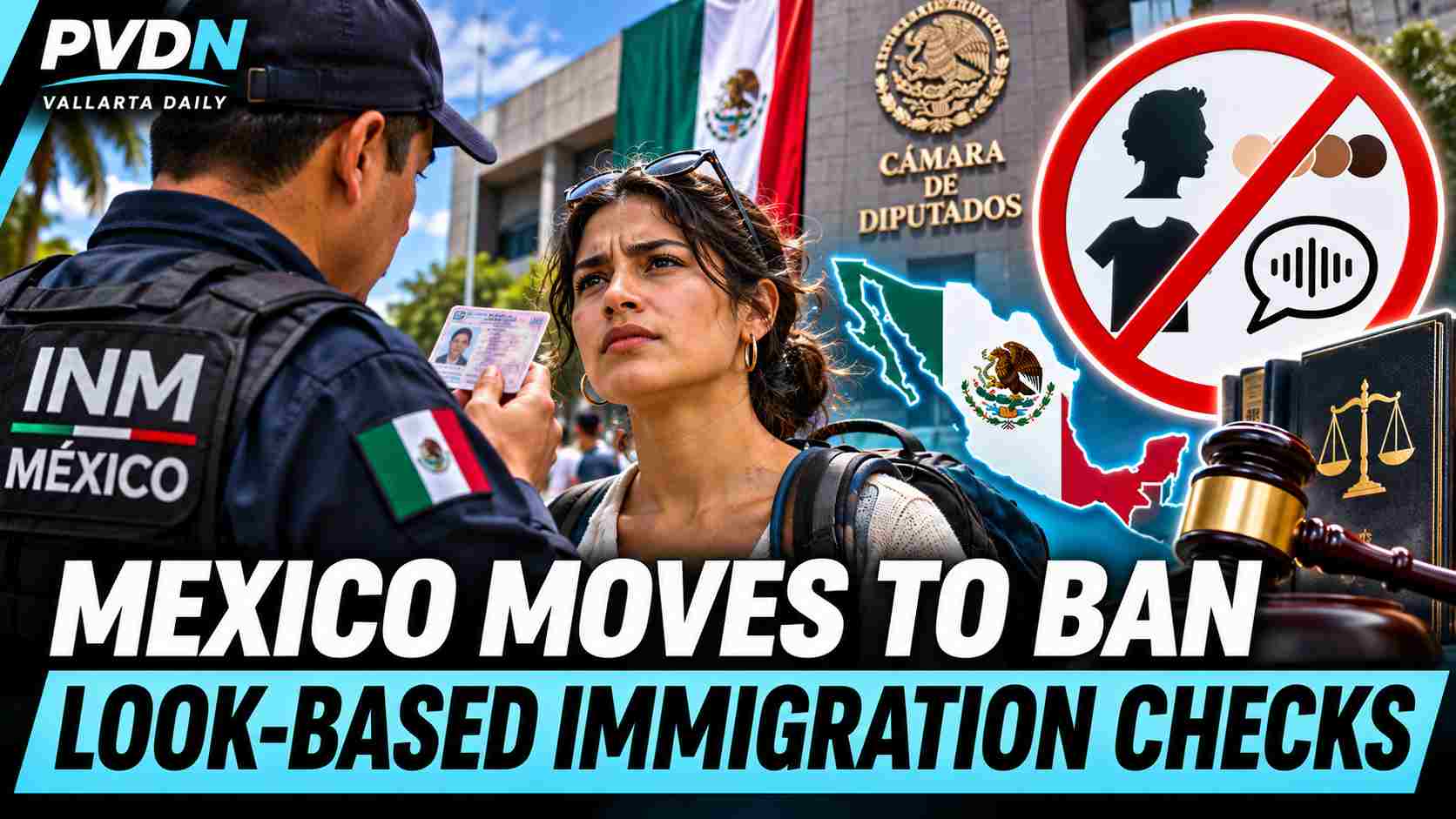
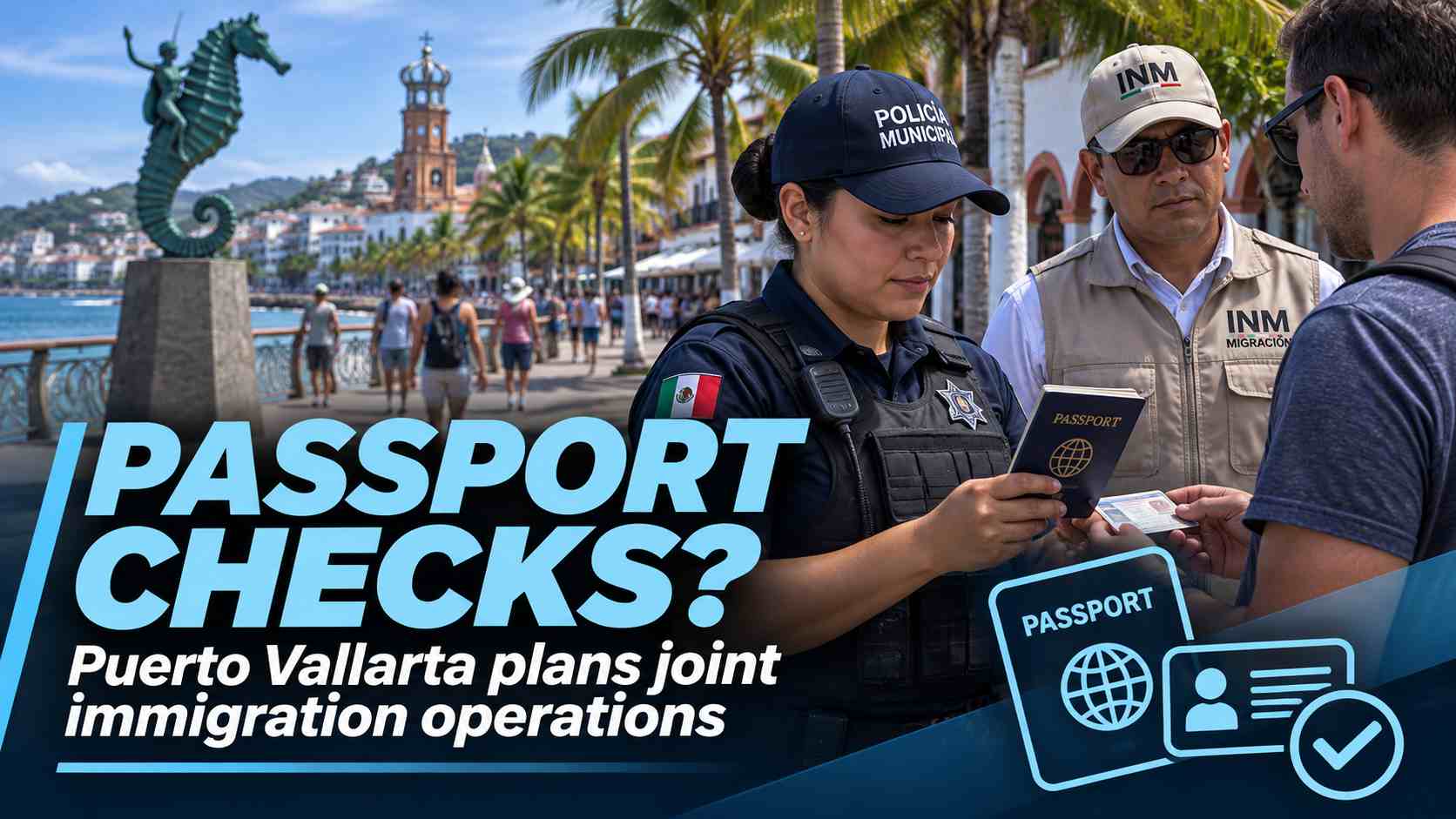
Puerto Vallarta police and immigration officials plan joint document checks. Here’s what foreign residents and tourists need to know about their rights.
Puerto Vallarta, Jalisco, November 28, 2026 – Foreign residents and tourists in Puerto Vallarta may soon encounter federal immigration officials working alongside municipal police in some of the city’s busiest public areas.
Puerto Vallarta’s Municipal Police Department and Mexico’s National Immigration Institute (INM) have agreed to conduct joint security operations that will include checking identification documents and passports belonging to both Mexican and foreign nationals.
The agreement was announced Friday following a meeting between regional immigration officials and Puerto Vallarta’s police chief, José Omar Quintero Becerra.
The operations are intended to strengthen crime prevention, detect possible cases of human trafficking and protect children who may be traveling under suspicious or vulnerable circumstances.
However, the announcement has left several important questions unanswered, particularly for the thousands of foreign residents and tourists who spend time in Puerto Vallarta.
Where will immigration officials conduct document checks?
The municipal government has described the locations as strategic points with high concentrations of people but has not identified specific areas where the operations will take place.
Authorities have also not announced a starting date or indicated how frequently the operations will be conducted.
There is currently no confirmation that immigration officials will establish checkpoints along the Malecón, in the Romantic Zone, outside shopping centers or in other popular tourist areas.
There is also no indication that authorities intend to target specific nationalities or neighborhoods with large foreign populations.
For now, what has been announced is an agreement between municipal and federal authorities, not the beginning of widespread immigration checks throughout Puerto Vallarta.
Protecting children and preventing human trafficking
An important part of the initiative involves Puerto Vallarta’s specialized police unit responsible for locating missing persons.
Officers will participate in the operations to identify children traveling alone, in vulnerable circumstances or without documentation establishing their relationship to an accompanying adult or permission to travel.
The initiative comes shortly after Vallarta Daily reported on new requirements for tourism businesses serving adults traveling with children, part of Mexico’s broader efforts to prevent the exploitation and trafficking of minors.
Grandparents traveling with grandchildren, divorced parents vacationing with their children and adults accompanying minors who are not their own may want to pay particular attention to their travel documentation.
Keeping copies of birth certificates, parental authorization letters and relevant custody documents accessible could help explain those relationships if questions arise.
That does not mean Puerto Vallarta has introduced a new requirement for families to carry birth certificates every time they leave their homes or hotels. No such requirement was announced.
Can Puerto Vallarta police ask for your immigration documents?
This is where the distinction between municipal police officers and federal immigration agents becomes important.
Under Article 96 of Mexico’s Immigration Law, other government authorities may assist the National Immigration Institute when requested. However, that cooperation does not give municipal police the authority to independently conduct immigration enforcement, verification or inspection procedures.
Municipal police retain their ordinary law enforcement responsibilities, but the authority to conduct immigration procedures belongs to federal immigration officials.
The arrangement announced Friday specifically states that INM personnel will conduct the passport and identification checks.
In other words, the agreement does not suddenly turn every Puerto Vallarta police officer into an immigration agent.
Nor does it give authorities unlimited discretion to stop people simply because they look or sound foreign.
Mexico’s Supreme Court has already addressed random immigration checks
There is another important legal consideration that was not addressed in the municipality’s announcement.
In May 2022, Mexico’s Supreme Court ruled against broadly applied immigration inspections within the country’s interior, finding that the procedures established under Articles 97 and 98 of the Immigration Law violated constitutional protections concerning freedom of movement, equality and nondiscrimination.
The case involved Mexican citizens from an Indigenous community who were detained after immigration officials questioned their nationality.
The court subsequently established binding judicial precedent on the constitutionality of such inspections in September 2023.
That does not eliminate the federal government’s legitimate authority to verify the immigration status of foreign nationals through lawful procedures.
It does, however, raise questions about how Puerto Vallarta’s proposed operations will be conducted, how individuals will be selected for document checks and what safeguards will be in place to prevent arbitrary stops.
The municipality says the operations will respect human rights and applicable law. The practical details of how that commitment will be implemented have not yet been made public.
What documents should foreign residents carry?
If you are a temporary or permanent resident of Mexico, your residency card is the document that establishes your immigration status.
The U.S. Embassy’s guidance on immigration enforcement in Mexico recommends that American citizens residing in the country carry their original Mexican residency cards at all times.
That is sensible advice for foreign residents of other nationalities as well.
A foreign driver’s license, a Mexican bank card or even a photograph of your passport does not necessarily establish that you have legal residency in Mexico.
Foreign residents should also check that their temporary residency cards have not expired and keep secure copies of their immigration documents and passports in case the originals are lost or stolen.
Permanent residents should not confuse their residency card with proof of Mexican citizenship. They remain foreign nationals unless they have separately obtained Mexican nationality.
What about tourists and snowbirds?
For visitors who spend several weeks or months in Puerto Vallarta without obtaining Mexican residency, the documentation is slightly different.
Tourists should have their valid passports and evidence of their authorized stay in Mexico.
The U.S. Embassy’s guidance for visitors recommends carrying original passports rather than relying on photocopies.
The Canadian government’s travel advisory for Mexico also advises travelers to keep their immigration permits accessible as evidence of their legal status.
Many international visitors arriving at Puerto Vallarta’s airport no longer receive the traditional paper immigration form known as the FMM. Instead, their arrival is registered electronically.
Visitors can obtain their digital immigration document, known as the FMMd, through the National Immigration Institute’s online services portal.
It is worth downloading the document while your authorized stay remains valid and saving a copy that can be accessed without an internet connection.
And remember, Mexico does not automatically grant every tourist 180 days in the country. The authorized period is determined by immigration officials when you enter.
Anyone spending the entire winter in Puerto Vallarta should check their actual authorized departure date rather than assume they have six months.
What should you do if an immigration official approaches you?
An encounter with immigration officials does not necessarily mean you have done anything wrong.
If approached during an operation, remain calm and ask which agency the officers represent and why your documents are being requested.
A few practical precautions are worth remembering:
- Ask officials to identify themselves and explain the purpose of the inspection.
- Cooperate with lawful requests from authorized immigration personnel.
- Do not offer money to resolve an apparent documentation problem.
- If you do not understand Spanish, request language assistance.
- If you are detained, request legal assistance and ask to contact your country’s consular representatives.
Article 17 of the Immigration Law also places restrictions on the retention of immigration documents when authorities suspect they are fraudulent.
Presenting your residency card for inspection is not the same as permanently surrendering it to an officer.
If you believe your documents have been improperly retained or your rights violated, seek legal or consular assistance.
Is Puerto Vallarta becoming more restrictive toward foreigners?
Nothing in Friday’s announcement establishes that Puerto Vallarta is introducing new immigration requirements or changing the conditions under which foreigners can live in or visit the city.
The municipality does not have the authority to independently change Mexico’s residency requirements, tourist entry conditions or authorized periods of stay.
What is changing is the level of cooperation between local police and federal immigration authorities.
For foreign residents who have valid residency documents and tourists who are within their authorized period of stay, there is no reason to assume the announcement changes their legal status or their ability to enjoy Puerto Vallarta.
Still, authorities owe the public a more detailed explanation of how these operations will work.
People should know who is authorized to request their documents, under what circumstances those requests can be made and what protections exist against arbitrary or discriminatory treatment.
Preventing human trafficking and protecting vulnerable children are worthwhile objectives. Ensuring that those efforts respect the rights of everyone living in and visiting Puerto Vallarta is equally important.