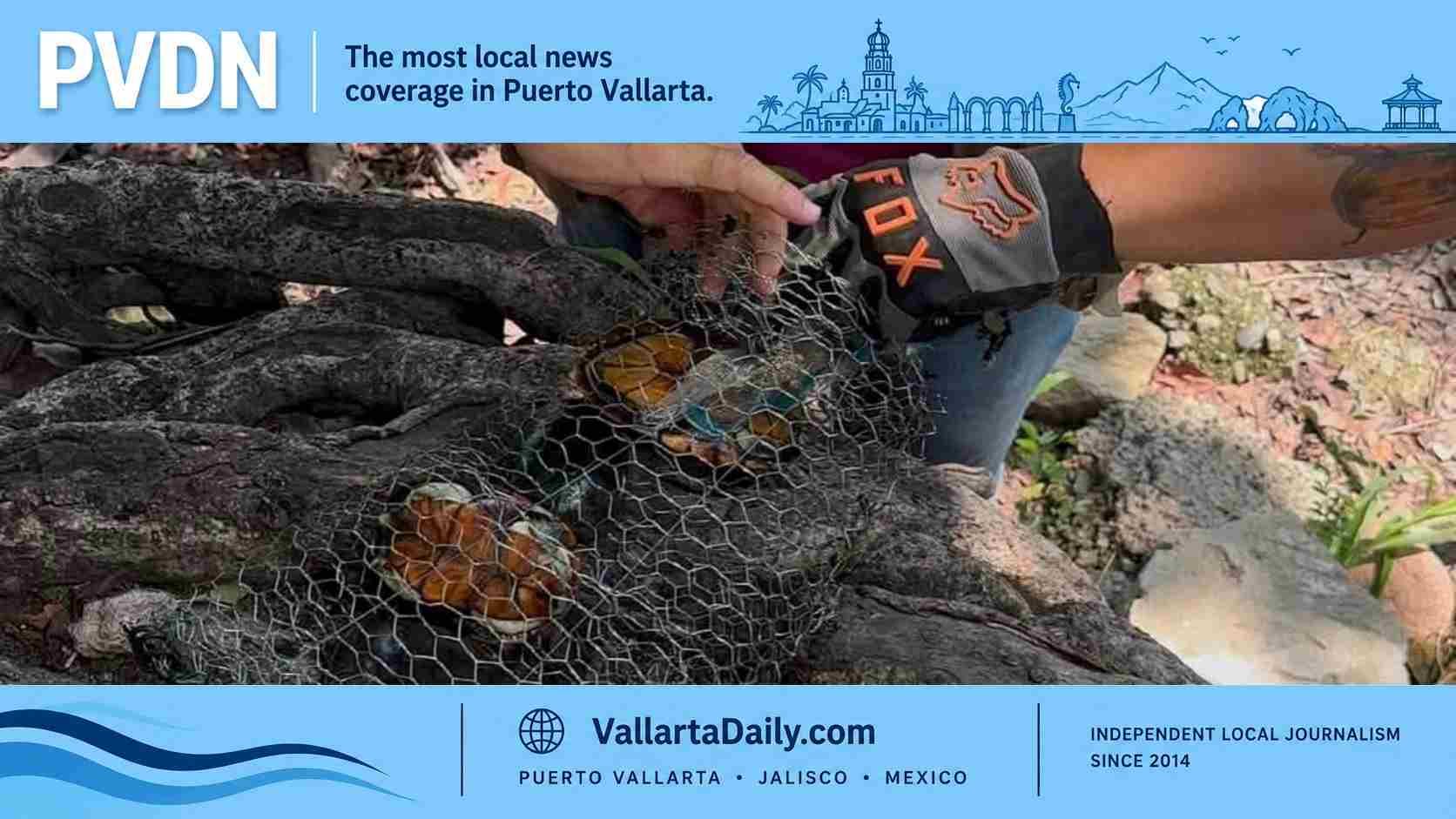
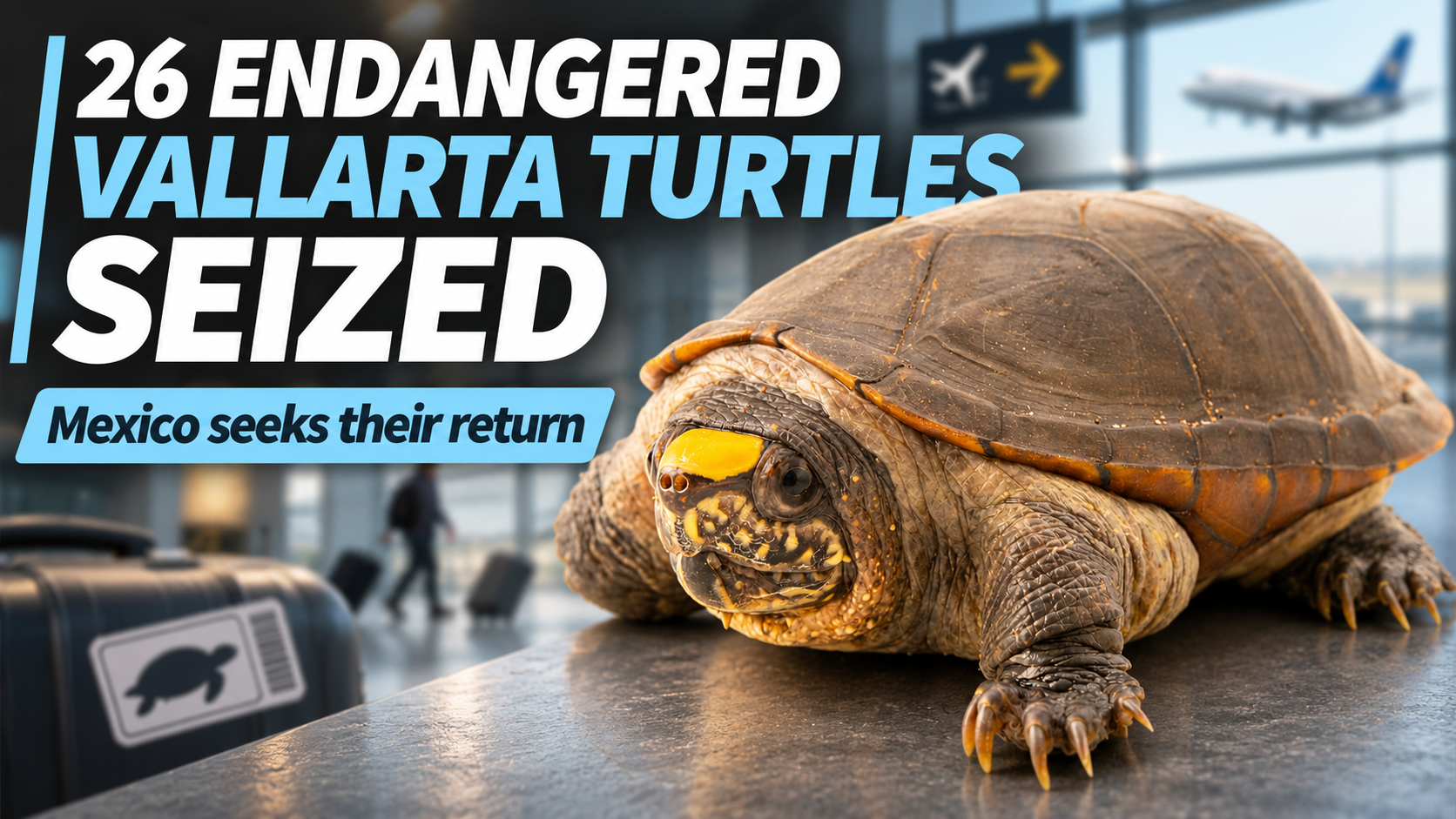
Mexico is working to recover 26 critically endangered Vallarta mud turtles seized at Amsterdam’s airport during a suspected wildlife trafficking case.
Puerto Vallarta, Jalisco, November 29, 2026 – Mexican environmental authorities are working to bring home 26 critically endangered Vallarta mud turtles seized at Amsterdam’s Schiphol Airport, in a case that highlights the growing international demand for one of Puerto Vallarta’s most vulnerable native species.
The turtles were discovered on November 21 in the luggage of a passenger traveling from Mexico to Hong Kong through the Netherlands.
According to the Dutch Food and Consumer Product Safety Authority (NVWA), all 26 turtles survived the journey despite being wrapped in adhesive tape that prevented them from moving.
The passenger was arrested and remains under investigation by Dutch authorities. The animals have been transferred to a specialized wildlife care facility.
Mexico’s Federal Attorney’s Office for Environmental Protection, known as Profepa, is now collaborating with Dutch authorities to support the criminal investigation and arrange the return of the turtles to Mexico.
No date for their return has been announced.
Nearly 10 percent of a wild population
Twenty-six turtles might not sound like a particularly large wildlife seizure until you understand just how few of these animals are believed to remain.
Dutch authorities estimate that approximately 300 Vallarta mud turtles survive in the wild. If all 26 recovered animals were taken directly from their natural habitat, their removal could represent nearly 10 percent of the estimated remaining wild population.
Investigators have not yet confirmed where the individual turtles originated.
Known in Mexico as the casquito de Vallarta, the species carries the scientific name Kinosternon vogti and was formally described by scientists in 2018.
Unlike the sea turtles that regularly attract attention along Puerto Vallarta’s beaches, these are tiny freshwater turtles found exclusively in the Bahía de Banderas region of Jalisco and Nayarit.
Adults generally measure less than 10 centimeters in shell length, making them among the smallest turtles in the world.
The IUCN Tortoise and Freshwater Turtle Specialist Group classifies the species as critically endangered. It also receives the highest level of international trade protection under the Convention on International Trade in Endangered Species, commonly known as CITES.
Wildlife trafficking is becoming a familiar problem
The Netherlands seizure is not an isolated incident.
Earlier this month, Mexican authorities recovered five Vallarta mud turtles during a separate wildlife trafficking operation in Chihuahua. The animals were among 70 turtles of various species discovered during inspections of shipments being transported without documentation establishing their legal origin.
In October, Profepa announced criminal proceedings against three people following their arrest in Puerto Vallarta for the alleged illegal possession of a female Vallarta mud turtle capable of reproducing.
Vallarta Daily has also previously reported on illegal turtle traps discovered during federal enforcement operations.
The incidents illustrate the pressure that illegal wildlife collecting is placing on a species that was already struggling to survive.
The other threat is closer to home
While international wildlife trafficking makes headlines, another threat to the turtle’s survival is unfolding much closer to home.
Puerto Vallarta’s urban expansion has placed increasing pressure on the freshwater wetlands and seasonal ponds that these animals depend on.
Researchers from several institutions, including Mexico’s National Autonomous University, have identified urbanization and illegal wildlife trafficking as leading threats to the species.
In May, Vallarta Daily reported that Profepa closed work sites to protect the Vallarta mud turtle following the discovery of activities threatening its habitat.
For a species found naturally nowhere else on Earth, losing habitat in Puerto Vallarta and Bahía de Banderas means losing part of its entire world.
Conservation efforts have included captive breeding programs, environmental inspections and work by local researchers. However, protecting the remaining natural habitat remains essential to the species’ long-term survival.
Bringing the turtles home
For now, the good news is that all 26 turtles are alive and receiving care.
Profepa is preparing technical assessments requested by Dutch authorities that could help establish evidence in the criminal investigation and facilitate the animals’ eventual return.
Their repatriation would be an important conservation achievement, although returning them to Mexico would not automatically mean releasing them into the wild.
The larger challenge remains preventing more turtles from being taken in the first place and ensuring that there is still a suitable natural habitat waiting for them in the region they call home.