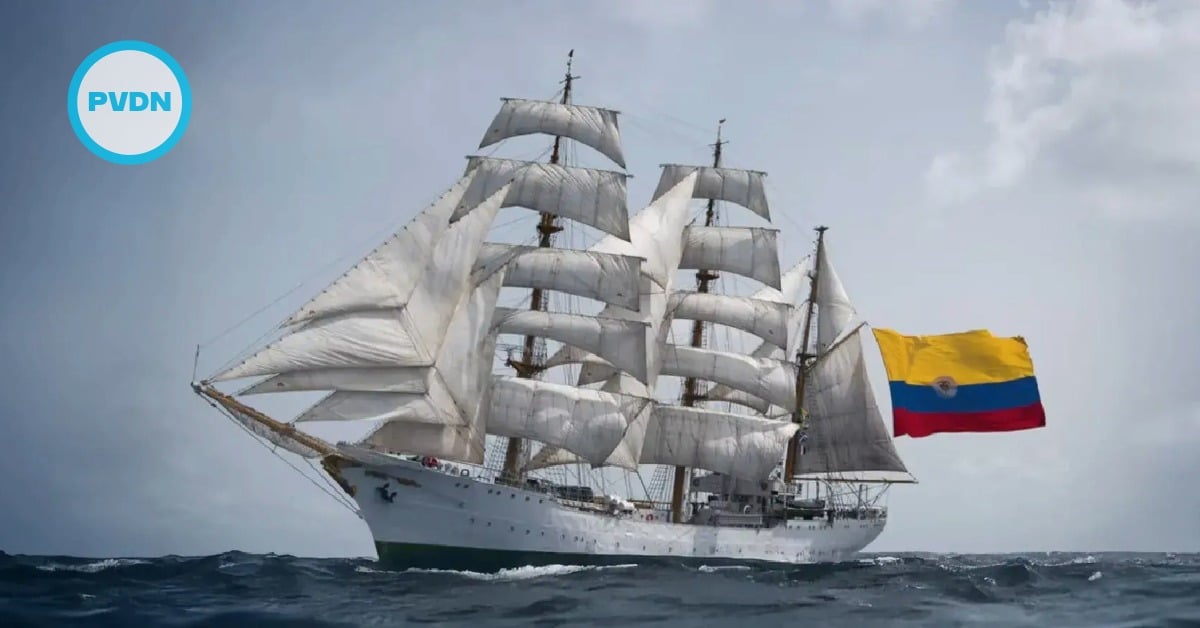
ARC Gloria’s arrival in Puerto Vallarta marks the ship’s first visit, with an anchoring offshore and tours that share Colombia’s flagship training vessel.
On a warm November morning over Banderas Bay, the Colombian Navy’s training ship ARC Gloria closed in on her anchoring point off Puerto Vallarta. For the crew, the historic first call to the city was less about ceremony and more about doing a familiar job exactly right. The focus was the bow, where the foremast division had already taken their stations before the ship crossed the line marked on their charts.
From that spot, Lieutenant Commander Nelson Rangel, who leads the foremast division, oversaw a tight team of sailors gathered around the ship’s anchoring gear. Each person had a specific role. One group stood by the windlass, ready to control the heavy machinery that hauls and releases the chain. Another handled the brake, which can stop the massive links from running too fast toward the water. A third team waited with a sledgehammer to free the chain at the right moment so the anchor could finally drop.
Before any of that metal moved, the morning began with a safety briefing that brought everyone on the bow together. The commander’s instructions were reviewed point by point. Each person’s position was confirmed, along with the basics that still matter at sea: boots laced, life jackets on, helmets secured, and clear lines of sight. The routine is simple but strict. No one starts the maneuver until every piece of equipment and every sailor is checked off.
Anchoring, Rangel likes to explain, can sound more complicated than it really is. In practice, it comes down to letting the anchor fall until it touches the seabed and its flukes bite into the bottom. The weight of the chain and the shape of the anchor keep the ship from drifting, turning a moving hull into a fixed point on the water. On this day, that point was just off the coast of Puerto Vallarta, where the vessel settled with the Colombian flag stretched out in the morning breeze.
For the cadets on board, many of whom are still months away from their first assignments in the fleet, an evolution like this is part classroom, part exam. ARC Gloria typically sails with around 150 people between permanent crew and trainees, and rotations through the bow station are one of the ways young officers and sailors learn to combine classroom theory with real movement, noise, and pressure at sea. A clean anchoring means not only that the ship is secure, but that the next generation has carried out a core task without incident.
ARC Gloria Puerto Vallarta on public view
With the anchor holding firm and the engines at rest, the visit to Puerto Vallarta officially began. The stop, scheduled from November 21 to 24, 2025, is the first time Colombia’s sailing ambassador has appeared in this Pacific port, an event that will be recorded in the ship’s logbook as a new line in a long list of harbors. Alongside the operational details, the entry marks a symbolic bridge between two coastal cities that share the same ocean but usually see each other only on shipping maps.
During the stay, the Colombian Navy announced visiting hours for the public, opening the gangway from mid-morning to the early evening on most days, with a shorter window on the day of departure. Those visits turn the steel-hulled barque into a temporary museum and classroom. Local residents and visitors are able to step onto the wooden decks, look up at the web of rigging and spars, and see first-hand the space where cadets sleep, study, and prepare for watches. For many guests, it is a rare chance to stand on a working tall ship rather than simply watching it from the shoreline.
ARC Gloria herself carries more than five decades of history into each port. Built in Spain in the late 1960s, the three-masted barque serves as both training ship and official flagship of the Colombian Navy, a dual role that has taken her to dozens of countries since she was commissioned. She is one of a small family of Latin American sail training ships designed on a similar plan, alongside Mexico’s Cuauhtémoc, Venezuela’s Simón Bolívar, and Ecuador’s Guayas, all of them combining traditional sail handling with modern navigation equipment on board.
The 2025 Cadet Cruise began in Cartagena in early September and has traced a long Pacific route. After crossing the ocean, ARC Gloria’s first Mexican stop was Acapulco, where she opened for guided visits before continuing north along the coast. From there, the itinerary has included ports in the United States and Canada, including San Diego, San Francisco, and Vancouver, with the ship offering public tours and cultural activities at each stop. Puerto Vallarta, now added to that map for the first time, joins a select list of cities that have hosted the vessel during this year’s voyage.
This year’s cruise also unfolds against a backdrop of renewed attention on the safety of sail training ships worldwide. In May, Mexico’s own sail training vessel Cuauhtémoc was involved in a fatal collision with the Brooklyn Bridge in New York while departing the city, an accident that left two crew members dead and others injured and led to a detailed review of procedures and port conditions. For crews aboard tall ships, incidents like that are a stark reminder of how quickly routine maneuvers can turn dangerous if anything goes wrong.
Seen from that angle, the careful rhythm of checks, briefings, and clearly assigned roles on ARC Gloria’s bow takes on additional weight. The anchoring off Puerto Vallarta may have unfolded without drama, but it showed cadets why standard steps matter, even on a calm morning with no visible threat beyond a shifting swell. For the city watching from shore and for the sailors logging every moment on board, the visit is more than a photo opportunity. It is a small, shared chapter in a wider story about seamanship, training, and the ties between two Pacific nations whose futures are tied to the ocean.