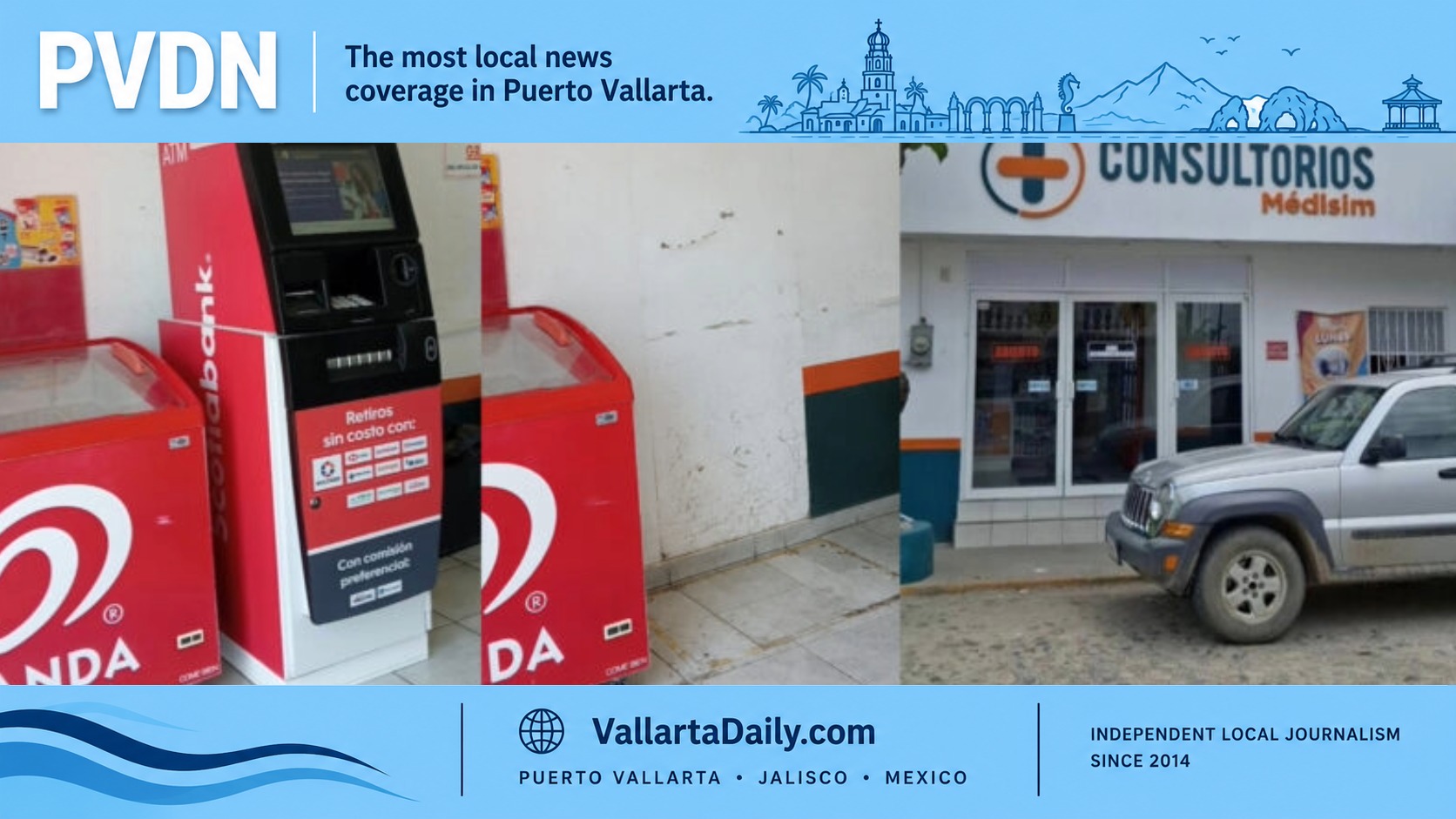
Bahía de Banderas, Nayarit, July 7, 2026 – A string of attacks on cash machines has moved through Bahía de Banderas’ coastal towns and commercial corridors this year, with recent cases in La Cruz de Huanacaxtle and Jarretaderas showing how ATMs inside small businesses have become targets after closing hours.
The latest reported case was in Jarretaderas, where a cash machine was removed from inside a pharmacy on Avenida México during the early hours of Monday, July 6. Badeba Media reported, citing the police report, that employees arrived to find metal curtains forced open and damaged locks at a Medissim pharmacy near the town entrance. The Scotiabank machine had been pulled from its installation point, leaving cables and marks on the floor. The amount of cash inside was not disclosed.
That robbery followed a June 8 attack in La Cruz de Huanacaxtle, a fishing and marina community where many residents and visitors rely on small commercial corridors rather than full bank branches. NoticiasPV reported that armed men entered a business on Calle Langosta, where an ATM was installed, and held an older man at gunpoint after he went to check on noise from the premises around 3 a.m. The outlet described him as about 65 years old and said he later felt ill after the confrontation. Tribuna de la Bahía, which documented the broader wave of ATM attacks, reported that an older adult was injured in the La Cruz case.
The cases are not identical, but the pattern is narrow enough to get attention. The targets have largely been machines placed inside pharmacies, convenience stores, liquor stores and other commercial spaces rather than stand-alone bank branches. Several reports describe late-night or early-morning attacks, damage to doors or shutters, and suspects using force to open, empty or remove the machines.
Lo de Marcos has appeared in local accounts more than once. Noticias de la Bahía reported damage to two ATMs at a liquor store near the public plaza around the New Year period. Tribuna separately listed a May 18 case in Lo de Marcos in which suspects allegedly struck a machine with sledgehammers but failed to open it. The same coastal corridor had already seen similar reports before 2026, including a May 2025 San Pancho case involving two ATMs.
The issue reaches beyond the machines themselves. Many of these towns have grown faster than their banking infrastructure. ATMs inside shops fill a gap for workers, retirees, visitors, restaurant staff and small business owners who need cash outside regular banking hours. When those machines are removed, damaged or taken out of service, the immediate cost falls on the business owner, but the inconvenience spreads through the town.
The safety concern is sharper for employees and nearby residents. A damaged ATM can be replaced. A clerk, guard, owner, or neighbor walking into a robbery cannot be treated as collateral damage. The La Cruz case is the clearest example so far because the reported victim was not using the machine. He was drawn into the robbery after hearing noise from the business.
The reports reviewed by PVDN did not identify any arrests tied to the La Cruz or Jarretaderas cases. They also leave several unanswered questions: whether the same group is responsible for multiple attacks, whether the machines had working alarm systems, whether bank cameras captured usable images, and how quickly police were notified in each case.
Tribuna reported that investigators were looking at a possible group of three or four people operating in Bahía de Banderas. That has not been publicly confirmed through a detailed case bulletin from Nayarit prosecutors or municipal police.
The ATM attacks also fit into a broader complaint from businesses in the Puerto Vallarta-Bahía de Banderas corridor. PVDN recently reported that violent business robberies have become a growing concern for local merchants, particularly when staff is left exposed during low-traffic hours. The cross-border nature of daily life in the bay has also pushed Jalisco and Nayarit officials to talk more openly about tourist corridor security cooperation, though those discussions do not answer the immediate question of how small businesses with indoor ATMs are being protected overnight.