
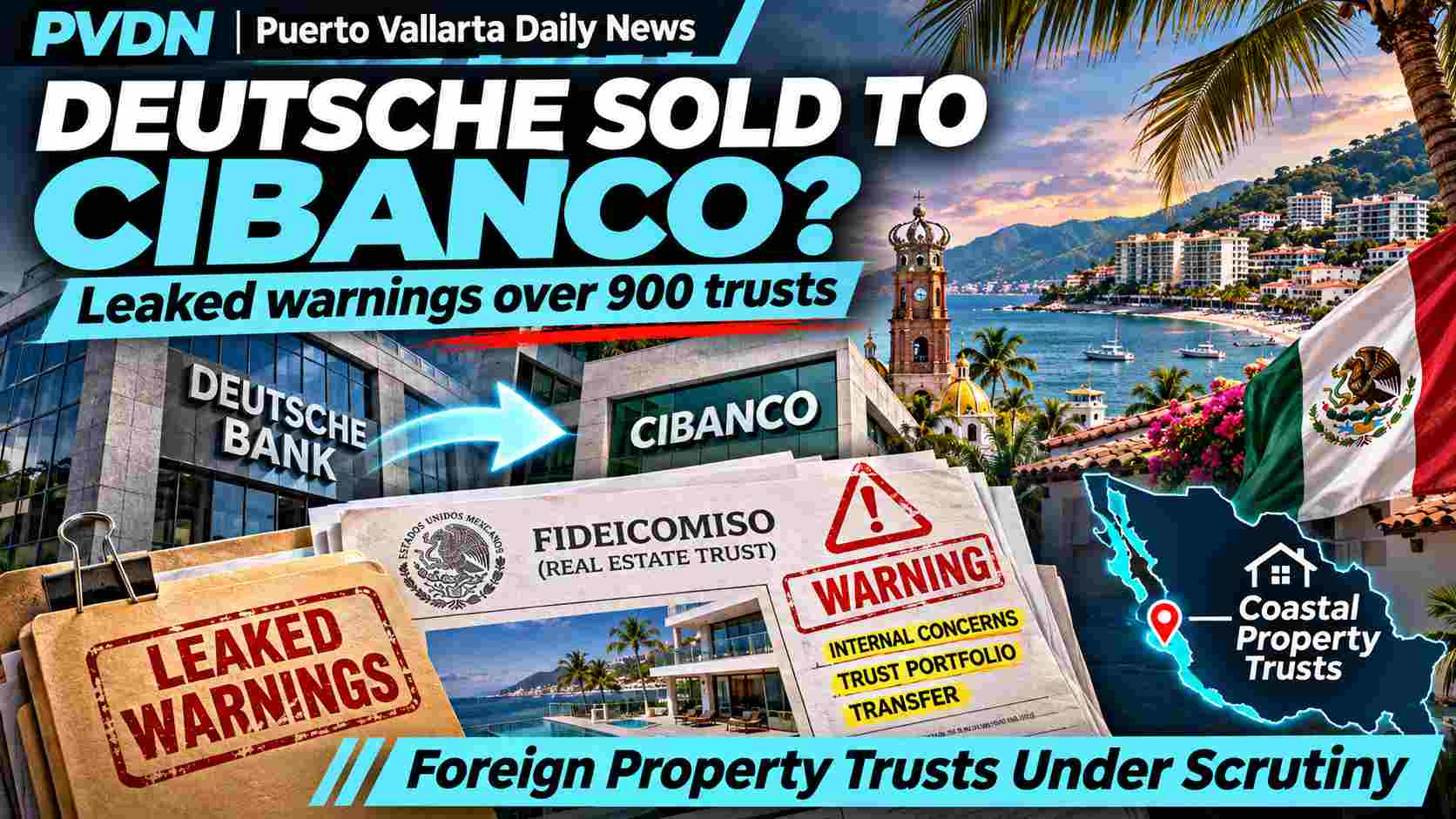
Leaked records show Deutsche Bank flagged CIBanco before selling 900-plus Mexican trusts. Here’s what happened to the portfolio and property owners.
Mexico City, Mexico, November 20, 2026 — Deutsche Bank identified financial-crime concerns involving CIBanco shortly before selling the Mexican institution a trust business managing more than $21 billion in assets, according to a newly published investigation based on leaked internal emails and confidential banking records.
The transaction involved more than 900 Mexican trusts, including arrangements used by foreigners to hold real estate in Mexico’s coastal restricted zones.
What makes the investigation particularly troubling is the timing.
Deutsche Bank’s financial-crime investigators raised concerns about CIBanco in November 2019. Within an hour, those concerns were reassessed as acceptable, partly because Deutsche Bank was selling the business rather than buying it.
The agreement was signed the following month.
Six years later, CIBanco became the subject of U.S. Treasury action over alleged money laundering connected to Mexican drug cartels, eventually leading to the bank’s liquidation.
The newly uncovered records don’t establish that the trust business Deutsche Bank sold was involved in the transactions identified by American authorities. Nor do they suggest that foreign property owners using those trusts were engaged in illegal activity.
But they reveal serious questions about how Deutsche Bank assessed its buyer and the quality of the customer records that changed hands.
For Americans and Canadians who own homes through Mexican bank trusts, the story also brings attention to a part of property ownership that usually receives little attention after closing: the financial institution responsible for administering the trust.
Deutsche Bank’s own investigators raised concerns
The investigation published November 20 by El Universal and the Centro Latinoamericano de Investigación Periodística (CLIP) is part of Inside Deutsche Bank, an international reporting project based on more than 15 million leaked documents.
Mexican journalist Miriam Ramírez examined internal communications surrounding Deutsche Bank’s effort to sell its Mexican trust operations.
On November 19, 2019, Deutsche Bank ordered an internal review of four potential buyers.
Two days later, an investigator in the bank’s financial-crime division sent an email identifying concerns involving CIBanco.
The review found that Deutsche Bank had previously closed CIBanco accounts as part of efforts to reduce financial risk.
That history raised questions within the German bank about whether CIBanco was an appropriate buyer for its Mexican trust portfolio.
But the assessment changed quickly.
About 40 minutes after the original warning, the same financial-crime department concluded that the risks were acceptable because Deutsche Bank was disposing of the business.
The internal assessment focused on the risks the transaction presented to Deutsche Bank as the seller.
The investigation also found that a separate 2010 case involving CIBanco as an intermediary had been closed without a suspicious-activity report. That distinction matters because an earlier risk warning is not, by itself, evidence that the bank committed a financial crime.
Still, the correspondence raises a question that extends beyond whether Deutsche Bank faced additional exposure.
What responsibility did the seller have to ensure the institution taking over hundreds of trusts could properly manage and monitor them?
Deutsche Bank disputes the suggestion that it knowingly proceeded with an unacceptable transaction.
In its response to the investigative consortium, the bank said it had not identified specific financial-crime concerns that would have prevented the 2019 sale.
It also maintained that the transaction met regulatory requirements.
Why Deutsche Bank was under pressure to sell
The German bank had been trying to leave Mexico for several years.
Its board approved the withdrawal in late 2015 as part of a wider restructuring that reduced the bank’s presence in several international markets.
An earlier attempt to sell its Mexican trust operations to Investa Bank, which later became Accendo, became entangled in litigation.
By 2019, the situation had become more urgent.
Germany’s financial regulator, BaFin, had instructed Deutsche Bank to sell its trust operations before the end of that year and complete its withdrawal from Mexico by March 2020.
The order followed longstanding concerns about the bank’s internal controls.
Deutsche Bank opened another sale process in April 2019, but the earlier dispute with Accendo continued to delay the transaction.
As the deadline approached, potential buyers withdrew.
By November 25, just one offer remained.
CIBanco proposed paying approximately 10 million euros for the business.
That offer came only four days after Deutsche Bank’s financial-crime department had raised concerns about the Mexican institution.
Internal communications reviewed by the investigative consortium show executives discussing the consequences of failing to complete the sale.
Those consequences potentially included regulatory penalties or restrictions on Deutsche Bank’s operating license.
On December 20, 2019, the bank signed the agreement with CIBanco.
The acquisition was subsequently completed in 2020.
CIBanco’s purchase greatly expanded its position in Mexico’s trust market, eventually helping it become one of the country’s largest institutions administering assets on behalf of other parties.
The records behind the trusts had serious problems
The newly disclosed investigation goes beyond the decision to sell to CIBanco.
It also examines the condition of the trust portfolio Deutsche Bank was transferring.
Before the transaction, German regulators had ordered an external review of the bank’s Mexican operations.
KPMG conducted an on-site audit in November 2019, examining customer files and the bank’s procedures for identifying clients and the sources of their money.
The results, as reported by El Universal and CLIP, were troubling.
81%
of reviewed trusts lacked verifiable information on the origin of funds
79%
lacked sufficient information to establish beneficial ownership structures
10%
of more than 2,500 trust settlors had complete records
Findings attributed to KPMG’s 2019 audit in the El Universal/CLIP investigation. The percentages do not establish that the underlying transactions were illegal.
KPMG also examined a sample of 313 trust contracts that Deutsche Bank had classified as suitable for sale.
According to the investigation, those records failed to meet the standards set by the European Union’s Fourth Anti-Money Laundering Directive.
That directive requires financial institutions to identify customers, establish who actually benefits from transactions, and maintain adequate records for detecting suspicious activity.
A missing or outdated customer file doesn’t automatically mean the customer is involved in money laundering.
But weak records make it more difficult for financial institutions to identify questionable transactions or determine who controls assets.
The distinction becomes especially important when a bank takes over an existing portfolio.
Its new responsibilities don’t begin with newly opened accounts. They include trust arrangements created years earlier, sometimes involving multiple beneficiaries, companies, properties, and financial transactions.
In this case, the portfolio contained more than 900 trusts representing approximately $21 billion in assets under administration.
That figure describes the assets managed through the trust arrangements, not money that Deutsche Bank or CIBanco owned outright.
The portfolio included property trusts, commercial arrangements, credit guarantees, securities structures, and other forms of asset management.
Deutsche Bank’s response maintains that the sale complied with applicable regulatory requirements.
Five years later, CIBanco faced U.S. money-laundering action
The name CIBanco became widely known outside financial circles in June 2025.
The U.S. Treasury Department’s Financial Crimes Enforcement Network, or FinCEN, identified CIBanco, Intercam Banco, and Vector Casa de Bolsa as institutions presenting serious money-laundering concerns connected to illicit opioid trafficking.
As Vallarta Daily reported when the U.S. action was announced, American authorities accused the institutions of facilitating financial transactions connected to drug cartels and companies involved in supplying chemical precursors used to manufacture synthetic opioids.
The original Treasury announcement specifically identified concerns about CIBanco’s dealings involving the Cártel Jalisco Nueva Generación, Cártel del Golfo, and the Beltrán Leyva organization.
Among the allegations, FinCEN said a CIBanco employee had facilitated the opening of an account connected to an alleged $10 million laundering arrangement for a member of the Cártel del Golfo.
American authorities also identified payments involving businesses accused of supplying chemical precursors from China.
The resulting restrictions prevented covered U.S. financial institutions from conducting certain transfers involving CIBanco.
Mexico’s Secretaría de Hacienda y Crédito Público challenged the strength of the evidence publicly disclosed by U.S. authorities. CIBanco and its shareholders also rejected the accusations.
The restrictions nevertheless created serious difficulties for the bank.
Its access to international banking services became more complicated, while customers and financial institutions reconsidered their relationships with CIBanco.
By October 2025, the bank had entered liquidation.
Vallarta Daily covered the start of CIBanco’s liquidation and the role of Mexico’s deposit insurance agency, including the distinction between ordinary bank deposits and other financial arrangements.
The Instituto para la Protección al Ahorro Bancario, or IPAB, took responsibility for winding down the bank.
In April 2026, FinCEN modified its restrictions to allow certain transactions necessary for the Mexican government to complete that liquidation.
The original U.S. money-laundering findings remained in place.
There is an important limit to what these events establish.
The investigative consortium found no evidence connecting the Deutsche Bank trust portfolio acquired by CIBanco to the transactions that prompted FinCEN’s 2025 action.
Deutsche Bank also rejected any suggestion that the later U.S. allegations were connected to its earlier trust sale.
The newly published documents raise concerns about the banks’ internal controls and the decision-making behind the transaction. They do not establish that the trusts themselves were used to launder money.
What happened to the trusts when CIBanco collapsed?
For foreign property owners in Puerto Vallarta, this may be the most useful part of the story.
The trust business did not simply disappear when CIBanco entered liquidation.
Months before that happened, Mexican financial authorities arranged for another bank to take over its trust operations.
On August 19, 2025, the Secretaría de Hacienda announced that CIBanco’s fiduciary division would be transferred to Banco Multiva.
The government said the arrangement was intended to protect existing trust contracts and their beneficiaries.
The transaction was completed in early September.
According to Banco Multiva’s announcement reported by El Economista on September 5, the bank took over CIBanco’s fiduciary business, including its responsibilities as trustee and the legal ownership it held in that capacity over trust property.
Multiva said the transfer preserved the rights of participants and allowed existing trust operations to continue.
That is a crucial distinction.
CIBanco’s commercial banking business and the assets it administered through trusts were not the same thing.
When the bank later entered liquidation, the fiduciary business had already been transferred to another institution.
The government and Multiva described the transaction as protecting the continuity of existing contracts.
That doesn’t independently establish that every individual customer experienced a problem-free transfer. Anyone with questions about a specific trust still needs to check its records and current administration.
But the available evidence doesn’t support the idea that foreign homeowners lost their properties because CIBanco closed.
Nor does the new investigation establish that a particular Puerto Vallarta property was included in Deutsche Bank’s original 900-plus-trust portfolio.
Why this matters to Americans and Canadians who own property in Vallarta
Most foreign property owners in Puerto Vallarta are familiar with the word fideicomiso.
It’s the bank trust commonly used by foreigners purchasing residential property within Mexico’s restricted coastal zone.
Under Article 27 of the Mexican Constitution, foreigners cannot directly hold title to land within 50 kilometers of the coastline or 100 kilometers of an international border.
Instead, the Secretaría de Relaciones Exteriores allows qualifying residential property to be held through a Mexican bank trust.
The bank holds legal title as trustee, while the foreign buyer holds the beneficial rights established in the trust agreement.
Those rights generally include using, selling, renting, and passing the property to designated beneficiaries, subject to the trust agreement and applicable law.
As Vallarta Daily has explained in its coverage of foreign property ownership risks, the legal structure is widely used, but buyers still need to examine the underlying property records, existing obligations, and the bank administering their trust.
For many homeowners, their relationship with the bank is fairly limited after closing.
They pay an annual trust fee, maintain contact information, and occasionally request paperwork when refinancing, selling, or changing beneficiaries.
The bank’s name may remain on the original deed for years.
What happened with CIBanco shows why the institution behind the trust deserves attention.
A homeowner may have a properly established fideicomiso and still experience changes in the financial institution responsible for administering it.
Those changes don’t automatically affect ownership rights, but they can affect where fees are paid, whom beneficiaries contact, and who must provide documents when a property changes hands.
For anyone whose original trust names Deutsche Bank or CIBanco, the relevant question is who currently administers that specific agreement.
Banco Multiva acquired CIBanco’s fiduciary operations in 2025, but an individual property’s paperwork and administrative history should still be checked before making assumptions about its current status.
Owners can request written confirmation of the current trustee, their trust number, the appropriate payment instructions, and the contact information for the department handling their account.
They should also confirm any new payment instructions directly with the bank through independently verified contact details.
There is no evidence in the newly published investigation that all foreign-owned property trusts were affected by the compliance failures it identified.
Why the original sale still deserves scrutiny
The Deutsche Bank case raises two separate questions.
The first concerns the buyer.
Deutsche Bank’s own financial-crime department raised concerns about CIBanco shortly before the sale, then reassessed those concerns in light of Deutsche Bank’s position as the seller.
The second concerns the assets being transferred.
The newly reported KPMG findings suggest that Deutsche Bank had significant gaps in the records used to identify trust clients, establish beneficial ownership, and verify the origin of funds.
Those are different problems, but they came together in the same transaction.
Deutsche Bank was under pressure to complete its withdrawal from Mexico. Regulators wanted the bank to finish the sale, potential buyers had withdrawn, and its Mexican trust business needed a new administrator.
That urgency helps explain why the deal moved quickly.
It doesn’t answer whether the buyer’s compliance systems and the transferred records were adequate.
The central concern is not that every trust in the portfolio was suspicious. The investigation provides no basis for such a conclusion.
It’s that a bank responsible for managing billions of dollars in other people’s assets was attempting to transfer those responsibilities while dealing with serious weaknesses in its own customer documentation.
The newly released correspondence gives a rare look at how executives weighed those concerns against the pressure to complete the sale.
There has been no newly reported court finding establishing that Deutsche Bank committed a crime by selling the trust business to CIBanco.
The bank maintains that it fulfilled its regulatory obligations.
CIBanco declined to provide a response to the new investigation because of its liquidation, while the Comisión Nacional Bancaria y de Valores did not comment.
The unanswered question for Mexico’s trust industry
Mexico’s banking system has already gone through a major restructuring of its trust business following the CIBanco and Intercam cases.
The transfer to Banco Multiva was intended to preserve existing arrangements rather than leave trust beneficiaries without an institution to administer their contracts.
The larger issue raised by the Deutsche Bank documents concerns how financial regulators assess the records and compliance systems accompanying those transfers.
When a bank acquires hundreds of trusts, it also inherits responsibility for maintaining accurate information about the people and assets behind them.
A portfolio valued in the billions can still contain incomplete customer files.
And a completed sale does not, by itself, correct those records.
The new investigation doesn’t establish whether all the deficiencies identified in the 2019 audit were subsequently corrected, either by Deutsche Bank before the transfer or by CIBanco afterward.
It also doesn’t establish the present condition of those particular records under Banco Multiva.
For foreign homeowners, the immediate issue is considerably narrower.
The bank that originally established their fideicomiso may no longer be the institution responsible for administering it.
Anyone whose property documents still identify CIBanco can ask Banco Multiva to confirm the current trustee, verify the trust’s registration and beneficiary information, and provide the correct instructions before the next annual trust payment comes due.