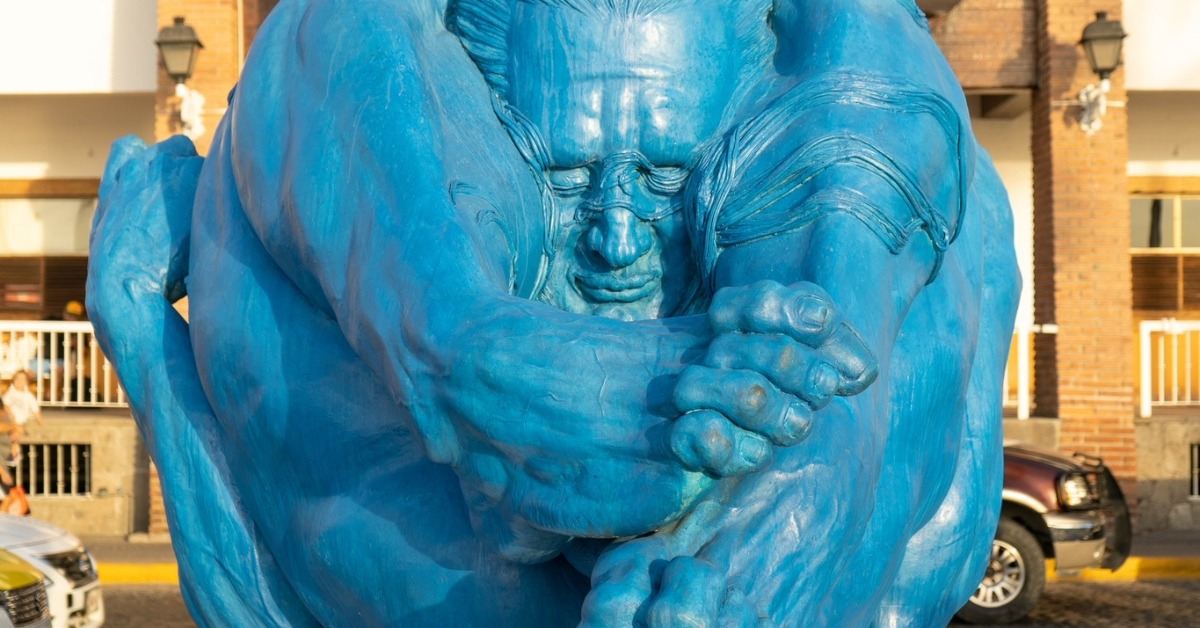
A public sculpture installation tied to Semana del Arte Puerto Vallarta 2026 has sparked a fresh debate over what kind of art belongs on the Malecón, one of the city’s most visited public spaces. The controversy began after several works from Álvaro Fuentes’ collection Contorsiones were installed along the waterfront as part of the event’s opening activities. The pieces, described by organizers as an exploration of movement and bodily expression, quickly drew criticism on social media from residents who said the imagery was too explicit for a promenade used by families, tourists, and children.
The criticism soon moved from online reaction to local politics. A municipal council member called for the sculptures to be removed after complaints spread, arguing that the Malecón is not a neutral gallery wall but a shared civic space with a different standard than a museum or private exhibition. That response gave the story a wider local meaning. It was no longer only about whether people liked the sculptures. It became a question of who sets cultural limits in the city’s most public setting, and how quickly officials respond when art runs into public discomfort.
Why the Malecón changes the meaning of the story
The same installation likely would have drawn less attention in a gallery. On the Malecón, it was always going to be different. Puerto Vallarta’s waterfront is not simply a tourist boardwalk. It is also one of the city’s most recognizable public stages, where locals, street performers, vendors, families, and visitors all pass through the same space. That matters because public art on the Malecón is rarely seen as private expression alone. It becomes part of the city’s image and, in many cases, part of how people understand Vallarta itself.
That helps explain why the reaction was so immediate. The issue was not only nudity or erotic form. It was the location. Residents who objected were responding to the idea that works with an overtly sensual tone had been placed in a promenade with almost no barrier between the art and the general public. Supporters of the display could reasonably argue that public art is supposed to provoke conversation and that Vallarta has long marketed itself as an open, creative city. Critics, however, saw the choice of venue as the real problem. In that view, the debate was about curation, not censorship.
What organizers appear to have intended
By all indications, the installation was meant to signal ambition, not scandal. The works were presented as part of the first edition of the Galería Pública del Puerto, an open-air activation within Art Week 2026. Organizers promoted the broader effort as a way to connect artists, galleries, and the public more directly, using the city itself as a cultural venue. The sculptures were part of that strategy. Rather than keeping art inside formal spaces, the event brought it onto the waterfront and into everyday pedestrian life.
That idea fits a larger pattern in Puerto Vallarta. The city already leans heavily on the Malecón as a place where art, tourism, and civic identity overlap. Visitors know the promenade for its permanent sculptures, seasonal installations, and guided walks centered on public works. In that sense, placing contemporary sculpture there was not unusual by itself. What made this case different was the subject matter and the speed of the public backlash. Organizers appear to have treated the display as an artistic intervention. Much of the criticism treated it as an avoidable failure of judgment in a high-visibility public setting.
What officials and critics were really arguing about
The council member who pushed for removal did not frame the issue as opposition to art in general. The concern was more specific. The argument was that there are spaces for erotic or adult-oriented art, but the Malecón may not be one of them when the audience is uncontrolled and includes minors. That distinction is politically important. It gives officials room to distance themselves from accusations of broad censorship while still demanding limits on placement, timing, or content in certain public areas.
That is also why this story matters beyond one installation. Puerto Vallarta depends on a public image built around openness, creativity, and tourism, but it also remains a city where cultural boundaries are negotiated in full view. When a dispute like this breaks out, it exposes a tension that has been there for years. Vallarta promotes itself through its public spaces, and those spaces often carry artistic symbolism. At the same time, the more visible the setting, the more likely it is that art will be judged not only on its intent, but on who is expected to walk past it.
What happens next may matter more than the backlash
The immediate controversy may fade quickly, especially if the installation was temporary. But the larger question will remain. If Puerto Vallarta wants to keep expanding public cultural programming, officials and organizers may face growing pressure to define how works are selected for the Malecón, what notice the public receives, and whether certain kinds of installations should come with clearer context or limited placement. That would not settle the debate over taste, but it could reduce the sense that decisions are being made without regard for the setting.
For international residents and visitors, the dispute is also a useful reminder of how local cultural politics work in Mexico’s tourist cities. Public space is never just public space. It is also a meeting point for commerce, identity, government, religion, family life, and art. In Puerto Vallarta, the Malecón sits at the center of all of that. This week’s argument over erotic sculpture was not just about a few controversial pieces. It was about what kind of city Vallarta wants to project in its most visible place, and who gets a say when that image is challenged.