A Spanish-language opera about Frida Kahlo, Diego Rivera, Mictlán, and Día de Muertos will close the Met’s live season in Mexico City. The Auditorio Nacional broadcast gives Mexican cultural imagery a high-profile international opera platform, but the work also carries a sharper question. How does a global stage handle two artists whose lives, pain, and politics are already heavily packaged for public consumption?
Frida and Diego close the Met season in Mexico City
El último sueño de Frida y Diego, a Spanish-language opera built around Frida Kahlo, Diego Rivera and Día de Muertos, will close the 2025-2026 En Vivo desde el Met season at Mexico City’s Auditorio Nacional on Saturday, May 30.
The transmission is scheduled for 11 a.m. at the Auditorio Nacional, where the venue lists prices from 180 pesos to 1,150 pesos. The opera will be transmitted live from the Metropolitan Opera, sung and subtitled in Spanish, according to the Auditorio Nacional event listing.
The closing slot gives the work a particular weight in Mexico. The season began in October with a Mexico-linked milestone, Rolando Villazón directing the Met’s new production of La sonnambula, and ends with a new Met staging centered on two of Mexico’s most recognizable artists. The Auditorio Nacional previously described the season as eight operas transmitted from Lincoln Center to Mexico City and other venues worldwide.
The opera is by Gabriela Lena Frank, with a libretto by Nilo Cruz. The Met describes it as Frank’s first opera and a “magical-realist portrait” of Kahlo and Rivera, shaped as a reversal of the Orpheus and Eurydice myth. In this version, Frida leaves the underworld on Día de Muertos and returns to Diego, who is nearing death. The Met production page lists the work as sung in Spanish and gives an estimated running time of two hours and 50 minutes, with one intermission.
A Mexican story on an international opera platform
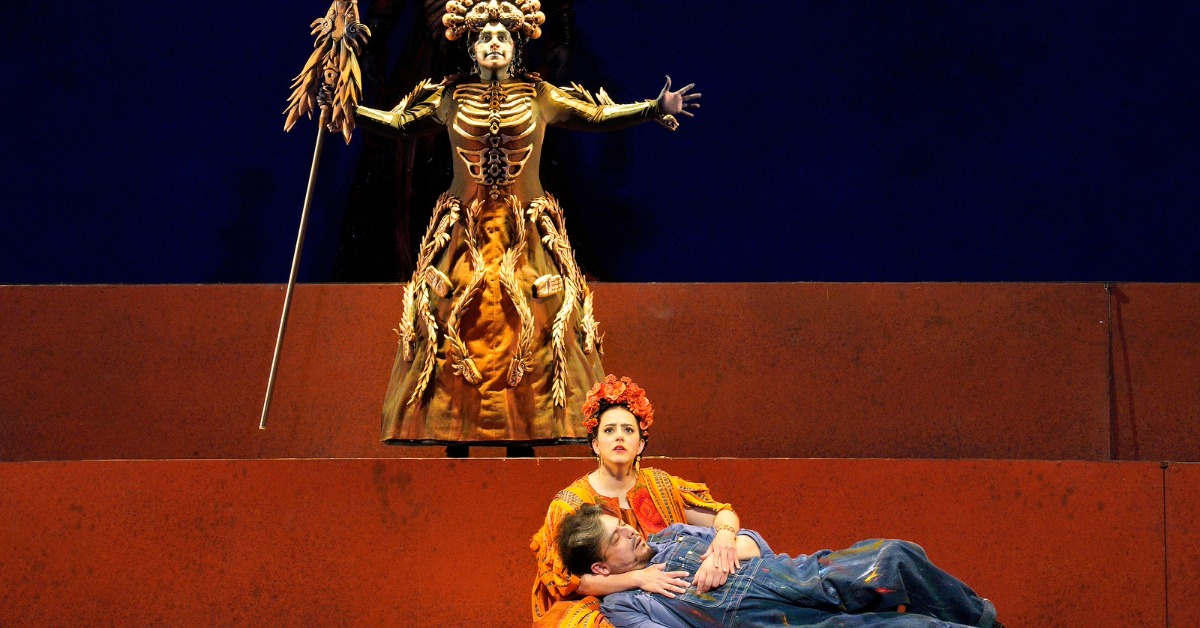
The production arrives with obvious visual force. It draws from Kahlo and Rivera’s paintings, Mictlán, Catrina imagery, and the ritual language of Día de Muertos. But the stronger tension sits under the spectacle. Kahlo and Rivera are not neutral cultural figures. They are artists whose images have been turned into souvenirs, political symbols, museum routes, and commercial shorthand.
That makes the opera’s framing worth watching. The Met says the story is not a conventional biography. It places Frida in the underworld, where death has released her from physical pain, then sends her back toward Diego for a final encounter. Mezzo-soprano Isabel Leonard sings Frida, while baritone Carlos Álvarez portrays Rivera. Soprano Gabriella Reyes sings Catrina, and countertenor Nils Wanderer sings Leonardo.
Leonard has described the work as “a journey of emotions that every human can possess,” told through figures many people already recognize. Cruz has been more blunt about the story’s limits. “I wasn’t interested in writing a biopic,” he said of the project’s early development.
That choice keeps the opera away from a timeline of famous incidents. It also gives the creative team room to work with myth, grief, and memory. Cruz has said Rivera’s late wish to have his ashes joined with Kahlo’s stayed with him during research. “That was something that really stayed with me,” he said.
The work had a long road to the Met
The opera did not appear suddenly. Its origins trace back more than a decade, with development disrupted and extended before its world premiere at San Diego Opera in 2022. The work later moved through other U.S. houses before reaching the Met in a new production directed and choreographed by Deborah Colker.
Frank has said she wanted the score to avoid easy musical shorthand. Instead of leaning on obvious Latin motifs, she described looking for something “colorful” and “otherworldly,” with the marimba appearing throughout the opera’s sound world.
That restraint matters because the subject invites cliché. Kahlo’s face is already one of the most reproduced Mexican images in the world. Rivera’s murals are civic art, political argument, and tourist landmark all at once. The opera has to carry that recognition without flattening both artists into decoration.
For readers following the work’s longer path, Vallarta Daily previously covered how the Kahlo Rivera opera landed major international 2026 dates, including its Mexico City stop. The latest Auditorio Nacional date now brings that calendar to its close for Mexico broadcasts.
Tickets, language and timing
The May 30 Mexico City screening is part of the Met’s Live in HD cinema and venue transmission program, which sends selected performances to audiences outside New York. The Met says the May 30 performance will be transmitted live to cinemas worldwide as part of that series.
For the Auditorio Nacional audience, the language choice is direct. The venue lists the opera as sung and subtitled in Spanish, which changes the usual distance between a Mexican subject and an international opera house format. It also puts the libretto’s emotional turns closer to the cultural material being staged.
The story opens three years after Kahlo’s death. On Día de Muertos in 1957, Diego lost Frida and faced his own end. Catrina intervenes. Frida returns for 24 hours. The fictional structure gives the work its final meeting, not through biography, but through the Mexican calendar of memory and return.
Vallarta Daily readers looking for the broader cultural context can also revisit coverage of CDMX Day of the Dead events and the older Frida Kahlo and Diego Rivera art trail in Mexico City, both of which sit near the same public fascination with the couple, their city, and the rituals built around remembrance.