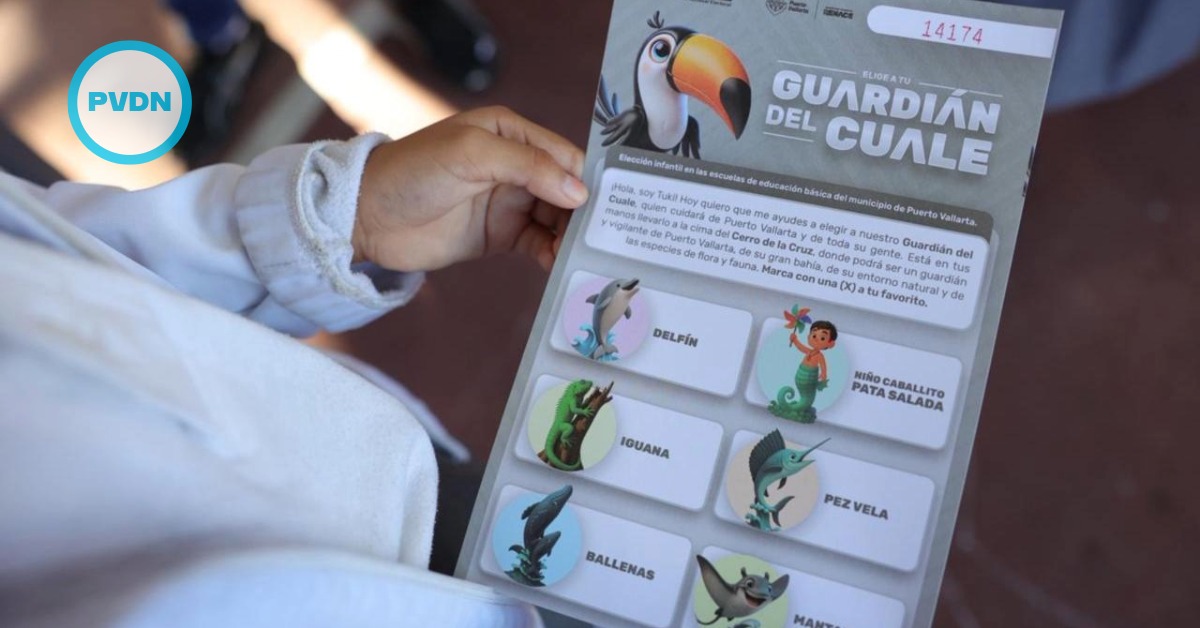
Primary students across Puerto Vallarta cast real INE-style ballots to choose a symbolic Guardian of the Cuale for Cerro de la Cruz.
On a weekday morning in downtown Puerto Vallarta, the playground at Primary School 20 de Noviembre looks different. Instead of lining up for recess, students are called up class by class, receive paper ballots and are invited to mark a single choice before dropping it into a ballot box.
The exercise is part of a new citywide vote to choose the Guardian of the Cuale, a symbolic character that will be turned into a sculpture on the popular Cerro de la Cruz overlook. From 3 to 16 December, primary students in public and private schools across Puerto Vallarta are being asked to pick which figure will watch over the hill above the city and the nearby Cuale River.
The choices are all drawn from the bay’s marine life and local identity. On the ballot, students can mark their vote for El Delfín, El Niño Caballito Pata Salada, La Iguana, El Pez Vela, La Ballena or La Mantarraya. Each name connects either to the Pacific waters off Vallarta or to the “pata salada” nickname widely used for people born in the city.
Children vote for the Guardian of the Cuale
The municipal government set up the process to look and feel like a real election. In each participating school, officials arrive with voting booths, paper ballots and ballot boxes provided by Mexico’s National Electoral Institute. Teachers and staff explain how to fill in the ballot correctly and place it in the urn, mirroring the basic steps of an adult election.
Local authorities describe the vote as a way to introduce democratic practice long before students turn eighteen. For many children, this is the first time they have handled materials that are usually reserved for adults on federal and local election days. Walking through the process in a familiar environment aims to make it easier to understand how decisions are made beyond the classroom.
The winning character will be installed as a sculpture on the summit of Cerro de la Cruz, the steep hill and viewing platform that rises just behind the historic center. From there, residents and visitors look out over the bay, the river corridor and the dense hillside neighborhoods that surround the city. Linking that landmark to a vote led by children is also meant to anchor their sense of belonging to the landscape they see every day.
Mayor Luis Munguía has framed the initiative as a promise to involve children more often in decisions about Puerto Vallarta. During the launch at 20 de Noviembre, he told students that their ballots would decide which figure represents the city and that his administration intends to ask for their opinion again when future projects affect their lives.
Democracy, childhood and caring for the hill
The “Guardian” vote arrives at a moment when national and state electoral authorities are trying to strengthen civic education among younger generations. Mexico’s National Electoral Institute has spent years running its Children’s and Youth Consultation, a recurring exercise where minors share their views on everyday problems and rights. In Jalisco, the 2024 edition gathered more than 700,000 young participants and highlighted concern about environmental issues and local conditions.
Puerto Vallarta has also reported new efforts in environmental education. The city’s Directorate of Environmental Sustainability includes a Department of Environmental Education that documents school-based activities and outreach to protect urban trees and nearby ecosystems. Around the bay, organizations dedicated to botany, marine life and conservation also run workshops and field trips that bring students into contact with the region’s forests, rivers and wildlife.
Placing a child-chosen sculpture on Cerro de la Cruz fits into that broader picture. The hill is tied to walking routes that connect the Malecón seafront, the Cuale River island and the steep streets above downtown. Turning it into a place where children know their vote had a visible outcome can help make conversations about litter, erosion, wildfire risk and respectful tourism feel less abstract.
Exercises like this one can also reinforce the idea that democracy is not limited to voting every few years. Because the result will be visible on a hill that many families already visit, students will see that a decision they helped make has a lasting effect in their own city. For some children, it may be the first time they see a direct line between a ballot they filled out and a change in the urban landscape.
The ballots will be counted after the two-week voting period ends, with the winning design moving on to the sculpting and installation phase. Municipal officials have indicated that they expect strong participation because every ballot is tied to a tangible result: children will be able to visit the sculpture with their families once it is in place.
For now, the most important outcome may not be which character wins, but how seriously adults treat the process. If the city follows through on its promise to listen, the Guardian of the Cuale could become more than a mascot on a hill. It could mark the start of a tradition in which Vallarta’s children see themselves not just as future voters, but as present-day guardians of their river, their hill and their hometown.