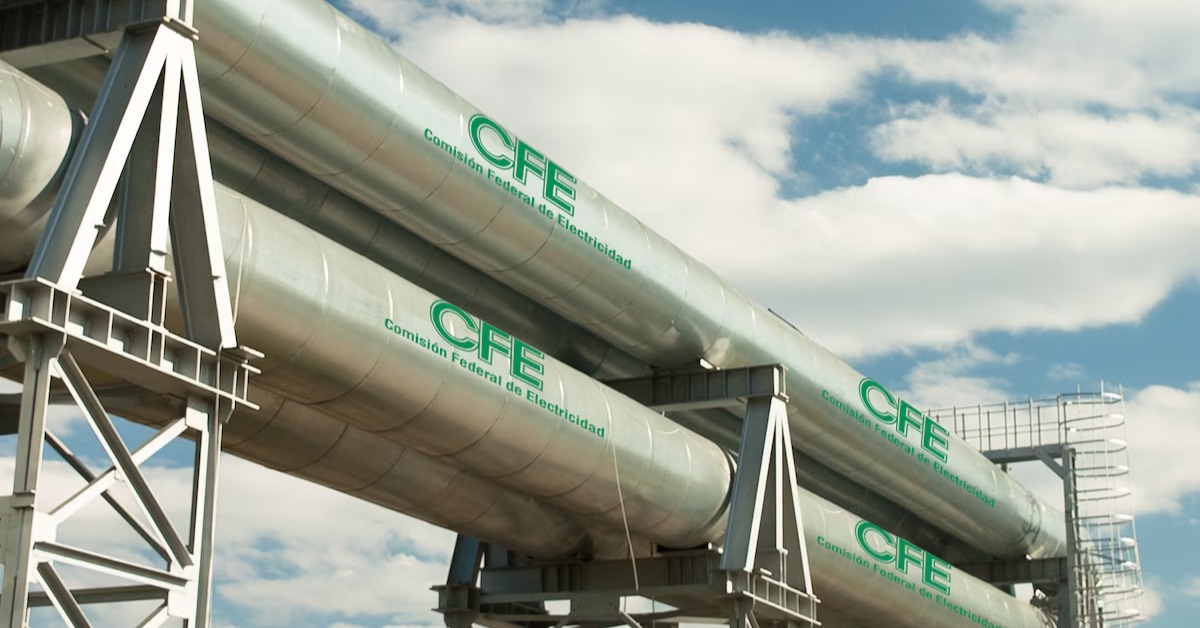
Mexico is preparing one of its largest gas infrastructure pushes in years, with more than 140 billion pesos planned for new pipelines and maintenance. The government says the work is needed to supply new CFE power plants and support national energy demand. But the plan also raises bigger questions about Mexico’s dependence on imported U.S. natural gas, the future of electricity reliability, and how fast the country can balance growth with cleaner energy goals.
Mexico plans major gas pipeline investment
Mexico’s federal government announced a 140.9-billion-peso gas pipeline plan to expand, modernize, and maintain the country’s natural gas transport network through 2030.
The plan is tied closely to electricity generation. Much of Mexico’s power system depends on natural gas, especially the combined-cycle plants operated by the Federal Electricity Commission (CFE).
The investment will be divided between new infrastructure and maintenance. Federal officials said about 101.3 billion pesos will go toward new gas pipeline projects, while about 39.6 billion pesos will be used to maintain and rehabilitate existing duct networks.
The plan places two public entities at the center of the work. CFE will be responsible for roughly 53 billion pesos in projects, while Cenagas, the national natural gas control center, will oversee about 87 billion pesos.
For residents in Mexico, the announcement is not about a direct change to household utility bills today. It is about the infrastructure behind the electricity system, industrial growth, and long-term energy supply.
The plan is tied to new CFE power plants
The government says the pipeline work is needed to supply 13 new CFE power plants. These plants are expected to rely on natural gas to generate electricity.
CFE is expected to build nine new gas pipelines. Cenagas is expected to build three more while also carrying out maintenance and rehabilitation across the national network.
Some of the projects are linked to areas where Mexico expects stronger electricity demand. These include industrial regions, new development zones, and states with growing power generation needs.
The government has also linked the plan to Plan México, the broader economic strategy aimed at supporting industrial investment and regional development. For that strategy to work, factories, data centers, ports, housing projects, and tourism zones need dependable electricity.
That is where the pipeline plan becomes more than an energy story. It is also an economic development story.
Why natural gas remains central to Mexico’s grid
Mexico has expanded its renewable energy capacity, but natural gas remains the backbone of the power system. It is widely used because gas-fired plants can generate electricity more steadily than solar or wind alone.
Combined-cycle plants are also often cheaper and cleaner than older fuel-oil or diesel plants. That makes gas an important bridge fuel in Mexico’s current energy model.
Still, natural gas is a fossil fuel. That means the plan also raises environmental questions, especially as Mexico works toward cleaner electricity goals.
The government’s argument is that Mexico needs a more reliable gas network while it continues adding cleaner sources. Critics of heavy gas dependence argue that more pipelines can lock the country into fossil fuel use for years.
Both points are part of the larger energy debate. Mexico needs more power, but the country also faces pressure to reduce emissions and modernize its grid.
The U.S. gas connection
The greater challenge is that Mexico does not produce enough natural gas to meet its own demand. A large share comes by pipeline from the United States.
That trade has helped Mexico keep gas supplies available and relatively affordable. It has also made the country more exposed to U.S. market swings, weather disruptions, and cross-border infrastructure issues.
When gas supplies are strained, the effects can reach electricity generation. That matters in places where demand is rising because of heat, tourism, industrial growth, or new housing.
For foreign residents, this is the practical angle. Natural gas supply does not always appear on a CFE bill, but it sits behind the reliability of the power system that many households and businesses depend on.
Mexico’s gas network also affects regional growth. Areas with stronger energy infrastructure are better positioned to attract investment, while weaker areas may face delays or higher operating risks.
Maintenance is a major part of the story
The plan is not only about building new pipelines. A large part of the investment will go toward maintaining and rehabilitating existing infrastructure.
That matters because older pipelines and related facilities can limit how much gas reaches certain regions. A power plant is only useful if fuel can reliably reach it.
Cenagas manages a large share of the national gas network. Some ducts have been transferred from Pemex over time, which has added to the need for repairs, modernization, and clearer operating responsibility.
The government says maintenance work will help make gas transport safer and more efficient. It is also meant to reduce bottlenecks that can affect power generation and industrial supply.
In simple terms, Mexico is not just adding capacity. It is trying to improve the existing system.
What comes next
The plan will unfold over several years, with projects expected to move forward through 2030.
The biggest test will be execution. Energy infrastructure projects often face delays tied to permitting, land access, financing, environmental review, and construction timelines.
Another question is whether the investment will reduce Mexico’s vulnerability or mainly help move more imported gas through the country.
The government has framed the plan as part of its energy sovereignty strategy. In practice, that will depend on whether Mexico can improve supply security while also diversifying power generation.
For now, the announcement signals that natural gas will remain central to Mexico’s electricity system for years. It also shows that CFE and Cenagas will continue to play a leading role in the country’s energy planning.