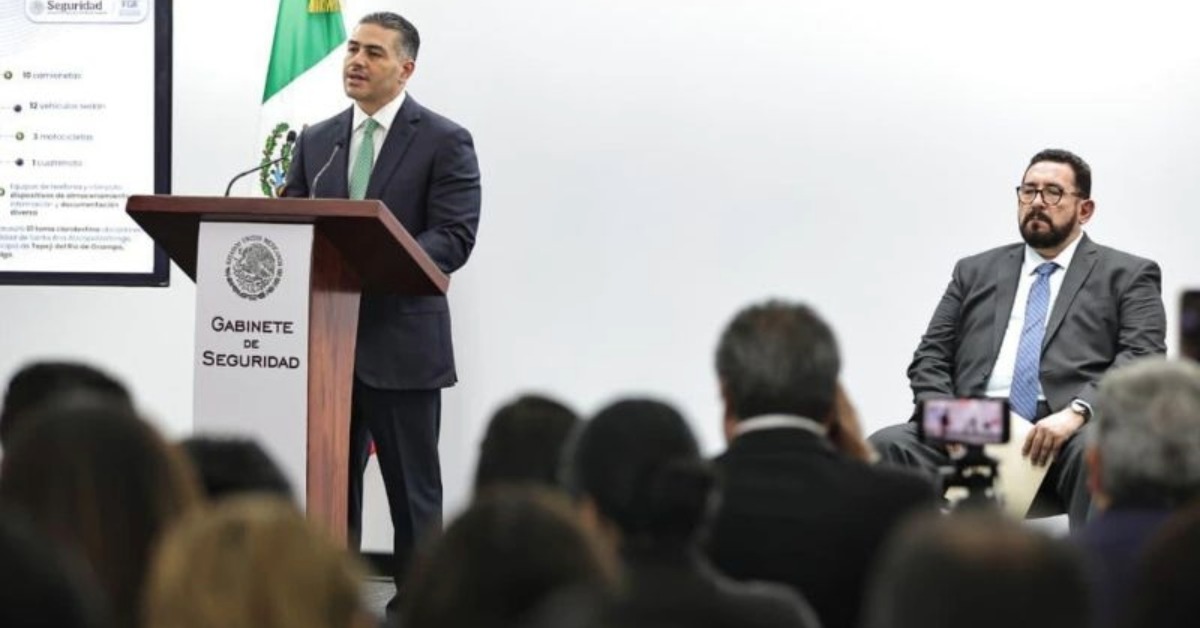
Mexican authorities say they have dismantled one of the country’s most important fuel-crime structures, in a case that combines traditional huachicol with huachicol fiscal, the tax and customs fraud side of the fuel business.
That distinction matters. For many readers, huachicol means fuel siphoned from pipelines. This case is broader. Prosecutors say part of the operation relied on shell companies, false documentation, and simulated commercial activity worth more than 23 billion pesos. Security officials also described a parallel structure tied to the extraction, transport, storage, and sale of stolen fuel. Taken together, the case points to a criminal model that blends street-level theft with corporate-looking paperwork and financial cover.
Authorities announced arrests, seizures, and searches across several states. The numbers in early reports were grouped across related operations, but the public briefing made one thing clear. The government is presenting this as a large-scale strike against both the physical theft of fuel and the paper-based fraud that facilitates the movement of illegal fuel through the economy.
What authorities say they found
According to federal officials, investigators identified a network of more than 40 companies that allegedly simulated operations tied to fuel imports, transport, and sale. Prosecutors said those firms were used to support a huachicol fiscal scheme that moved fuel with false or inaccurate records and helped evade tax, customs, and regulatory controls.
Officials said the investigation grew out of earlier work, including the 2025 seizure of the vessel Challenge Procyon in Tamaulipas. From there, authorities say they traced a wider business structure involving companies in sectors such as logistics, construction, energy, and transport. They described a multimodal system in which fuel could enter by sea, move inland by rail, and later be distributed by road.
The government also said it carried out simultaneous operations against another fuel-theft structure in the center of the country. In that branch, officials described a network that allegedly extracted, stored, and sold hydrocarbons through front companies, gas businesses, and transport fleets. That part of the case is important because it shows how the line between classic fuel theft and financial concealment can disappear. One network steals the product. Another hides it on paper. In practice, they can reinforce each other.
What huachicol fiscal means
Huachicol fiscal is not simply stolen gasoline sold off the back of a truck. It is a tax and customs fraud model built around the fuel trade. The basic idea is straightforward. Fuel is brought into the country, moved through the market, or sold onward using documentation that disguises its origin, what taxes should have been paid, or what it is.
That can include false invoices, shell companies, prestanombres, and cargoes labeled as lower-tax or differently regulated petroleum products. On paper, the operation can appear to be a lawful commercial transaction. In reality, authorities say the structure is used to avoid IEPS, customs duties, permits, traceability requirements, and other controls that legal sellers must meet.
This is one reason the crime has drawn so much attention. Traditional pipeline tapping is visible. It leaves physical evidence, security incidents, and shortages. Huachicol fiscal can be harder to detect because it travels through invoices, customs filings, corporate signatures, and banking channels. It can look legitimate long enough to move very large volumes and very large sums of money.
Why this case matters beyond organized crime
This story matters because it sits at the intersection of public security, tax collection, market fairness, and state capacity. When prosecutors talk about simulated operations worth 23 billion pesos, they are describing more than a criminal ring. They are describing a system that, if proven, could distort competition and drain public revenue at scale.
For ordinary residents, the issue is not only whether fuel was stolen. It is whether illegal operators can undercut legal businesses, corrupt logistics chains, and move products through ports, rail lines, and highways while avoiding the taxes and controls that others must pay. That affects confidence in regulation and weakens trust in how the fuel market is supervised.
There is also a wider cross-border angle. Recent investigations have drawn scrutiny to fuel shipments arriving from abroad under questionable classifications. That has helped shift the public conversation. The problem is no longer seen only as a stolen Pemex product. It is also seen as a transnational smuggling and tax-evasion system that can involve importers, customs paperwork, transport networks, and financial operators on both sides of the border.
Why the government is tightening controls now
The timing is not accidental. Mexican tax authorities are rolling out a new invoicing requirement for hydrocarbon and fuel sales intended to improve traceability of permits and product origin. The goal is simple. Make it harder for illegal fuel to disappear into normal-looking commercial transactions.
That will not solve the problem on its own. Criminal networks adapt quickly. But it shows how the government now sees the threat. This is no longer treated as only a policing issue. It is also a documentation, tax, customs, and compliance problem. In other words, the state is trying to close the bureaucratic gaps that make huachicol fiscal profitable.
For international readers, that may be the clearest takeaway. Mexico is still fighting traditional fuel theft, but the bigger battle now includes paperwork, company structures, and supply-chain controls. The crime has evolved. The response is evolving with it.
What comes next
The arrests and seizures are only the opening phase. Prosecutors will still need to prove who controlled the companies, who signed or authorized the transactions, and how the money moved. That is often the harder part of cases like this. A network built on multiple firms and layered transactions can spread responsibility across many names, entities, and jurisdictions.
Even so, the public significance of this case is already clear. Authorities are arguing that fuel crime in Mexico has become more corporate, more mobile, and more financially sophisticated. If that assessment holds up in court, this will stand as one of the clearest recent examples of how organized crime can operate through trucks, tankers, warehouses, and invoices simultaneously.
For readers living in Mexico, the story is also a reminder that fuel crime is not only about cartel violence or dramatic pipeline taps. It is also about who controls essential markets, who pays the real cost of fraud, and how easily illicit business can hide inside ordinary commerce.