Mexico’s fight against fiscal fuel smuggling has delivered an estimated 301 billion peso blow to criminal organizations, according to federal security data cited in the latest public reporting on the case.
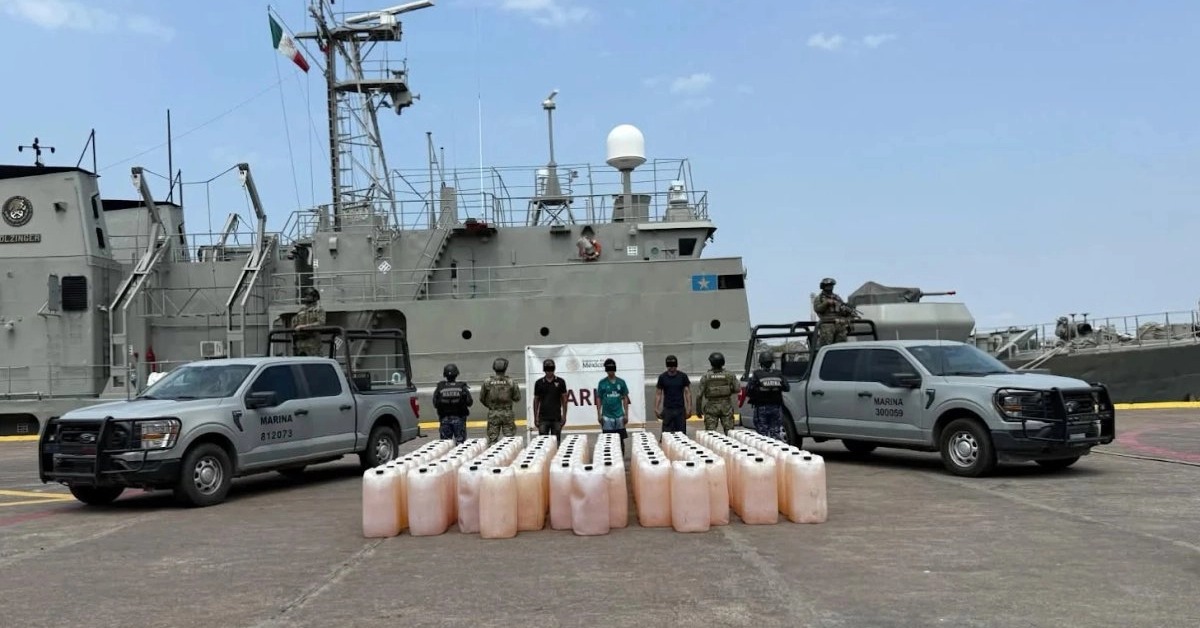
The campaign has also led to the seizure of more than 11 million liters of fuel over the past year. Authorities say the operations have focused on illegal fuel imports, false paperwork, customs fraud, and companies accused of helping move fuel into the legal market.
The case is not only about stolen gasoline. It is also about tax evasion, ports, shipping records, aduanas, shell companies, and the movement of fuel through networks that can look legitimate from the outside.
For foreign residents in Mexico, the issue matters because fuel smuggling affects public finances, energy supply, fair competition, and funding for organized crime. It is one more example of how criminal groups profit from ordinary markets, not only from drugs.
What is huachicol fiscal?
In Mexico, huachicol commonly refers to stolen fuel. For years, the term was associated mostly with pipeline theft, in which criminal groups tapped Pemex pipelines and sold stolen gasoline or diesel.
Huachicol fiscal is different. It usually refers to fuel brought into Mexico under false or misleading documents to avoid taxes and customs controls.
In this model, a shipment may be declared as an additive, lubricant, or another product with lower tax exposure. Once inside the country, the fuel can be stored, moved, and sold through companies or stations that appear to be operating legally.
That makes the crime harder to detect than a pipeline tap. It can involve import permits, invoices, customs brokers, transport firms, storage sites, and corporate paperwork. Authorities are now treating that paperwork trail as part of the criminal structure.
Why the 301 billion peso figure matters
The 301 billion peso figure should be understood as an estimated economic hit to criminal groups, not as cash recovered by the government.
It reflects the value authorities place on disrupted fuel operations, seized product, blocked shipments, and networks that can no longer move fuel through the same routes.
Federal investigations have also resulted in more than 50 arrest warrants and the dismantling of three large organizations involved in illegal fuel commerce. Authorities say at least 35 suspected contraband operations were stopped at ports including Salina Cruz, Topolobampo, Coatzacoalcos, Tuxpan, and Progreso.
Those ports matter because large fuel shipments can move far more product than street-level theft. A single vessel can carry millions of liters, resulting in significant tax losses if the cargo is misdeclared.
The port case that changed the strategy
One of the central cases involves the tanker Challenge Procyon, detected at the port of Tampico. Authorities say the vessel carried fuel that had been declared as additives, a classification that would reduce tax obligations.
That case widened into a broader investigation involving businesspeople, customs representatives, and members of the Navy. Several people now face proceedings related to hydrocarbon crimes and organized crime.
The case also pushed the federal government to adjust its strategy. Instead of focusing only on stolen fuel after it reached the market, authorities began looking more closely at ports, invoices, import documents, and the companies used to move fuel.
That shift is important. It recognizes that illegal fuel does not always enter the economy through back roads or hidden pipeline taps. Sometimes it enters through formal infrastructure, helped by false declarations and weak oversight.
Shell companies and the petrofactureros model
Recent operations have also focused on a group described as petrofactureros. The term refers to people or companies accused of using false invoices and shell businesses to give illegal fuel the appearance of legal origin.
Investigators say more than 40 companies were linked to one such network. The firms allegedly operated across sectors such as logistics, construction, and energy, while lacking the infrastructure needed to legally handle fuel.
The purpose, according to authorities, was to create a paper shield. With enough invoices, contracts, and corporate names, illegal fuel could be moved through the market while making it harder to identify the people behind the operation.
This is where fuel smuggling crosses into money laundering. The profit does not come only from selling the fuel. It also comes from avoiding taxes, hiding ownership, and turning illicit income into business revenue.
What authorities say they seized
The broader crackdown has included fuel, vehicles, storage equipment, real estate, jewelry, weapons, cash, and transport units. In one recent operation, authorities reported the seizure of more than 150,000 liters of Gas LP, dozens of tankers, and multiple storage tanks.
Another part of the investigation involved alleged commercial simulations worth billions of pesos. Authorities say those schemes helped move fuel with false or incomplete records.
The numbers show why organized crime has moved into this business. Fuel can generate a steady cash flow and be sold through markets that consumers use every day.
That does not mean every gas station is suspicious. It does mean fuel sales can provide criminal groups with a way to mix legal and illegal activity.
Why this matters beyond the crime beat
Fuel smuggling hits Mexico in several ways. It reduces tax revenue, weakens Pemex, hurts legitimate fuel distributors, and gives criminal groups another source of income.
It also creates risks for consumers and businesses. Fuel of uncertain origin may be adulterated or moved through unsafe storage and transport systems. Legal companies can also be undercut by competitors that avoid taxes and compliance costs.
For residents, the most visible effect may not always be at the pump. The stronger effect is on public revenue and security. Money lost to fuel fraud is money not available for services, infrastructure, or enforcement.
The case also shows how modern criminal groups work. They do not rely only on violence. They use accountants, import documents, transport contracts, and corporate fronts.
A test for Mexico’s institutions
The campaign now depends on whether Mexico can sustain investigations after the first round of arrests and seizures. Fuel smuggling networks are built to adapt. If one route closes, another can open.
The government’s next challenge is to prove cases in court, trace money, identify corrupt officials, and implement stronger checks at customs and ports without slowing lawful commerce.
That is a difficult balance. Mexico needs fuel imports, transport companies, and energy suppliers to function. The goal is not to treat the whole sector as suspect, but to separate legitimate trade from criminal networks.
For now, the 301 billion peso estimate gives the public a sense of scale. The crackdown has become one of Mexico’s largest security and financial investigations, and it shows how much money criminal groups can make when tax fraud, fuel markets, and corruption meet.