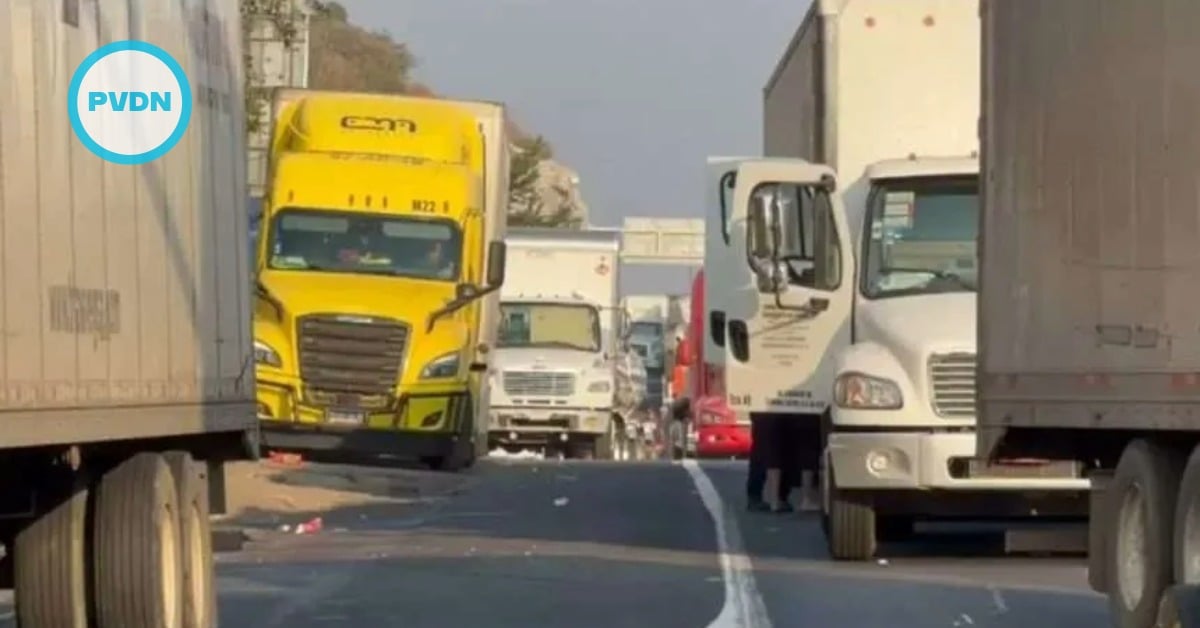
Farmers and truckers ended four days of Mexico highway blockades after the federal government agreed to revise a water law and boost road security.
For four tense days this week, long lines of trucks and private cars stretched across highways, toll plazas and border crossings in at least 25 Mexican states. Farmers parked tractors across lanes. Trailer drivers waited in their cabs while freight backed up for kilometres. Families trying to get home, and ambulances trying to reach hospitals, all hit the same wall of stalled traffic.
By Friday morning, the picture had changed. After a marathon round of talks in Mexico City, unions representing farmers and freight haulers agreed to pull back from the roads. The Interior Ministry announced that the blockades would be lifted immediately, clearing routes that had been partially or totally closed since Monday.
The agreement does not erase the anger that drove thousands of people to put their vehicles sideways across federal highways. But it does give them something they did not have on Sunday night: written commitments on water, prices and safety that the government now has to deliver on in public view.
Behind the scenes, the standoff had grown more tense by the hour. Industry chambers warned of mounting losses as export shipments sat idle at border crossings. State governments began rerouting fuel tankers and food supplies, warning of possible shortages if the protest dragged on through the weekend.
On the ground, ordinary drivers found themselves trapped in a national dispute between the countryside and the capital. In many stretches, traffic advanced only a few kilometres in several hours. Others turned back altogether after learning that almost every route out of their city was blocked. For many, the blockades turned what should have been routine trips into exhausting, expensive detours.
Mexico highway blockades
The national protest was called mainly by the Frente Nacional para el Rescate del Campo Mexicano, the Movimiento Agrícola Campesino and the Asociación Nacional de Transportistas. Together they launched what they described as a megablockade starting Monday, November 24, targeting some of the country’s most important freight corridors and several border ports of entry.
Their demands fell into three big buckets. The first was security. Cargo theft, highway robberies and extortion have become a daily risk for drivers moving goods between states. Transport leaders argued that without stronger protection on the roads, and clear rules on police checkpoints, every trip was a gamble with their lives and their cargo.
The second demand was about money. On the farm side, producers of grains such as wheat and corn pressed for clearer guaranteed prices, faster payment of overdue supports and new lines of credit after the disappearance of the national rural finance agency. Without predictable income, they said, the cost of planting a new cycle is a leap into the dark.
The third demand, and the most politically sensitive, centred on a controversial draft of a new General Water Law backed by the federal government. Rural groups feared that the proposal would weaken their rights to the water they use for irrigation and make it harder to pass concessions from one generation to the next, while large industrial users kept their current advantages.
Those three issues shaped the talks that began early Thursday at the Interior Ministry. For more than 13 hours, representatives from the main organisations sat with federal officials and technical teams from the national water commission. Close to midnight, both sides walked out saying they had a deal.
According to those at the table, the government pledged to adjust the water bill before it moves forward in Congress. The changes include keeping the possibility of inheriting and transferring water concessions together with the land, and spelling out different rules for agricultural, industrial and other uses while still giving priority to drinking water for households.
On the agricultural side, officials promised to open new credit windows for producers, speed up payments that have not yet arrived and review production costs with farmer groups in order to set price guarantees for key grains. Those talks are scheduled to continue in December.
For transport workers, one of the most concrete promises is the creation of a specialised prosecutor’s office for highway crimes. The new unit is supposed to focus on robberies, cargo theft and extortion targeting trucks and buses. The agreement also includes more cameras along federal roads, tougher control over who can install checkpoints and a review of licensing rules that drivers describe as chaotic.
By late Thursday night, truckers’ groups reported that around 90 percent of blocked roads had already been reopened, including key toll plazas in Michoacán and Jalisco. Business groups on the northern border said cargo lanes at Nogales, Sonora, were slowly recovering after days of almost total closure that left warehouses on the Arizona side working at a fraction of normal capacity and warning of multi-million dollar losses if the disruption continued.
What changes on the roads now
In many communities, relief is immediate. People who spent hours in traffic this week now have a clear route to work, school or medical appointments. Long-distance bus routes that had been cancelled or diverted are returning to their usual schedules. Emergency services that rely on those same roads can move without negotiating every few kilometres with picket lines.
For the protesters, though, the end of the Mexico highway blockades is a tactical pause rather than a clean victory lap. Several of their leaders have already said publicly that if extortion on the roads resumes or if Congress pushes ahead with a water law they consider unfair, they are ready to go back to the highways.
The government also faces pressure from groups who feel left out. Some producers from northern states travelled to the capital and say they waited for hours without being received by federal officials. They now question whether the changes promised for the water bill will protect their orchards and fields, or simply move the conflict into the legislative arena.
President Claudia Sheinbaum’s administration argues that the agreement shows that negotiation works when both sides stay at the table. From the National Palace, she and Interior Minister Rosa Icela Rodríguez have defended the idea that access to water should be treated as a right, not a privilege, and that public security on the roads is a basic condition for anyone who moves goods for a living.
What happens next will be slower and less visible than lines of trucks across a highway. The Interior Ministry and other federal agencies must now turn the broad points of the deal into concrete steps: draft language for changes to the water initiative, budget lines and rules for new farm credits, technical plans for cameras and patrols, and the legal framework for a special prosecutor’s office.
For drivers and farmers who spent this week parked for hours at roadblocks, it all comes down to whether those steps make a difference in their daily lives. Fewer assaults on the road, clearer prices for their harvest and the certainty that they will not lose access to water with the stroke of a pen will matter far more than any late-night press conference.
For now, Mexico wakes up to open highways again. The blockades that paralysed much of the country for four days are gone. The underlying fight over who is protected on those roads, and who gets to control scarce water in the years ahead, is only just beginning.