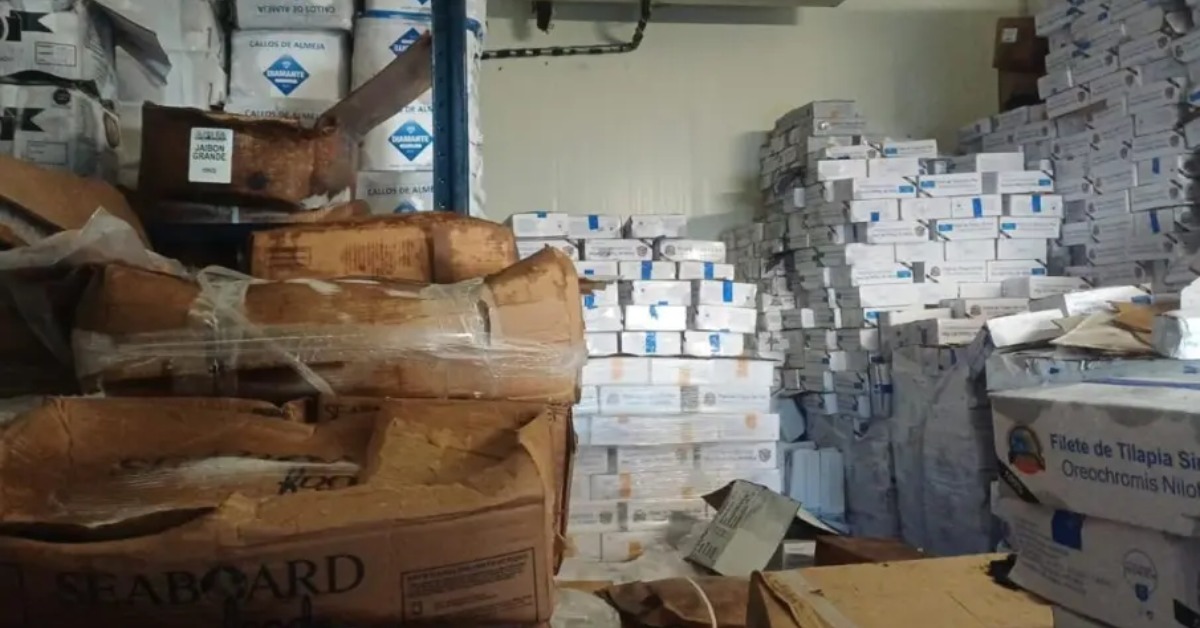
Mexican Navy personnel and federal fisheries inspectors placed 22,584 kilograms of seafood under precautionary hold after an inspection at a storage site in Villa Las Flores, Puerto Vallarta. Authorities said those responsible for the product could not prove its legal origin, and the merchandise was left under guard on the same property while administrative procedures proceed.
The action was carried out by the Navy through the Twelfth Naval Zone, working with CONAPESCA, Mexico’s national fisheries and aquaculture authority. Public reports describe the product as seafood from different species, but authorities have not publicly identified the company involved or broken down exactly what species were found in the warehouse.
That distinction matters. The public often imagines fisheries enforcement as something that happens only on the water, against boats or nets. In practice, enforcement in Mexico also reaches warehouses, trucks, markets, cold rooms, and distribution points. By the time seafood reaches a city, officials are no longer asking only where it was caught. They are also asking whether the product can still be tied to permits, landing records, transport documents, and sales paperwork.
What “legal origin” means in a Mexican seafood case
For international readers, legal origin is the center of this story. In plain terms, it means the seller or holder of seafood must be able to show records linking the product to a lawful catch, harvest, or import. Under Mexican fisheries law, that proof can include landing notices, harvest or production notices, import permits, fishing guides, and tax records linked to the relevant permit.
When that chain is broken, authorities can step in before the product continues to move through the market. That is why Friday’s case was framed as a precautionary hold rather than a final confiscation after a court ruling. The seafood was not described as cleared or released. It was held in place while officials completed inspection records and continued the legal review.
This kind of case can sound technical, but the issue is larger than paperwork. Traceability is one of the basic tools governments use to separate legal catch from seafood that may have been taken outside the rules. That can include catch from closed seasons, catch moved without the required records, or product that entered commerce without a verifiable trail. Mexico’s federal government has been working on a national seafood traceability system for that reason, presenting it as part of a broader strategy against illegal fishing.
Why this matters in Puerto Vallarta
Puerto Vallarta is a tourism city, but it is also part of a broader coastal supply chain in which seafood moves among boats, buyers, warehouses, markets, and restaurants. That makes it a logical place for inspections that focus on storage and distribution, not just on offshore fishing activity. A large hold in a warehouse can have a different meaning than a smaller seizure in a market stall. It suggests inspectors are looking higher up the chain, where the product can be consolidated before resale.
This case also did not happen in isolation. In recent weeks, the same federal enforcement pattern has appeared several times in Puerto Vallarta. Authorities reported a 250-kilo hold on March 25, another 172 kilos on March 26, about 1.43 tons on March 27, and 371 kilos on April 1. Friday’s operation is much larger than those earlier cases and stands out because it points to a storage site rather than a small retail point.
That recent pattern gives the latest action more weight. On its own, a holdover of missing documents can be read as a single compliance case. In the context of repeated inspections over the past three weeks, it looks more like a sustained enforcement push. Whether that reflects a broader local problem, a temporary inspection campaign, or both, is not yet clear from public information.
What authorities have and have not said
So far, authorities have said three things clearly. First, the product was held because its legal origin could not be proven. Second, the product remained under deposit at the same property while procedures continued. Third, the operation was part of a broader effort to combat illegal fishing and strengthen oversight of seafood commerce.
What they have not said is just as important. They have not publicly identified the warehouse operator. They have not released a list of species. They have not said whether any of the involved seafood species are under seasonal closures or special protection. They have also not announced any criminal charges tied to the case.
For readers, the responsible way to understand this story is to separate what is confirmed from what remains unknown. The confirmed fact is that federal authorities stopped more than 22 tons of seafood from moving freely because the documentation was not sufficient. The unknowns are what the product was, where it originated, and whether the case will end in sanctions, release of the goods, or a deeper investigation.
What to watch next
The next useful public update would be more specific than a weight total. Authorities would need to explain what documents were missing, what species were involved, and what the final administrative outcome was. Without that, the public knows there was a major compliance failure, but not yet the full scope of the underlying problem.
Even so, the size of the hold makes this more than a routine local brief. It points to a pressure point in Puerto Vallarta’s seafood chain and highlights a wider national issue: traceability is no longer a technical subject for regulators alone. It affects how seafood is monitored, how fisheries rules are enforced, and how confidently buyers can trust that the product moving through the market meets the law.