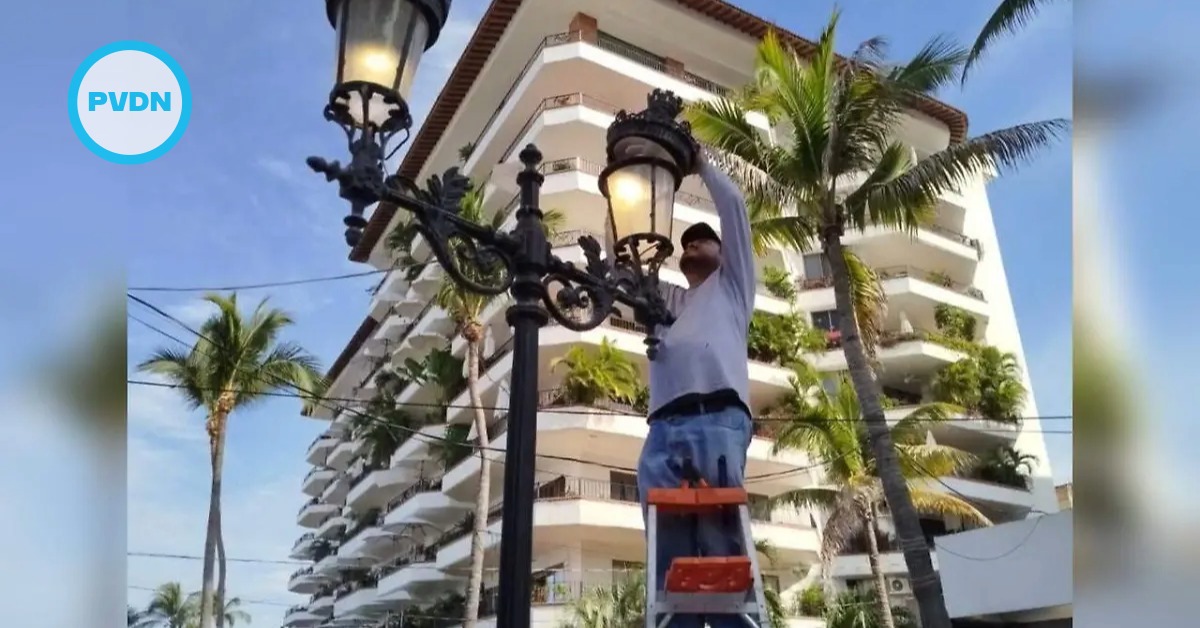
Night walks in Puerto Vallarta’s Centro can feel different when a street goes dark. The city says it’s tackling that, starting in the busiest blocks between the Río Cuale bridge and City Hall, as well as in the heart of the Zona Romántica. New LED fixtures are already going up, and crews are quietly sweeping and pruning before sunrise. The changes sound simple, but they can reshape how residents and visitors move after dusk. The question is what comes next—and how fast.
Puerto Vallarta has begun reinforcing public lighting in the downtown core. Early work is focused on the Centro and the Zona Romántica. City officials say the goal is better visibility after dark. They also want public spaces to feel more orderly for residents and tourists. The work is being led by the Gerencia de Ciudad y Centro Histórico. It sits within the administration of Mayor Luis Ernesto Munguía González. Crews are replacing some street fixtures with LED units. They are also cutting back branches that block light. Cleaning crews are being coordinated for the same areas. Officials say the upgrades support safety and the city’s image. They are starting where foot traffic stays heavy past midnight. The city says the focus is on high-traffic corridors, where pedestrians and cars mix with nightlife. For walkers, better light can change how a corner feels. For drivers, it can make pedestrians and curb edges easier to spot.
Why these neighborhoods first
Centro and the Zona Romántica are two of Vallarta’s most-walked neighborhoods. They function as a shared living room for the city. Locals come for errands, jobs, and government offices. Visitors come for the Malecón, restaurants, and nightlife. Many expats pass through daily as well. Some live nearby, while others come for services or friends. That mix raises the stakes of basic infrastructure. When lighting is uneven, simple things get harder. Street names disappear, curb edges blur, and potholes catch you. People change their habits fast. They cut a walk short or stick to one bright corridor. Side streets get skipped, even if they are perfectly safe. Businesses feel it when foot traffic thins out. Residents feel it when loitering clusters in the few lit spots. It also affects how secure people feel. So a lighting refresh is not just cosmetic. It is a quality-of-life issue that shapes how the city moves at night.
LED upgrades in the Zona Romántica
In the Zona Romántica, crews have started swapping older fixtures for LED units. City officials say 15 new 40-watt luminaires were installed in the first round. The aim is to provide steadier light on busy walking routes. The work is being coordinated with the neighborhood association in Colonia Emiliano Zapata. That matters in a dense area where outages get noticed quickly. The Dirección de Servicios Eficientes is also involved in the rollout. That suggests the changes will be folded into routine maintenance. LEDs tend to use less energy and last longer. But residents care most about the immediate effect. Better light means fewer dark patches between businesses. It also makes it easier to find building entrances at night. It can help drivers spot pedestrians at crossings. Crews are pairing the new fixtures with pruning. Overgrown branches can swallow light and cast heavy shadows. Officials say the combination should improve visibility without changing the character of the streets.
From Río Cuale to City Hall
Downtown work has also targeted a key corridor near the river. Officials say crews did a deep clean with a mechanical sweeper. The route runs from the Puente del Río Cuale. It continues along Insurgentes and Libertad. It ends on Calle Juárez near the Presidencia Municipal. That stretch is a daily shortcut for locals and visitors. It also carries steady deliveries and tour traffic. Litter and leaves build up fast there, especially after busy nights. The city says permanent cleaning crews are now assigned to the area. Much of the work is scheduled for the early morning hours. The idea is to avoid blocking narrow streets during peak business times. Daytime maintenance can snarl traffic and frustrate shoppers. Work before sunrise is quieter and easier to manage. By evening, the difference is more visible. Sidewalks are clearer, corners are less slippery, and crosswalks feel easier to read. Paired with better lighting, it can make movement feel smoother.
What to watch next
For residents, the real test will be consistency over the next few months. A new lamp helps only if it stays working. Burned-out bulbs, vandalism, and storm damage can erase gains fast. That risk rises during the rainy season, when water and wind hit the wiring. Officials have stressed the idea of permanent operations. The hope is to avoid quick fixes followed by long gaps. If the program holds, downtown could feel calmer after dusk. Fewer dim pockets can reduce anxiety on side streets. Clearer light also helps drivers and cyclists judge distance. It makes it easier to spot uneven pavement and curb cuts. For expats who walk home from dinner or language classes, that matters. Visitors benefit too, especially those navigating on foot for the first time. The city has framed this as ongoing maintenance, not a finished project. Residents will be watching for the next round of streets. They will also notice if the lights stay on once the news cycle moves on.
With information from El Occidental (OEM), Meridiano Vallarta, AZNoticias, Vallarta Uno