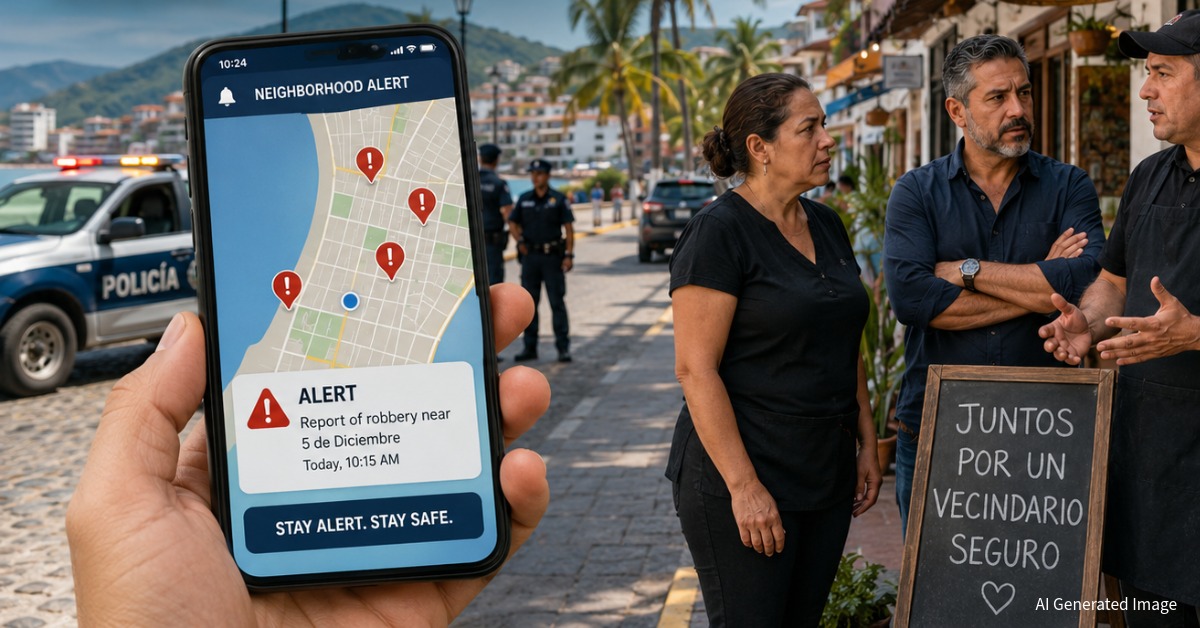
Puerto Vallarta, Jalisco, June 19, 2026 – Puerto Vallarta business leaders are pressing authorities to reinstate Alerta Vecino, a neighborhood alert system designed to connect businesses, residents, and police more quickly when robberies, assaults, or extortion attempts are reported.
Coparmex Puerto Vallarta president Francisco Vizcaíno said the proposal has been on the table since March and was brought back to the discussion after the new regional security council was formalized this week.
Vizcaíno described it as “a proposal we made in March,” tying the request to the security talks that followed the February crisis in Puerto Vallarta. The business group says local commerce is dealing not only with theft, but also extortion calls, bank fraud, impersonation of public officials, and robberies at businesses.
The request comes at a sensitive moment for the city. Authorities are reporting lower crime numbers in recent months, while business owners and neighborhood groups are describing a heightened sense of risk on the streets.
A safety tool built around speed
Alerta Vecino is not a replacement for the police. Its value is speed.
The idea is simple: businesses and neighbors in the same area share verified alerts, warn nearby shops, and get information to authorities before a report is lost in social media noise. In practice, that only works if the system has clear rules, trusted participants, and a police response that businesses can see.
A neighborhood alert system can help a plaza, commercial corridor, or block respond more quickly to a robbery pattern. It can also become just another WhatsApp group if no one verifies reports, no one files complaints, and no authority follows up.
Puerto Vallarta does not lack chat groups. It lacks consistent bridges between people who see problems first and agencies that can act on them.
The new security council changes the setting
The push comes as the Consejo Consultivo de Seguridad de Puerto Vallarta y la Región begins work as a formal space for municipal, state, federal, business, academic, and civil society participation. The council was created to improve coordination, prevention, and response to risks that affect the city and the surrounding region.
State security officials have said more than 24 million pesos will be directed this year to strengthen security and equipment for regional law enforcement agencies. The council also approved expanding its regional scope to include Cabo Corrientes, San Sebastián del Oeste, and Bahía de Banderas, with periodic meetings to track agreements.
Puerto Vallarta’s daily economy does not stop at the city line. Workers, deliveries, customers, and visitors move between Puerto Vallarta and Bahía de Banderas every day. So do many security concerns.
The business sector’s argument is that prevention needs the same regional view. A robbery pattern in one commercial area can quickly affect nearby plazas, bus routes, delivery drivers, and late-night workers.
Official numbers and street experience are diverging
Crime statistics and public experience often move at different speeds.
INEGI’s latest urban security survey showed Puerto Vallarta’s perception of insecurity rose from 32.0 percent in December 2025 to 59.9 percent in March 2026. That was one of the largest statistically significant increases among the surveyed urban areas.
That figure measures perception, not confirmed criminal complaints. But perception matters in a tourism city with a large service economy. It affects how employees get home, how late shops stay open, how visitors move around at night, and whether residents feel comfortable using public spaces.
State officials may be correct that some crime indicators have declined. Business owners may also be correct that robberies, assaults, or extortion attempts feel more present in their daily routines. Those two realities can coexist, especially when many incidents are never formally reported.
Reporting is still the weak link
A revived alert system will only help if it improves reporting.
For emergencies in progress, call 911. For anonymous information that does not require immediate dispatch, the national anonymous reporting line remains 089. Federal guidance distinguishes emergency calls from anonymous tips, which are meant for information that may require investigation but is not necessarily happening at that moment.
For businesses, that means alerts should not stop at warning the next shop. Owners and employees need a basic incident record: time, location, description, direction of travel, vehicle details if safe to observe, and whether anyone was injured. That information is what turns a neighborhood warning into something police can use.
It also protects the public conversation. A vague post about “armed men in the area” may scare hundreds of people without helping authorities find anyone. A clear report, routed through the right channel, has a better chance of producing a response.
Readers can follow current local updates on the Puerto Vallarta Live Map, and PVDN has also covered the broader business-sector push for a stronger Puerto Vallarta security plan. For broader context, see our guide on how to read Puerto Vallarta security news without panic.
The first measure will be trust
Business owners will want to know who manages the alerts, which neighborhoods or commercial zones are included, how reports are verified, how quickly police receive them, and whether there will be follow-up after an incident. Residents will want to know that the system will not expose personal data or become a rumor channel.
Puerto Vallarta has lived with enough public-safety noise this year. A working alert network would need to do the opposite: reduce confusion, shorten response times, and give businesses a reliable way to report what they are already seeing.