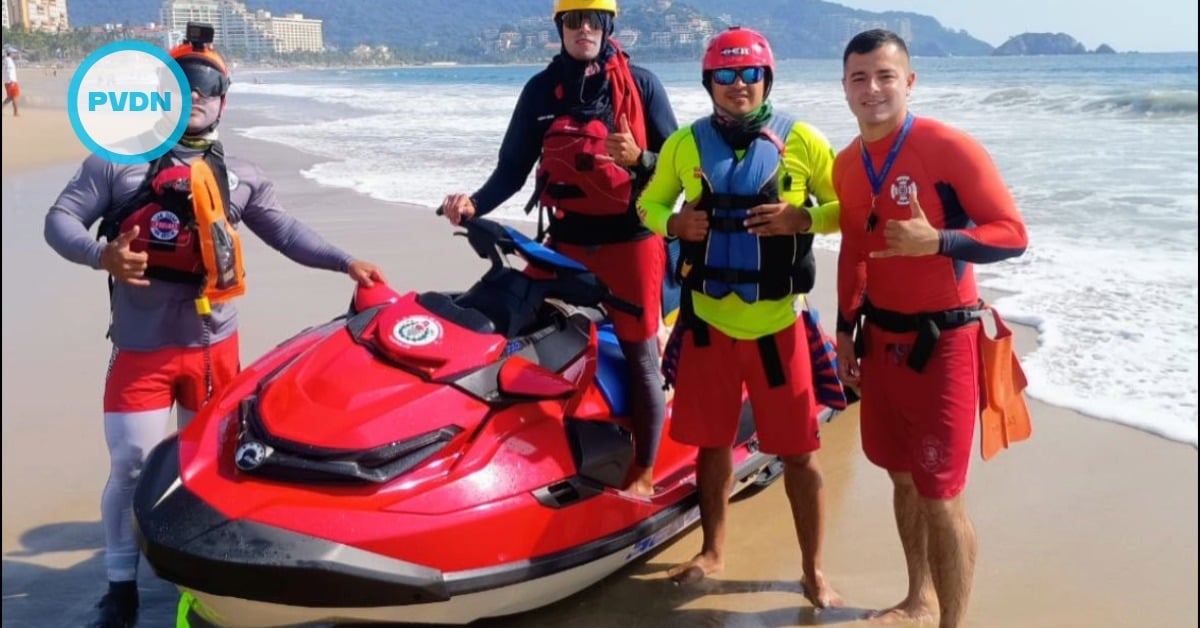
Puerto Vallarta has taken another concrete step to strengthen safety in its waters. Five members of the city’s Civil Protection and Fire Department joined the First National Certification of Lifeguards and Aquatic Safety, held from November 10 to 14 in Ixtapa Zihuatanejo, Guerrero.
The certification brought together lifeguards, instructors, and rescue specialists from across Mexico. The course was organized by the local Lifeguard Association based on Playa El Palmar in Ixtapa and endorsed by the Mexican federation responsible for aquatic rescue standards. The aim was precise: update techniques, unify protocols, and ensure that, when something goes wrong in the water, responders across the country speak the same technical language.
Puerto Vallarta sent a mixed team of instructors and frontline lifeguards. The head of the city’s Aquatic Rescue Area, Salvador Castillón González, and the first commander, Mario Alberto Ramírez Ramírez, joined the teaching staff as assistant instructors, helping to run both classroom sessions and practical work in the surf. Three operational lifeguards from the department attended as participants, putting their skills to the test in the pool, on the sand, and in open ocean conditions.
According to the department, the week ended with three of these lifeguards obtaining a National Ocean Lifeguard certification, a credential that recognizes they meet updated national standards for prevention, rescue, and immediate care in aquatic emergencies. For a city that depends heavily on its beaches, having that level of formal certification within the municipal corps is more than a line on a résumé; it is a reassurance for the people who enter the water every day.
Puerto Vallarta lifeguards
On the beaches of Puerto Vallarta, these lifeguards are often the only line between a close call and a tragedy. The Civil Protection and Fire Department already runs regular refresher courses before major holiday periods, focusing on water rescue, the use of rescue boards and buoys, first aid, and cardiopulmonary resuscitation. Local training often includes drills on city beaches that simulate unconscious victims, rip current rescues, and coordinated responses with ambulance crews.
The new national certification layers a standardized curriculum on top of that local experience. Over several days in Ixtapa, participants reviewed risk assessment on crowded beaches, safe approaches to distressed swimmers in heavy surf, and techniques for managing multiple victims. They also worked on unified communication protocols so that lifeguards from different states can communicate quickly when deployed together, for example, during major holiday operations or large events on the coast.
For Puerto Vallarta’s team, there was also a teaching role. By joining the group of instructors, Castillón González and Ramírez Ramírez were able to share lessons learned from years of operations on Jalisco’s Pacific coast, including work during high tourism seasons and storm-related emergencies. That experience helps keep the course grounded in real-life scenarios rather than theory alone.
Inside the department, officials highlighted the political support that made the trip possible. The lifeguards publicly thanked Mayor Luis Munguía for backing the training effort and the department’s director, engineer Misael López Muro, for helping secure the logistics and approvals needed to send personnel out of state. In a context of tight municipal budgets, paying for travel, lodging, and course fees is a choice, and in this case, the choice favored professional development.
Globally, drowning remains one of the leading causes of accidental death. International health agencies estimate that around 236,000 people die from drowning every year, with a large share of those deaths occurring in low- and middle-income countries. In many coastal communities, the victims are children, young people, and workers who are simply going about their daily lives near rivers, lakes, or the sea. Against that backdrop, structured training and standardized rescue protocols are seen as basic tools, not luxuries.
National push for safer beaches
Mexico has been moving in that direction by strengthening its national structures for aquatic safety. The federation that endorsed the Ixtapa certification is part of the country’s wider system for underwater and aquatic activities, which is recognized by international lifesaving organizations. In recent years, it has promoted national-level guardavidas courses, instructor training, and technical committees that aim for one simple objective: fewer deaths and serious injuries in the water.
Hosting the First National Certification of Lifeguards and Aquatic Safety in Ixtapa Zihuatanejo fits into that broader agenda. Playa El Palmar is one of the Pacific coast’s most active hotel zones, with constant water sports and heavy beach use. Training there exposes lifeguards to the same kind of conditions they face on other busy beaches in Mexico, from strong waves and changing currents to the challenge of maintaining vigilance while thousands of people move through the surf zone.
Puerto Vallarta’s participation also reflects how local departments are expected to operate in this new landscape. Municipal lifeguards are no longer seen only as strong swimmers watching a single stretch of sand. They are part of coordinated systems that include state and federal civil protection agencies, tourism authorities, and health services. When those systems work well, they share data on incidents, adjust patrol patterns, and design awareness campaigns for visitors.
For residents and tourists in Puerto Vallarta, the immediate change may be subtle. The same red and yellow uniforms will appear on the same towers, and the same whistles will cut through the sound of the waves. The difference is that more people wearing those uniforms now hold a national ocean lifeguard certification backed by a recognized federation and have just spent a week drilling side by side with colleagues from across Mexico.
City officials say they intend to keep sending personnel to similar courses and to continue local training cycles on Vallarta’s own beaches. If that commitment holds, every new certification will add another layer of preparation behind the simple, reassuring sight of a lifeguard scanning the water.