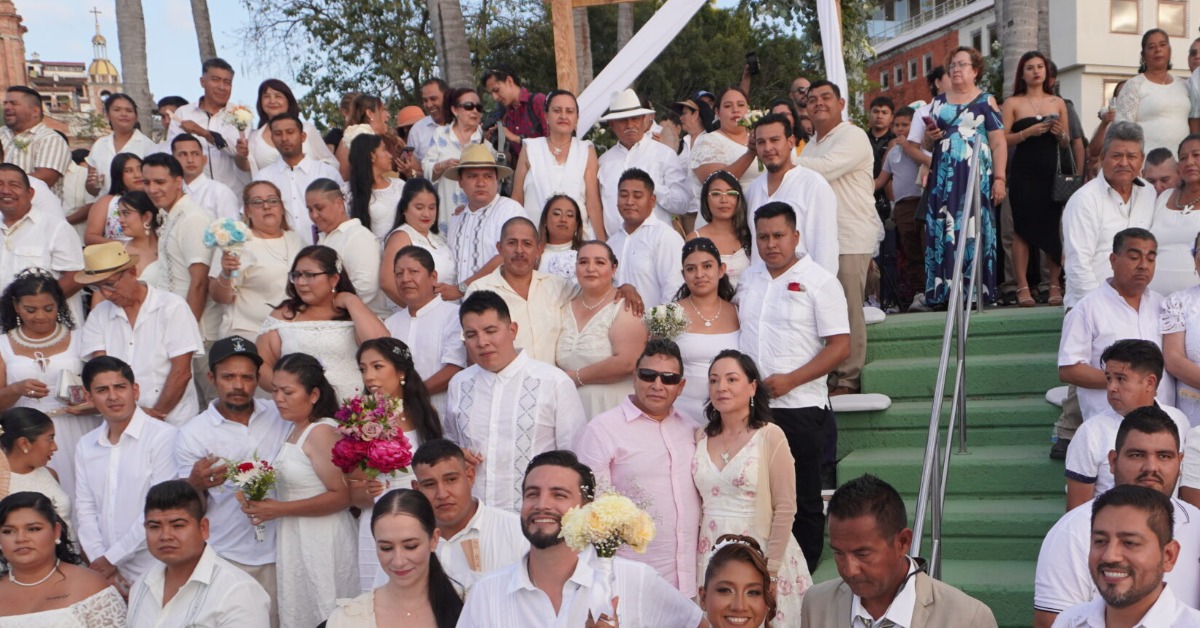
More than 300 couples said yes at Los Arcos del Malecón, turning one of Puerto Vallarta’s most recognizable landmarks into a public civil registry for the day. On the surface, it was a scenic local celebration. Underneath, it was a reminder of how Mexico’s collective wedding campaigns work, why civil marriage matters more than ceremony, and why this kind of event carries legal significance far beyond the photos.
More than 300 couples marry in Puerto Vallarta civic ceremony
More than 300 couples formalized their unions during Matrimonios Colectivos 2026 in Puerto Vallarta, in a ceremony held at Los Arcos del Malecón. The event gave one of the city’s most visible public spaces a different role for the evening. It became a place where the state recorded marriages in public view, surrounded by relatives, music, and celebration.
That scale is what made the ceremony stand out. Puerto Vallarta is used to beach weddings, private events, and staged tourism images. This was different. It was a civil marriage campaign, organized to move couples from an informal union into a legally recognized marriage through the Registro Civil.
Why a mass wedding is more than a feel-good story
At first glance, events like this can look like soft news. They are easy to photograph and easy to frame as a human-interest story. But collective civil weddings in Mexico usually serve a practical purpose. They are designed to reduce cost and paperwork barriers for couples who want legal recognition but have delayed the process.
That is why public officials and local reporting often describe these campaigns in terms like legal certainty and family protection. The wording may sound formal, but the impact is concrete. A civil marriage certificate can affect property arrangements, inheritance, family records, and other legal matters that become important later.
In Puerto Vallarta, the ceremony also carried a civic message. The city did not hide the legal process behind office doors. It placed it at one of the best-known points on the waterfront. That gave the event a public character and made formalizing a union feel visible, collective, and accessible.
Why the civil marriage matters most
For many international readers, especially in a tourist city, the most important distinction is simple. In Mexico, civil marriage is the legal marriage. A religious ceremony may matter deeply to the couple, but it is the civil act that carries legal force.
That helps explain why events like this exist. They combine bureaucracy with celebration. Couples do not just pose for photographs. They leave with a legal change in status. In that sense, the setting may have been scenic, but the substance was administrative and binding.
This is also why the story matters beyond Puerto Vallarta. Mass civil wedding campaigns are common in different parts of Mexico. They are often promoted by municipal governments and civil registry offices as a way for long-term couples to regularize their status without the usual financial or procedural friction.
A local event with broader legal meaning
The Puerto Vallarta campaign had been promoted for weeks before the ceremony. Local coverage ahead of the event described it as free, tied it to the city’s Registro Civil, and presented it as a chance for couples to formalize long-standing unions. That context matters because the ceremony did not begin and end at the Malecón. It was the public conclusion of an administrative process that had been building for months.
The event also reflects how local governments in Mexico use symbolic public spaces for civic action. In a city where the Malecón is tied to tourism and public identity, holding the ceremony at Los Arcos made the marriage a visible act of citizenship as much as a private milestone.
Local reports also highlighted the diversity of couples who took part. That included couples of different ages and at least one same-sex marriage that drew attention in local coverage. The broader point was not novelty. It was inclusion. The campaign was presented as a legal service open to couples seeking formal recognition under civil law.
What expats and foreign residents should take from the story
For expats and foreign residents, this story is useful because it clarifies how marriage works in Mexico. A destination wedding, symbolic vows, or a religious service may be meaningful, but they are not the same as a civil marriage. The legal step happens through the local civil registry, and that process can vary by state and municipality.
Foreign nationals may face additional paperwork. Requirements often involve identity documents, birth records, and, in some cases, authenticated or translated foreign documents. The details depend on where the marriage is registered. But the core point stays the same: in Mexico, it is the civil registry that creates the legal marriage.
That makes Puerto Vallarta’s ceremony more than a postcard moment. It shows how the city used a public event to make the legal process easier to access and understand. For local couples, that can mean fewer barriers to formal recognition. For international readers, it offers a clear example of how Mexican family law and local civic culture intersect.
The bigger takeaway
The most important part of this story is not only that more than 300 couples got married in a single ceremony. It is that Puerto Vallarta used a public campaign to close a practical legal gap for hundreds of families at once. The celebration gave the event visibility. The civil marriage certificates gave it lasting value.
In a place known for romance and scenery, that distinction matters. The beauty of the setting drew attention, but the real story was what happened on paper. More than 300 unions were not just celebrated. They were legally formalized.