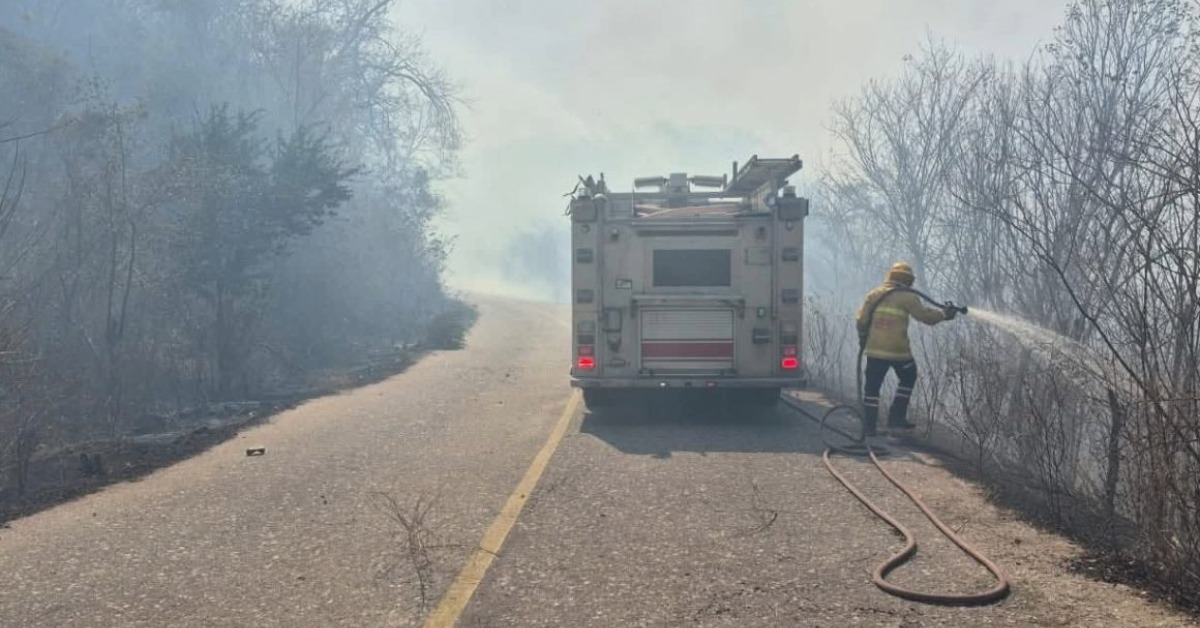
The fire is not in Puerto Vallarta itself, but it is close enough to matter. As flames tore through Llano Grande de Ipala, officials issued smoke warnings, sent more crews into rugged terrain, and cautioned that the burned-area estimate could still change. For readers along Jalisco’s coast, this is more than a rural fire story. It is a test of how the region handles air quality, emergency response, and the first hard stretch of dry season.
The fire is still active
A wildfire in Llano Grande de Ipala, in the municipality of Cabo Corrientes, was still burning on Wednesday, March 18. Authorities said it had consumed more than 2,000 hectares. One widely cited estimate put the affected area at 2,070 hectares. State officials also said the final figure will need a technical review after the emergency phase ends. That matters because a fire perimeter and a confirmed burn scar are not always the same thing. Some land inside the wider polygon may show less damage than first reports suggest.
The fire is part of the El Mirador / Llano Grande de Ipala complex. That complex has been burning since the weekend in the coastal mountains south of Puerto Vallarta. Earlier in the response, authorities reported about 117 forest firefighters and support personnel. They also deployed specialized vehicles from two fronts. The Witari helicopter was added for water drops and aerial monitoring. By midday Wednesday, state officials said the wider operation had improved. Three of four fires in the regional complex were under control. One active flank was still being worked.
Why this matters beyond a remote burn area
For many international readers, Cabo Corrientes may sound far removed from daily life in Puerto Vallarta. In practice, it is part of the same broader coastal region. Smoke, road concerns, emergency deployments, and the public image of the area can all spill past municipal lines. That is one reason this fire has drawn attention well beyond the immediate burn zone.
Authorities issued an atmospheric alert for Cabo Corrientes and Tomatlán because of smoke from the fires. The formal alert did not name Puerto Vallarta itself. Residents in affected communities were urged to reduce outdoor activity. They were also told to keep doors and windows closed. The alert covered areas including Llano Grande de Ipala, Mayto, Villa del Mar, La Cruz de Loreto, Gargantillo, Tequesquite, and La Gloria. No injuries had been publicly reported as of Wednesday. Even so, the fire had already become a public health concern due to air quality and prolonged exposure to smoke.
Atmospheric alert has been activated in Cabo Corrientes and Tomatlán due to wildfires
What is known and what is still uncertain
The clearest confirmed fact is that the fire response is still underway. The harder task is separating what is confirmed from what is still preliminary. Burned-area estimates often fluctuate as crews gain access, map the perimeter, and assess severity. That is why the more than 2,000-hectare figure should be read as a working estimate. It is important, but it is not yet the final technical total.
There is also a difference between control and liquidation. A fire can be partly controlled while remaining active in hot spots or along one open flank. That appears to be the situation in Cabo Corrientes. Officials have described progress, but they have not declared the main incident fully liquidated. Until that happens, weather, terrain, and dry fuels can still change the pace of the response.
Why fires like this grow quickly in March
This fire has spread under the same conditions that make much of western Mexico vulnerable every spring. Dry vegetation, heat, wind, and steep terrain can turn a local ignition into a large event quickly. Cabo Corrientes adds another challenge: access. In rugged areas, crews often need more time just to reach the hottest sections. Aircraft become especially important when ground brigades cannot move quickly enough.
That is also why the numbers tied to a fire can shift from one day to the next. More brigades may arrive. Air support may be added. New flanks may open, while others are contained. Even the estimate of burned land can change after the first emergency reports. For readers in Puerto Vallarta and the wider Bahía de Banderas region, the bigger takeaway is clear. The dry season fire risk is no longer theoretical. It is already shaping air quality, emergency planning, and business concerns on the coast.
What readers should watch next
The next meaningful update will not just be a larger hectare count. It will be the moment authorities say the fire is fully extinguished and the atmospheric alert can be lifted. After that, the more important numbers will be the technical damage assessment and the burn severity. Officials will also need to show whether community land, habitat, or productive forest was hit harder than first thought.
There is also a wider regional question behind this story. Business groups in Puerto Vallarta have already asked for stronger aerial support. They see the fires as an environmental problem with economic effects. That response reflects a practical reality for this coast. A major wildfire in Cabo Corrientes does not stay only a Cabo Corrientes story. It becomes a regional test of response capacity at the start of the dry season.