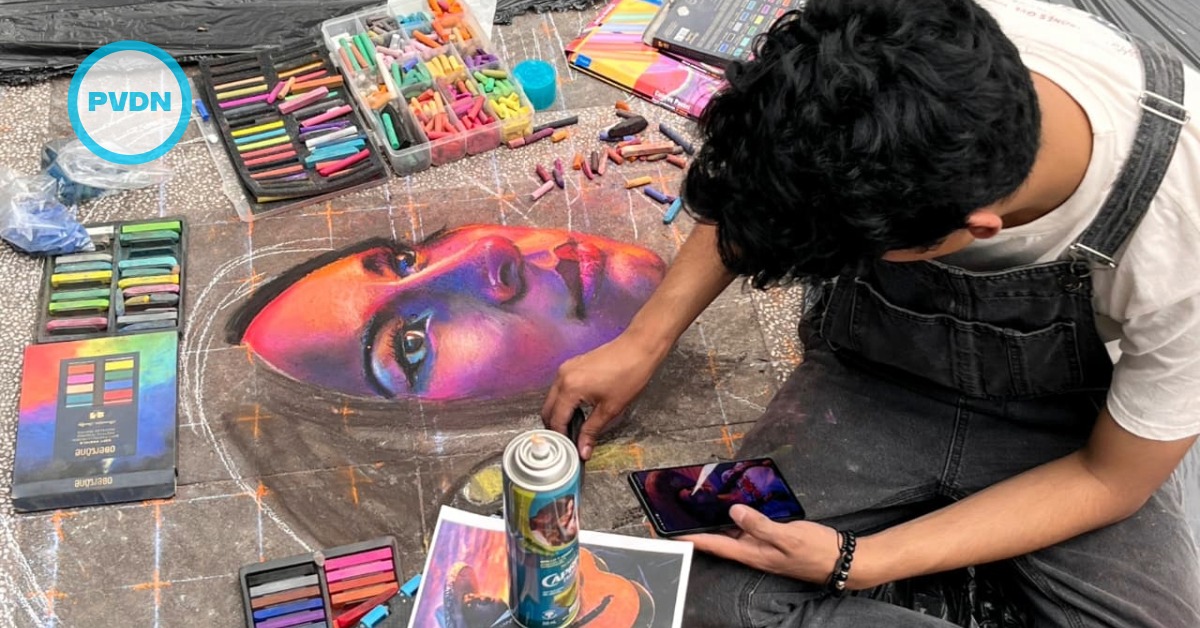
On any other weekend, Plaza de Armas is where you pass through on your way to the Malecón. This weekend, it’s where the city slows down and looks at the ground. From early morning, artists kneel on the pavement, layering pastel chalk into images that exist only as long as the weather allows. What starts as blank concrete becomes a shared gallery—part competition, part community ritual—linking Puerto Vallarta to its sister city across the border.
A plaza becomes a canvas
Puerto Vallarta’s downtown heart has been re-drawn, quite literally, for the XVIII Madonnari Festival 2026. The Plaza de Armas, normally a crossroads of errands and evening strolls, is now an open-air studio where more than 150 artists—children, teens, and adults—are turning concrete into brightly detailed street paintings using soft pastel chalk.
The festival’s appeal is immediate, even if you don’t consider yourself an “art person.” You can watch the entire arc of creation in real time: faint outlines sketched at sunrise, shadows built slowly through the afternoon, and final highlights added with careful hands while curious passersby hover at the edges. By the time the plaza is fully in motion, the atmosphere feels less like an art show and more like a living neighborhood tradition—one that happens to be spectacularly photogenic.
Municipal officials have framed the weekend as more than a cultural attraction. In opening remarks, city leadership emphasized that the festival supports cultural tourism and provides local talent with a high-visibility platform in one of Puerto Vallarta’s most emblematic public spaces.
How the festival works
Madonnari runs across three days, from Friday, February 13, through Sunday, February 15, with artists working long daylight hours. Organizers have described a full-day rhythm on Friday and Saturday, followed by a shorter Sunday schedule that leads into the awards ceremony, planned for early evening at City Hall.
The competition spans multiple age groups, which is part of what gives the plaza its energy. You’ll see young kids focused on filling in a sky or smoothing a gradient, while nearby older artists work on ambitious, large-scale compositions designed to stop pedestrians in their tracks. The judging, meanwhile, ties Puerto Vallarta’s event to a larger tradition of street painting: works are evaluated with support from artists connected to Santa Barbara, California.
That sister-city relationship shows up in a concrete way. In the adult category, the top prize includes the chance to travel to Santa Barbara to participate in the well-known I Madonnari festival held there in late May, turning a weekend on the plaza into a cross-border cultural exchange.
Even with its Italian roots, the local festival keeps its focus firmly on community and shared space. The theme is open, but organizers have made clear that artworks must remain apolitical and non-religious—an approach that helps the plaza stay welcoming for everyone who wanders through.
A tradition imported, now deeply local
The word “Madonnari” points back to an old European practice of creating ephemeral images on streets and plazas, often as traveling artists. In Puerto Vallarta, that tradition has evolved into something distinctly local: a family-friendly weekend where art is made in public, for the public, and where the process is as important as the finished image.
This year’s edition is also a reminder of how much the festival depends on civic glue—volunteers, educators, sponsors, and organizers who keep the event running year after year. Leaders from the organizing committee and the Puerto Vallarta–Santa Bárbara sister-cities group have highlighted that behind every finished square of chalk is a small network of people making sure artists have space, structure, and support.
For expats living in Mexico, you don’t need a ticket, a special invitation, or even a plan. You can drift through for ten minutes on your way to coffee, then come back later and see how a sketch has transformed into a finished piece. And because the artwork is temporary by nature, there’s an added urgency—if you want to see it, you have to show up while it’s still there.