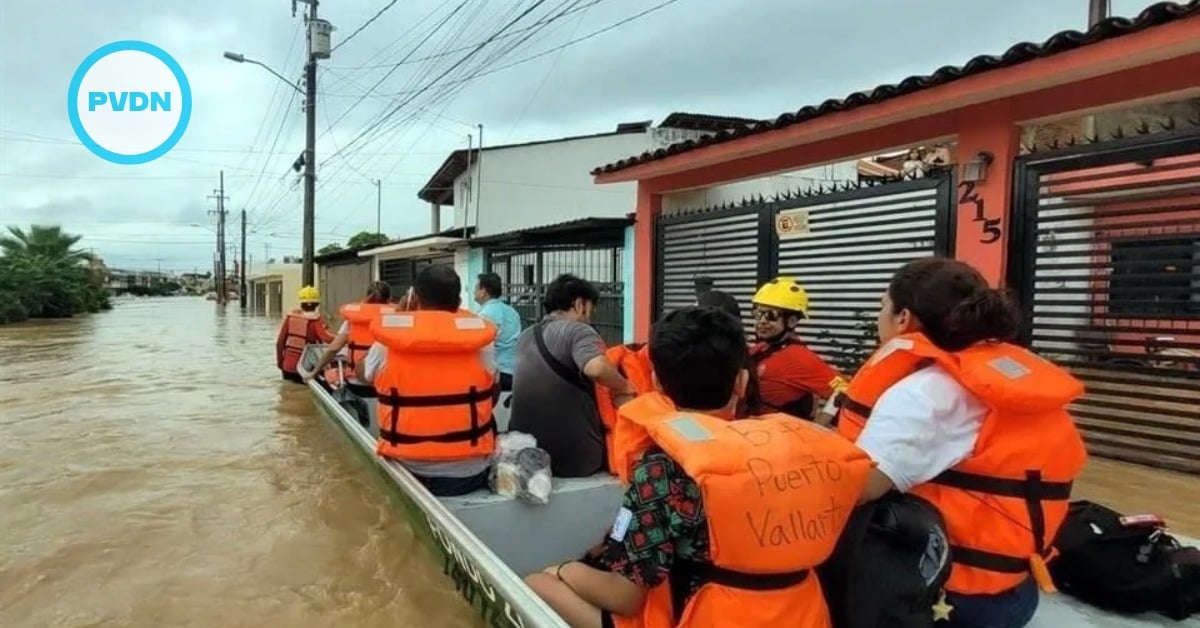
Before dawn on Sunday, October 12, heavy bands from Raymond’s remnants turned city streets into rivers. Puerto Vallarta flooding climbed to door handles in some blocks, pushing mud into living rooms and small shops. State officials later raised the damage count to hundreds of homes and dozens of businesses while opening shelters and moving families out by boat. A state Blackhawk helicopter joined rescue efforts as crews fanned out to check neighborhoods still cut off by high water. The clean-up starts now, but so do the questions.
Puerto Vallarta flooding
Heavy overnight rain tied to the remnants of Tropical Storm Raymond drenched the Jalisco coast early Sunday, October 12, sending water up to a meter high through parts of Puerto Vallarta and leaving a man dead after his vehicle was swept away, according to state civil protection.
By evening, officials had updated the toll to 703 homes, 85 businesses, and two schools affected by water and mud—numbers that climbed as door-to-door assessments continued. In some blocks, the surge reached window level before receding.
Multiple drainage canals overflowed during the most intense bursts, including Virgen, Contentillo, Rastro, Poetas, Villas Universidad, and Mojoneras, spilling into neighborhoods such as Ixtapa, Cañadas, Mojoneras, Bobadilla, La Floresta, Portales, and Parque Las Palmas. Reporters on the ground and state posts documented high-water lines and living rooms blanketed in silt.
City crews worked through the night, later reinforced by state teams and federal support as evacuations got underway. Authorities opened temporary shelters at Vida Nueva in La Lija and at the Casa Ejidal in Ixtapa, with the DIF municipal network also readied to receive families. Collection points across the city began taking food, hygiene items, and other essentials.
Governor Pablo Lemus said he deployed a Blackhawk helicopter to Puerto Vallarta to strengthen rescue operations, a move acknowledged on state channels as crews shuttled between cut-off areas and staging grounds.
What residents are seeing, and what comes next
As runoff pushed through canal networks and low-lying streets, civil protection warned drivers to avoid flooded avenues and asked people to stay home until crews cleared debris. In some pockets, neighbors reported the water rising fast enough to trap vehicles; others described slower, relentless seepage that left thick mud behind. Local outlets also flagged a crocodile alert—a familiar post-flood caution in areas near the Ameca River—after sightings in standing water.
The death reported Sunday underscored how quickly conditions changed. State officials said the victim’s vehicle was dragged off a roadway by a sudden current. Earlier counts in the morning listed “more than 300 homes” impacted; by late day, after crews reached additional colonias, damage totals more than doubled. That shift reflects the usual pattern after significant overnight events: early snapshots give way to fuller sweeps as responders move beyond primary routes.
Mayor Luis Ernesto Munguía toured inundated blocks, saying the city would cover immediate basics for families who lost beds and other essentials. By afternoon, his team was distributing mattresses and bed frames and setting up a community dining station to keep meals flowing while clean-up progressed.
Regionally, the weekend brought a volatile mix offshore. While Priscilla churned in the Pacific and weakened as it lifted away, Raymond’s moisture fed long rainbands along the coast—enough to push Vallarta’s canals past capacity even without a direct landfall, that atmospheric set-up matches forecasts calling for intermittent heavy pulses along Jalisco and Nayarit, which explains why streets dried quickly in some zones but stayed dangerous in others.
Officials say damage assessments will continue through the week, with a priority on restoring classrooms and small businesses hit by the mud line. For households, the advice is simple and maddeningly familiar: document losses, disinfect floors and walls, and watch for wildlife displaced by the floods. For now, the city’s focus is on keeping people safe and getting them back to dry beds tonight.