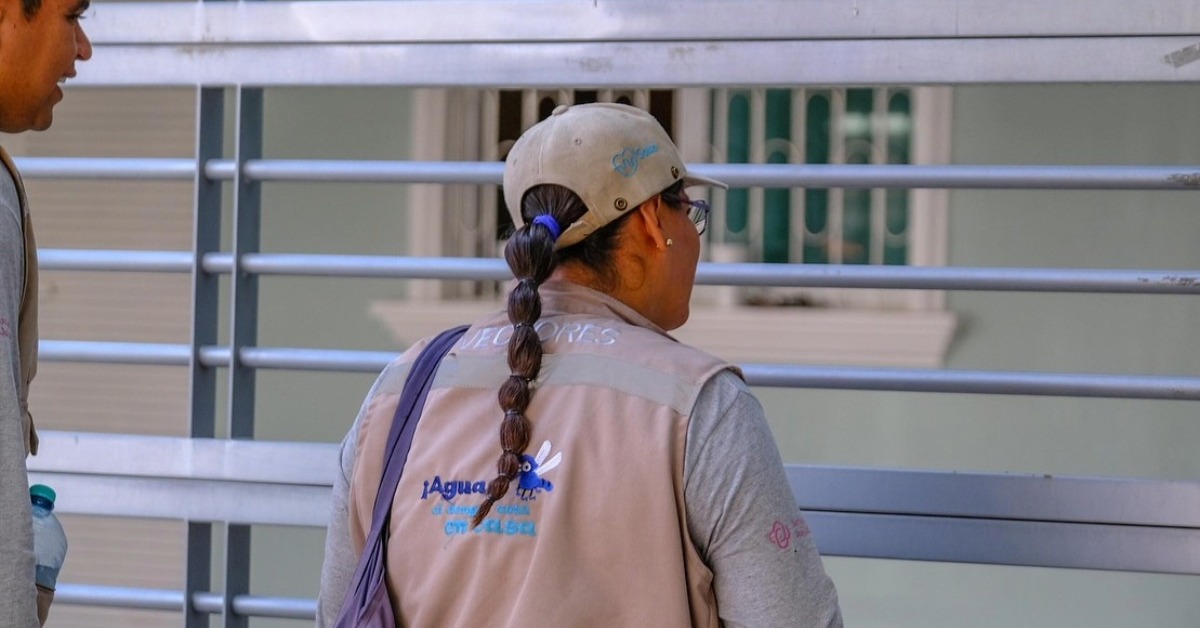
Health authorities in Puerto Vallarta trained neighborhood coordinators this week as part of a local effort to reduce dengue risk before conditions become more favorable for mosquito activity. The session brought together community representatives from across the city at the Unidad Municipal Administrativa, where they received guidance on identifying and removing mosquito breeding sites and reinforcing prevention messages with residents.
According to regional health officials, the training is part of joint work involving the VIII Región Sanitaria, the Secretaría de Salud Jalisco, and the state health services system. The idea is straightforward. Coordinators already have direct contact with residents in their own colonias. That makes them useful messengers when authorities need fast, repeated action at the neighborhood level. In dengue control, that local link matters because the places where mosquitoes breed are often found in private homes, small shared spaces, and overlooked corners that public crews cannot monitor every day.
Why this kind of training matters
The move reflects an important reality about dengue prevention. Health agencies can spray, inspect, and issue warnings, but they cannot eliminate every container that holds water in a city the size of Puerto Vallarta. The mosquito most associated with dengue, Aedes aegypti, is closely tied to urban life. It often breeds in ordinary objects such as buckets, flower pots, tires, rooftop drains, pet dishes, and uncovered water storage containers.
That is why officials are focusing on eliminating breeding sites instead of waiting for more infections to appear. Earlier this month, the head of the VIII Región Sanitaria said Puerto Vallarta had only two confirmed dengue cases through epidemiological week 12 in 2026. He said that was well below the level seen at the same stage in 2024, when the city had already registered roughly 30 to 40 cases. The low count does not remove the risk, but it does suggest authorities want to keep the number low by acting before the wetter and warmer part of the year gains momentum.
A coastal city has reasons to stay ahead
Puerto Vallarta’s climate helps explain the urgency. Dengue is a persistent threat in tropical and subtropical areas, especially in urban and semi-urban settings. In the Americas, the disease tends to follow seasonal patterns, peaking during warmer, rainier months. For cities on Mexico’s Pacific coast, that means prevention work done in spring can shape what happens later in the year.
That timing also matters for a city with a large international population. Many residents and long-stay visitors know dengue exists, but they may not understand how local control campaigns work. The disease is not spread from person to person through casual contact. It is spread by infected mosquitoes. That makes household prevention central to public health. A single neglected container can produce larvae. Several homes on the same block can create a much bigger problem. When officials train neighborhood coordinators, they are trying to turn that same block-level reality into an advantage.
What residents should know about dengue
For many people, dengue begins like a sudden viral illness. Common symptoms include high fever, headache, pain behind the eyes, muscle and joint pain, nausea, vomiting, and rash. Many cases are mild, but some can become serious. One of the difficult aspects of dengue is that warning signs of severe illness can appear as the fever begins to subside. That can create a false sense of recovery.
Residents should pay close attention to warning signs such as severe abdominal pain, repeated vomiting, bleeding from the nose or gums, blood in vomit or stool, or unusual fatigue and restlessness. Those symptoms require prompt medical attention. There is no specific treatment that cures dengue itself, which is why early evaluation and supportive care matter. For local authorities, that is another reason to push prevention before transmission accelerates. The cheapest and safest case is still the one that never happens.
The message behind the meeting
The training of coordinadores de colonias may sound modest, but it points to a broader public health strategy. Dengue control works best when it is repeated, local, and practical. It depends less on a single campaign day and more on whether people keep water containers covered, empty standing water, clean drains and gutters, and allow prevention crews to do their work when needed.
In that sense, the meeting was about more than information. It was about building a chain of responsibility from health agencies to neighborhood leaders and then to households. Puerto Vallarta has seen how quickly dengue can become a larger problem when environmental conditions shift. The current push suggests authorities would rather organize early than respond late. For residents, that means the next stage of dengue prevention will not be measured only by official announcements, but by what happens in homes, courtyards, rooftops, and streets across the city.