From a revamped Malecón to sewer upgrades and panic buttons, Puerto Vallarta public works are reshaping safety, water service and daily life.
The sound of jackhammers on the Malecón has become part of the background noise in Puerto Vallarta. Behind it is a clear message from City Hall: this administration wants to be seen working on the basics, from the waterfront to the hillsides.
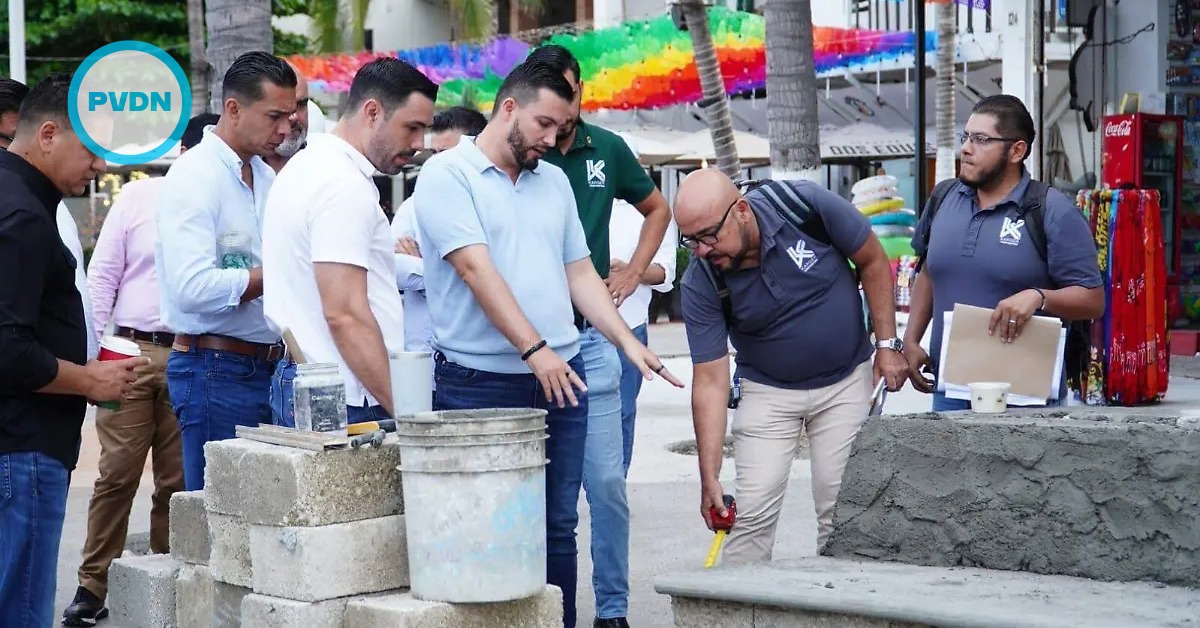
Mayor Luis Munguía recently walked the work zone along the bay with a cluster of senior officials from Public Works, Regulations, Strategic Projects and the Historic Center office, checking details on what is being billed as a major facelift for one of the city’s most photographed spaces. The project focuses on widening pedestrian areas, improving safety and refreshing the image of the seafront for both locals and visitors.
One of the most visible touches will be on the ground itself. The new black stone flooring is being laid out with patterns that incorporate Wixárika animal symbols and abstract motifs, a nod to the Indigenous culture that has long been part of the region’s identity. City designers say the idea is to move away from generic tourist-boardwalk aesthetics and give the bayfront a look that actually reflects Jalisco and the Sierra.
Business owners along the Malecón have pressed for clarity on construction times and access, but many have also welcomed the investment. They see the cleaner, more open promenade as a way to draw people back on foot, extend evening strolls and, with luck, steady the flow of customers after a tough few years for tourism. At the state level, officials have framed the waterfront work as part of a broader plan to rehabilitate the historic center and prepare for future maritime infrastructure expected to roll out from 2026.
While the heavy machinery dominates the bayfront, quieter but equally important work is happening underground. SEAPAL Vallarta, the city’s water and sewer utility, is in the middle of replacing a long-troubled sanitary sub-collector in the Villa Río and Fluvial Vallarta neighborhoods. The project covers 417 meters of new pipe, increasing the diameter from 15 to 24 inches to carry more wastewater away from homes.
The line serves large parts of the El Pitillal delegation, including the Centro and Bobadilla areas and streets such as Revolución and Exiquio Corona. For families who have lived with recurring blockages and overflows, the upgrade is about more than engineering: it is meant to reduce foul odors, protect the nearby rivers and lower the risk of sewage backing up during heavy rains. The work is financed with federal resources from the Proagua program of the National Water Commission, following joint planning between the municipality and SEAPAL.
On the surface, city crews are also trying to keep day-to-day traffic from falling apart while the bigger projects move forward. Pothole repairs with cold asphalt have been underway along Avenida Prisciliano Sánchez and the road to El Cantón, where repeated rains and heavy vehicles left serious damage in the pavement. The Public Works Department has asked drivers to slow down, respect signage and expect lane reductions as the patches cure, arguing that short-term inconvenience is the trade-off for smoother routes later in the season.

Security and gender equality in focus
Bricks and asphalt are only part of the city’s current push. Another visible change is the introduction of new patrol vehicles and equipment explicitly designed to protect women.
In late November, Puerto Vallarta received a batch of five units for the Municipal Public Security Police Station under an agreement with the state government. Four of them will go into regular patrol work, while one is a specialized vehicle for the unit that assists victims of gender-based violence. As part of the same package, the city was also assigned Pulso de Vida devices, small electronic alarms designed for women whose lives are at risk and who already have a protection order or are under close monitoring by authorities.
Across Jalisco, Pulso de Vida has grown into a broader strategy that combines panic-button technology with a network of safe spaces. The state has been signing agreements so that convenience stores and pharmacies can serve as immediate refuge points, allowing women in danger to step inside, ask for help and trigger a coordinated response that connects local police with the state’s C5 monitoring center. Recent figures released by state officials show dozens of specialized victim-attention units now operating and more than 2,000 designated “Pulso de Vida zones” being planned statewide.
For Mayor Munguía, the new vehicles arrive alongside a change in command structure. He has highlighted that the current police commissioner has passed the required background and trust-control examinations, a step local authorities describe as necessary to rebuild confidence in a force that works in a high-pressure tourist destination. The city has also indicated that more patrol units are being considered for 2026 to extend coverage in residential neighborhoods once the tourist strip is better served.
The safety agenda does not end with patrols. Puerto Vallarta officials have been taking part in state-level working groups to prepare the Diagnosis for the State Program for Equality between Women and Men, led by Jalisco’s Secretariat of Substantive Equality. Those sessions bring together municipal staff, including the local Women’s Institute and human resources trainers, to discuss themes such as incorporating gender perspective into every public policy, reshaping traditional masculinity, guaranteeing care work and social rights, and ensuring that women and girls can exercise their political, economic and environmental rights.
The idea behind that process is to move from isolated projects toward a long-term framework that guides how budgets, training and local programs are designed. For Puerto Vallarta, which depends on tourism but is also struggling with everyday issues like domestic violence, wage gaps and care burdens at home, those discussions could influence how future police training, social services and even urban planning are carried out.
Puerto Vallarta public works
If the Malecón construction is the most visible symbol of change, the PURA Tinacos program may be the one that residents feel most directly in their kitchens and bathrooms.
On the fourth day of deliveries for the program, held in the IDIPE neighborhood of the Ixtapa delegation, 1,200 residents received household water storage tanks during a public event led by Mayor Munguía and SEAPAL director Carlos Ruiz. The tanks, with capacities of around 1,100 liters, are being given at no cost to families in vulnerable situations as a way to cushion them from service interruptions caused by pipe repairs, power outages or maintenance work on the network.
According to SEAPAL’s own guidelines, priority goes to homes that lack a proper tank or still rely on improvised containers, and to neighborhoods with intermittent service or lagging infrastructure. Families with older adults, people with disabilities or many children are also given preference in the selection process. To qualify, residents must show identification, be up to date on their water bills and complete an application at SEAPAL attention modules in Vallarta, El Pitillal, Ixtapa or El Coapinole.
At the Ixtapa event, the mayor framed the deliveries as part of a push to correct what he called years of neglect in the delegation, saying that the community “deserves all the support” and is now “more vibrant than ever” thanks to recent programs. SEAPAL has echoed that message, arguing that stabilizing the utility’s finances has made it possible to invest not just in pipes and plants but also in equipment that helps families ride out inevitable outages with a bit more security.
Taken together, the waterfront overhaul, sewer upgrades, road repairs, security units, gender-equality planning and water-tank deliveries paint a picture of a city trying to catch up on years of pending work in a short window. Residents of Puerto Vallarta will ultimately decide whether these efforts feel like a coherent strategy or just a flurry of disconnected projects. For now, the dust, detours and ribbon-cuttings are the visible sign of a local government betting that investment in basic services, safety and equality can shore up daily life in a town that often lives under the spotlight of the tourism industry.