The man who turned himself into a living sand statue on the Puerto Vallarta Malecón was found shot dead in a parked car before dawn.
Shortly after 12:40 a.m. on Friday, emergency crews were called to the López Mateos neighborhood, a few minutes inland from the waterfront. Police and paramedics arrived to find a gray Volkswagen Vento with its doors open. In the driver’s seat, a man lay with a gunshot wound to the head. Medics confirmed he had no vital signs.
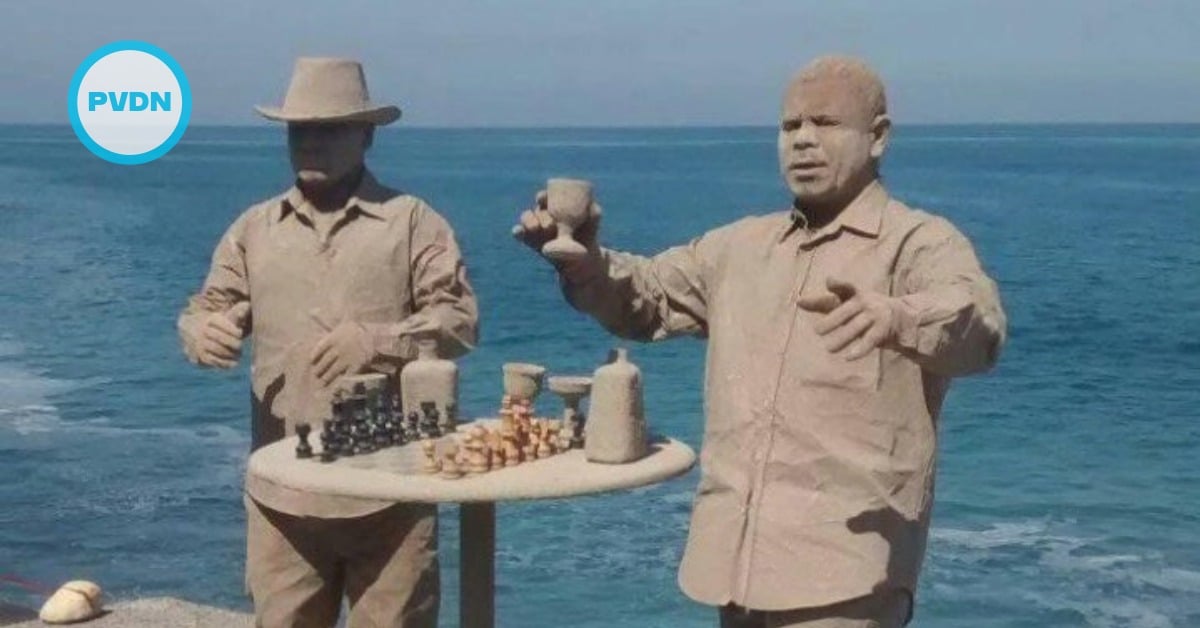
Neighbors told officers they recognized him at once. It was the “hombre de arena” of the Malecón, the quiet street performer who spent nights covered in sand-colored makeup and clothing, frozen at a chessboard while tourists sat down across from him for a photo or a playful game.
Municipal police cordoned off the intersection of Río Danubio and Río Grijalva while investigators worked the scene. Forensic staff documented the vehicle and collected evidence inside and around the car. Authorities have not yet made the victim’s formal identity public. Still, local outlets and residents have identified him as Ángel Silva Morán, known in the city as “El Hombre de Arena”, “El Arenas” or simply “Pocho”.
For neighbors, the sight of his body under crime-scene lights was hard to reconcile with the still figure they were used to seeing beneath the streetlamps of the Malecón.
A human sand statue on the Malecón
For nearly two decades, the sand-covered figure was part of the city’s nightly rhythm. In videos recorded on the boardwalk, he explained that he had been working “about 18 years” in the role, an act he said he helped create and establish on the seafront.
His performance was simple and striking. He would cover his clothes, skin, and hair in sand packed with a special mud until he looked carved from the beach itself. Then he took his place at a table with a chessboard, usually motionless, waiting for someone brave enough to sit down. At first glance, he seemed like a sculpture; only when he moved a piece or turned his head did newcomers realize the statue was alive.
Tourists lined up to pose as if they were deep in thought over the next move. Children tried to surprise him into breaking his stillness. Locals walked past on their nightly strolls, comforted by the familiar sight of the sand man in his usual spot along the ocean.
Beyond the photos and tips, people describe him as patient and soft-spoken. Clips shared on social media show him talking about his work, his costume, and the hours he spent getting ready each day. Other videos show kids and visitors challenging him to real games, treating the encounter as much more than a quick snapshot.
His act sat at the intersection of street theater and visual art. It fit easily into a Malecón already known as an open-air stage, where musicians, painters, and food vendors share space with permanent bronze sculptures and the steady surf.
Puerto Vallarta sand man
The killing of the Puerto Vallarta sand man has rippled far beyond the López Mateos streets where he died. On local news pages and neighborhood groups, comment sections were filled with disbelief, condolences, and memories of first encounters with him on the boardwalk. Many people posted old photos of themselves, their parents, or their children sitting across a chessboard from a man who looked like he had grown out of the sand.
Police have opened a homicide investigation. So far, officials have not released information about possible suspects or a motive. The case is now in the hands of municipal authorities and state investigators, who will review forensic findings, camera footage, and witness statements to piece together what happened in the early hours of Friday.
The death lands in a country already struggling with high levels of violence. Mexico recorded tens of thousands of killings last year, averaging around 70 homicides a day. Human rights groups say most murders go unpunished, as investigations stall and cases fade from view over time.
Puerto Vallarta has long promoted itself as a relaxed and relatively safe destination on the Pacific coast. Even so, national surveys show that many residents in Mexican cities say they feel unsafe where they live, especially after high-profile crimes. When a victim is not a stranger but a familiar face from the Malecón, that fear becomes more personal.
For the local economy, which relies heavily on tourism, the loss of such a recognizable figure also carries symbolic weight. The sand man was part of the unofficial welcome committee, appearing in travel videos, family albums, and social media posts that helped sell the city’s charm to new visitors. His absence leaves an empty space not just on the promenade, but in how Puerto Vallarta sees itself.
In the coming days, friends, colleagues, and fans are likely to improvise their own tributes. Some have already spoken about holding a small vigil or creating temporary art in the spot where he used to sit. Others simply promise that they will keep telling his story to anyone who asks why a chess table on the Malecón feels so strangely quiet.
Like the makeup that washed off each night and the sand that never stayed in place, his performances were meant to be temporary. His killing, however, leaves a lasting mark. For now, the city is left with grainy videos, fading footprints in the sand, and a nagging question that no headline can answer: why someone would shoot a man whose job was to sit still, covered in sand, and share a quiet game of chess by the sea.