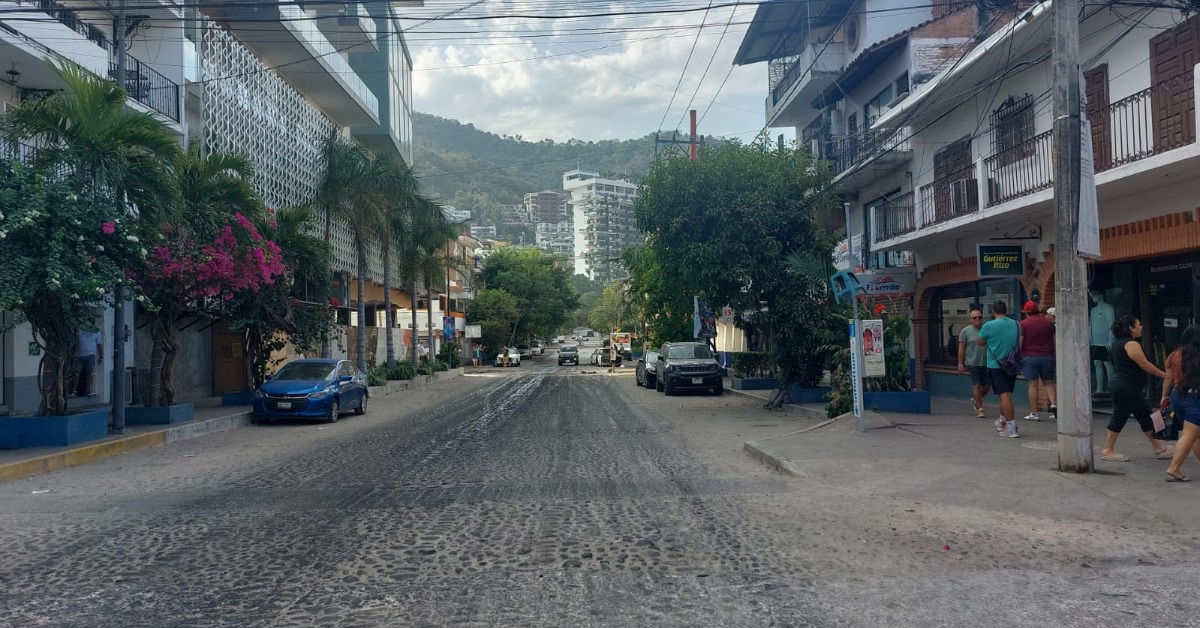
Puerto Vallarta is moving again, but not at full speed. Buses are back on key routes, workers are commuting, and traffic has returned to major avenues, though at lower levels than usual. Behind that visible progress, crews are still clearing damaged vehicles, and authorities are maintaining security operations across the city. The recovery is underway, but several services remain uneven, and the next phase depends on how quickly mobility and supply routes stabilize.
Services Return in Stages
Puerto Vallarta began Tuesday with visible signs of movement after a violent weekend disrupted daily life. On Francisco Medina Ascencio Avenue, residents were again boarding buses at regular stops, and public transit resumed on a limited basis. Traffic and foot traffic remained below normal levels in the city, reflecting the slower pace of recovery across several sectors. Local transit operator UnibusPV said service is being restored gradually as road conditions improve and damaged areas are cleared. The city’s main transportation network is central to the local economy, especially for workers moving between neighborhoods and job sites. Cross-border commuting also matters in this region, and one of the key interstate routes to Bahía de Banderas in Nayarit was scheduled to resume service on Tuesday after a suspension tied to security concerns. That step gives residents and workers another sign that mobility is returning, even if the system is still operating with limits.
Cleanup and Security Operations Continue
The city’s recovery remains tied to cleanup work and security coordination. Municipal authorities held a security meeting on Monday to review damage and organize the next phase of response after blockades and fires hit multiple roads. Officials said the violence followed a federal operation in Tapalpa and led to road obstructions with burned vehicles in different parts of Puerto Vallarta. The mayor said the priority was clearing major avenues to restore circulation, and authorities reported a preliminary estimate of more than 200 affected vehicles, including buses and private cars. Local reporting also shows crews worked through Sunday night, but full clearance was delayed in part because tow services were not fully available overnight. Municipal officials said police, civil protection, and public service teams are continuing coordinated operations with state and federal agencies. The work includes vehicle removal, patrol reinforcement, and support for basic services while the city moves from emergency response to partial normalization.
A Partial Recovery for Residents and Visitors
For residents, workers, and foreign visitors, the main message is that Puerto Vallarta is operating again, but not at full capacity. Local officials and state authorities have described the recovery as gradual, with public services returning in stages while security deployments remain in place. Local coverage on Monday reported that the airport and bus terminals were functioning, although urban transit was still running at reduced levels. State officials also said conditions in Puerto Vallarta were being prioritized so that transport, food supply, and services in the hotel zone and local neighborhoods could continue to recover. Flight operations have also been uneven, with some carriers resuming departures while travelers were advised to confirm schedules before heading to the airport. That matters in Puerto Vallarta because many residents depend on tourism-linked jobs and cross-regional mobility. For now, the city is visibly active again, but the return to normal routines still depends on road clearing, service restoration, and continued security stability.
With information from Quadratín Jalisco, Tribuna de la Bahía, El Occidental, Infobae México