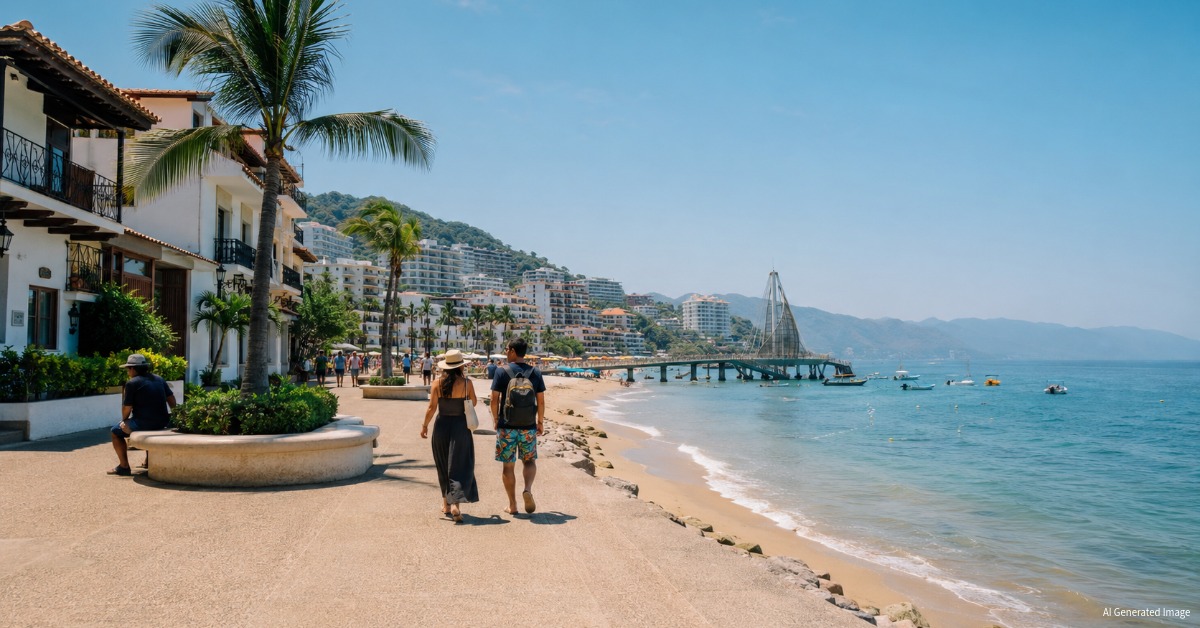
Puerto Vallarta ranked first among Mexican cities with 500,000 to 1 million residents in IMCO’s 2026 Urban Competitiveness Index, released this month, with the city’s tourism economy, local revenue strength, and security indicators helping drive its score.
The ranking comes from the Índice de Competitividad Urbana 2026, which compares 72 urban areas across Mexico. The index measures how well cities generate, attract, and retain talent and investment.
For Puerto Vallarta readers, the most important detail is geographic. IMCO’s score is for the Puerto Vallarta metropolitan area, which includes Puerto Vallarta, Jalisco, and Bahía de Banderas, Nayarit. It is not a scorecard for City Hall alone.
The ranking covers the metro area
IMCO placed Puerto Vallarta first in the 500,000-to-1-million-resident category. The report also listed Guadalajara second among cities with more than 1 million residents and Ocotlán third among cities with fewer than 250,000 residents.
Puerto Vallarta’s position does not mean it outranked every city in Mexico. Larger metro areas, including Querétaro and Guadalajara, were evaluated in a separate population group.
Our review of the underlying IMCO report shows that Puerto Vallarta’s top placement was primarily tied to its service and tourism economy. IMCO cited hotel occupancy of 73.38%, estimated GDP growth of 2.73%, and a strong mortgage market for the city’s size.
Tourism strength drove much of the score
The tourism measure gives Puerto Vallarta a clear advantage over many mid-sized cities. IMCO said the city had the highest hotel occupancy in its population group.
That finding should be read as a structural indicator, not a live tourism forecast. Puerto Vallarta’s tourism performance has been uneven in 2026, especially in air traffic. PVDN has tracked that pressure through recent coverage of Puerto Vallarta airport data and broader business and economy reporting.
The index important for local businesses, property owners, and residents because it captures the deeper economic base behind those monthly swings. Puerto Vallarta remains one of Mexico’s most visible tourism-driven urban economies, but its ranking also depends on public services, local revenue, labor conditions, safety, and housing patterns.
The city sheet also flags pressure points
Puerto Vallarta ranked first in its group for the political system and government, third for innovation and the economy, fourth for law and public security, seventh for the labor market, eleventh for society and the environment, and sixteenth for infrastructure.
Those sub-scores show a city with strong economic pull and some clear weaknesses.
IMCO listed informal employment at 38.81% of workers. That was better than some peer cities, but it still means a large share of the local workforce remains outside formal labor protections.
The city sheet also showed a 28.34% gender income gap. For a destination economy built on hotels, restaurants, services, health care, and retail, that measure is one of the labor indicators to watch.
Housing is another warning sign. IMCO reported that 74.93% of new housing was vertical, but only 0.58% was built within the consolidated urban area. Puerto Vallarta is building upward, but much of that growth is still pushing outward.
That pattern can add pressure on roads, water, trash collection, staff commutes, and neighborhood services. It also impacts buyers and renters trying to judge whether a new development is connected to the city or simply adds density on the edge.
How to read the ranking locally
The strongest local safety indicator was perception of security. IMCO placed Puerto Vallarta at 59.13%, the highest in its population group. The homicide rate was listed at 8.98 per 100,000 residents.
Those numbers are favorable inside the index, but they do not erase day-to-day public safety concerns. They also do not replace local crime reporting, police data, or neighborhood-level conditions.
On the environmental side, Puerto Vallarta led its group in operating water-treatment capacity, at 4.33 liters per second per 1,000 residents. The same city sheet placed solid-waste generation near the bottom, at 1.5 kilograms per person per day.
It shows why competitiveness rankings can be both encouraging and incomplete. Puerto Vallarta can rank high while still facing visible pressure from growth, garbage, road congestion, utility demand, and uneven job quality.
For residents and investors, the 2026 IMCO result signals that Puerto Vallarta remains competitive among Mexico’s mid-sized urban areas. The practical test will be whether local and state governments can turn that position into better infrastructure, formal jobs, and growth that does not leave basic services behind.