A humpback whale reached Banderas Bay still tangled in U.S. fishing gear. After two days of tracking, trained rescuers finally cut it free.
A humpback whale arrived in Banderas Bay already bound in fishing lines it had dragged out of U.S. waters. For two days, park rangers followed the exhausted animal across rough seas while a specialized disentanglement team raced to reach it from Puerto Vallarta. When they finally caught up near the Marietas Islands, local ecotour operators joined the effort in a slow, risky operation around a moving, 30-ton whale. What happened next says a lot about how cross-border rescue networks now work in the bay.
The humpback whale was in trouble long before anyone in Puerto Vallarta laid eyes on it. According to the rescue teams, the animal reached Banderas Bay already wrapped in fishing gear it had been dragging since leaving the United States, towing heavy lines that cut into its skin and restricted its movement. In early December, park rangers from the Marietas Islands spotted the whale and realized the entanglement was severe.
From that first sighting, those rangers did not let the animal out of their sight. Operating inside the National Park, they shadowed the whale in shifts for two days, relaying its position and behavior while it surfaced, dove and struggled under the weight of the gear. That vigilance bought time for Mexico’s specialized whale disentanglement network to mobilize from the mainland.
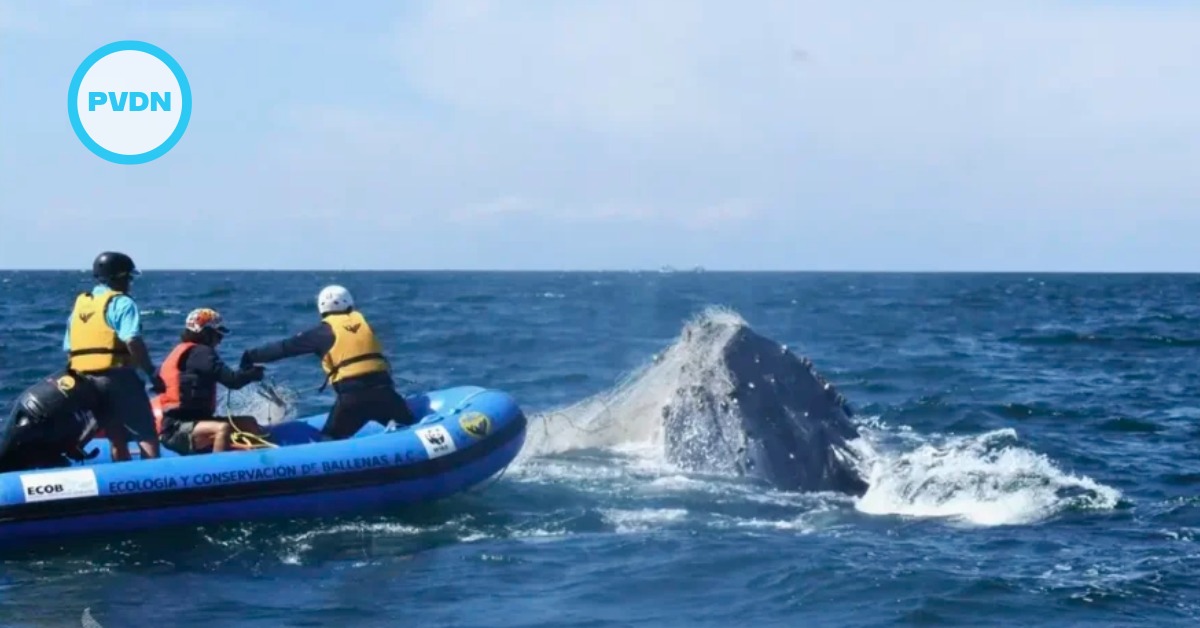
Ecología y Conservación de Ballenas (ECOBAC), which coordinates Mexico’s national network for entangled whales, assembled a small rescue crew in Puerto Vallarta. Before dawn and under rain, the team left port on a dedicated response vessel and spent almost two hours crossing more than 40 kilometers of open water toward the Marietas. On board were experienced responders from the RABEN Banderas Bay team and local allies who know these waters well.
Once they reached the whale, the scale of the problem was clear. Thick fishing lines were wrapped around the animal’s body and tail, with sections of gear trailing behind it. The responders could not simply jump in and cut the ropes; international protocols require that disentanglement be done from the boat using specially designed hooks, poles and knives, both to protect the whale and to keep rescuers alive. It was slow, repetitive work around a stressed animal that could easily capsize a small vessel with one sweep of its tail.
Local ecotour operators played a crucial role. Guides from Ecotours Vallarta helped position the vessels and keep other boats at a safe distance, while port authority staff from ASIPONA Puerto Vallarta supported the operation. Park rangers from the Marietas Islands, who had tracked the whale from the beginning, stayed in the water with the team until the last line came free. In the end, the whale was able to swim away without visible gear attached, leaving rescuers hopeful that it now has a real chance to recover.
Two days that changed one whale’s fate
What happened off the Marietas Islands was not an isolated accident. Entanglement in fishing gear is now recognized as one of the main threats to large whales worldwide. Global estimates suggest that hundreds of thousands of whales and dolphins die or are seriously injured every year after becoming caught in nets and lines, often dragging heavy gear for months or even years. The weight and friction can cause deep wounds, infections and exhaustion, and can make it difficult for whales to feed or surface to breathe.
Banderas Bay, where Puerto Vallarta sits, is one of the most important winter breeding and calving grounds for humpback whales in the eastern Pacific. Each season, hundreds of whales migrate here from feeding grounds in colder northern waters to mate and give birth in the bay’s warmer, calmer seas. That seasonal gathering is what makes the region a whale-watching destination – and also what makes it especially vulnerable to the effects of ship strikes and fishing gear left in their path.
ECOBAC created the RABEN network in the mid-2000s after a previous entanglement in Banderas Bay showed how unprepared local authorities were for such emergencies. Since then, the network has expanded along the Mexican Pacific, training whale-watching captains, park rangers, biologists and Navy personnel in specialized rescue techniques. Over two decades, RABEN teams have freed dozens of whales of several species and, as of the 2025 season, have surpassed one hundred successful rescues nationwide.
The Marietas operation also highlights how often entanglements cross borders. Official data from the U.S. West Coast show that humpbacks are the species most frequently found caught in gear there, and that some animals are later documented far from the original entanglement site, still carrying lines and buoys into other countries’ waters. The whale freed near Puerto Vallarta fits that pattern, likely carrying its burden for hundreds of kilometers before it was finally located by Mexican park rangers.
For rescuers, this reality turns every successful release into more than a local victory. Each disentangled humpback is a migrant that moves through multiple jurisdictions, and keeping it alive can help sustain the population that returns to Banderas Bay year after year to mate, calve and draw visitors who depend on healthy marine wildlife for their livelihoods.
Puerto Vallarta whale rescue and what comes next
The Puerto Vallarta whale rescue near the Marietas Islands shows how much depends on quick reporting from people on the water. In this case, videos and position updates shared by tour boats and park rangers helped responders understand how the gear was attached and where the whale was likely to surface next. That information shaped the rescue plan long before the disentanglement team reached the scene.
ECOBAC and RABEN stress that the public should never attempt to free an entangled whale on their own. Instead, they ask anyone who spots a whale caught in lines or nets to keep a safe distance, record photos or video and report it immediately through the official hotline or marine radio channel used along the Mexican Pacific. Those early images help trained teams identify the kind of gear involved, the parts of the body affected and the tools needed for a safe response.
Behind every operation is a network of volunteers who receive regular training and work without pay. Over the past two decades, conservation groups and international partners have helped equip these crews with rescue kits, protective gear and fuel support so they can launch quickly when calls come in. That investment was visible in this case: from Puerto Vallarta’s marina to the protected waters of the Marietas, the teams moved like a single unit, each boat and agency clear on its role.
As whale season continues in Banderas Bay, responders know this likely will not be the last emergency call. More whales in the bay means more magical encounters for visitors – and more chances for animals to run into lines, nets and careless boat traffic. For now, though, one humpback that arrived in Mexico wrapped in foreign fishing gear is swimming more freely because rangers, scientists and tour guides refused to give up over two long days at sea.