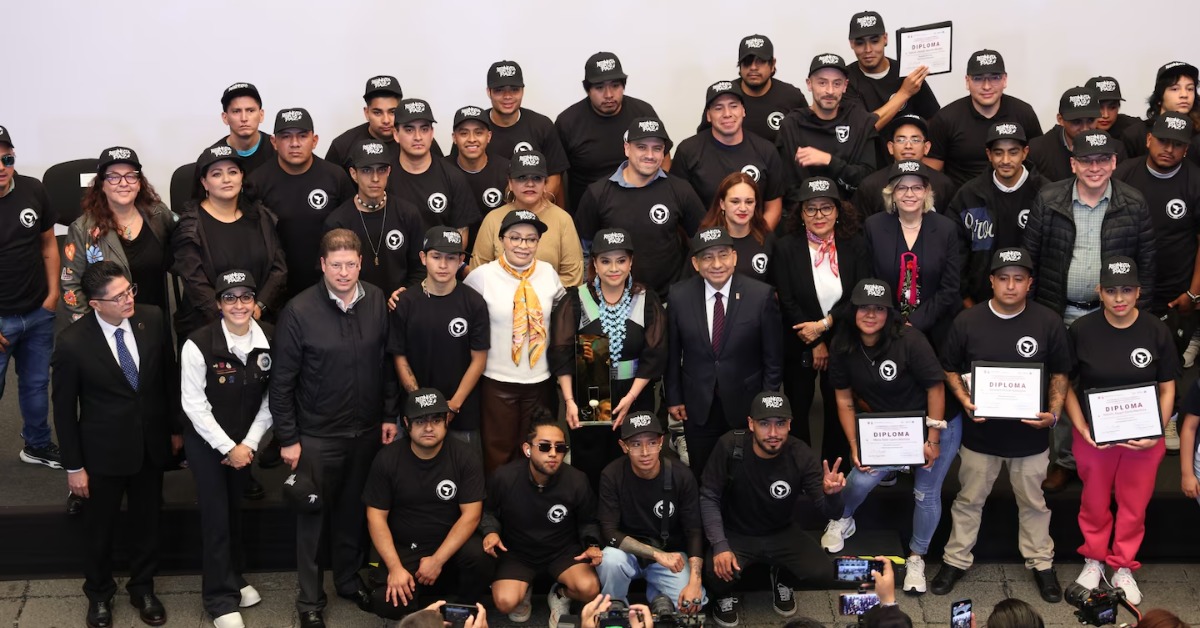
Mexico City – Ninety-three young people in Mexico City who once had brushes with the law marked a turning point in their lives with graduation from the program Reconnect with Peace youth rehabilitation. After six months of training, psychological support and mentorship, the graduates walked away with alternatives to crime: employment, education, and a renewed stake in society. The program, framed not as punishment but as repair, reported a recidivism rate of less than five percent among its participants.
Secretary of Citizen Security Pablo Vázquez Camacho addressed the cohort, underscoring the program’s aim to restore conduct rather than warehouse young people in incarceration. Those eligible—between 18 and 35 years old and with minor offenses resulting in potential sentences under five years—receive conditional suspension and are referred into the intervention. The curriculum centers on psychoeducational workshops rooted in cognitive-behavioral methods designed to interrupt cycles that previously led to criminal behavior.
Graduates finding real jobs, including with Netflix and government
Success stories from the program illustrate its practical impact. Aranza Belinda entered Reconnect with Peace youth rehabilitation on December 3, 2023. After a year of the program’s support, she was hired by the Legal Counsel Office of the Government of Mexico City while still completing her primary education—a dual trajectory of work and learning. Gerardo Daniel, who joined in April 2024, returned to the program a year later as a workshop facilitator, a full circle from participant to mentor.
Another high-profile success is Pedro, who after a year of training beginning in 2023 secured work on productions for the streaming platform Netflix, a placement made possible through a partnership between the company and the Secretariat of Citizen Security. Other graduates have filled roles in hotels, pizzerias, and retail stores, showing the diversified pathways the program opens for reintegration. Vázquez Camacho highlighted these outcomes as evidence that when support ends, graduates pursue productive roles—employment and personal development—rather than reverting to old patterns.
Program scale and government strategy to prevent crime
The initiative has reached roughly 1,300 people who previously engaged in criminal behavior, according to officials. Mexico City’s head of government, Clara Brugada, framed the program as part of a wider security strategy that avoids locking young people into lifelong consequences for early missteps. “No one can be defined by one mistake,” she said, urging that the program be seen as an opening to a “new chapter, full of future, dignity and peace.” She emphasized the ripple effect: families sleeping better, partners and children building a different future alongside the graduates.
Brugada described the broader effort to rebuild social fabric, citing the new Territories of Peace and Equality program, designed to address root causes and reduce the risk of youth offending before it begins. Complementing that is Aldeas Juveniles, a project building learning centers for young people not in school or work. There, participants spend a year in guided sports, cultural and psychosocial development; upon completion, those who want to continue education receive scholarships or are channeled into employment through the federal “Jóvenes Construyendo el Futuro” program.
Next steps for graduates and expansion plans
At the graduation ceremony, Brugada invited the 95 (reported as 93 earlier) newly certified youth to choose between two pathways: resume studies or enroll in an employment program offering about 8,500 pesos per month. She also previewed a forthcoming initiative modeled on Jóvenes Construyendo el Futuro, tailored for people over 30 who have economic dependents—a sign the administration is broadening the safety net for vulnerable populations.
The messaging was clear: personal transformation is a conscious choice, not passive surrender to circumstance. “We want transformation to value one’s own existence and take control of destiny,” Brugada said, pushing back on the idea that environment or inertia must determine life outcomes.
Reconnecting youth with society to cut crime
The Reconnect with Peace youth rehabilitation effort positions itself not just as intervention, but as a bridge—repairing harm, building skills, and connecting young people with employment, education and civic identity. With its low re-offense figures and visible placement of graduates in public and private sector roles, the program is being put forward by city officials as a replicable model for reducing crime while restoring lives.
As the administration continues to expand the scaffolding around at-risk youth, the graduates’ stories serve both as proof of concept and a public relations counterweight to punitive narratives. For many families, the transformation is tangible: a son or daughter who once ran afoul of the law now works, studies, or teaches others. That shift, officials say, is the core measure of success.
The city’s continued investment in rehabilitation pathways and the forthcoming employment program for older dependents signal a broader shift—one that redefines security not merely as enforcement, but as sustained opportunity.