
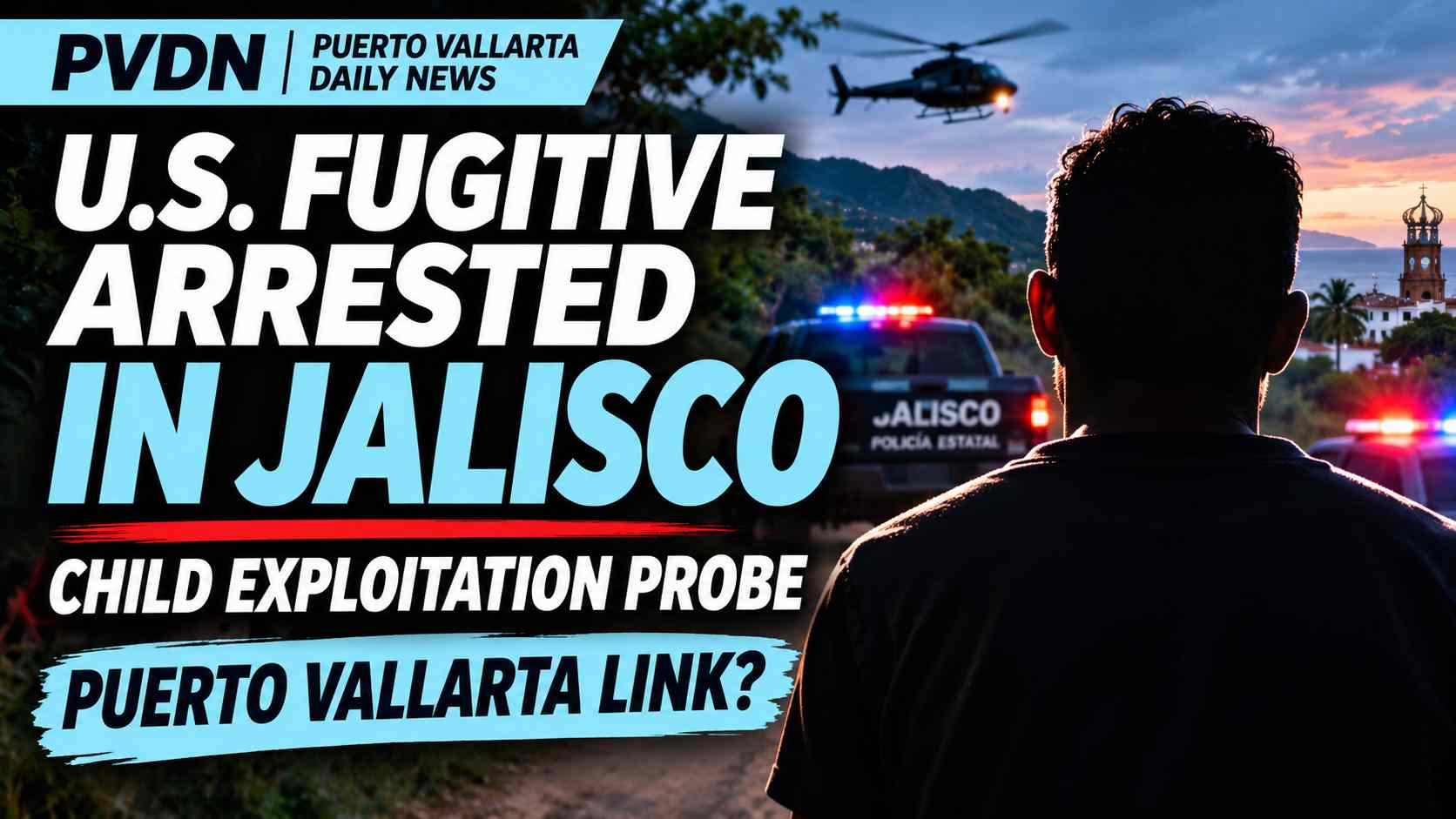
Jalisco police arrest a U.S. fugitive sought in a child abuse case. Authorities allege links to a wider network that may have reached Puerto Vallarta.
Puerto Vallarta, Jalisco, November 19, 2026 – Jalisco police have arrested a second American citizen wanted in the United States for alleged sexual crimes against children, linking him to an international exploitation investigation that authorities say may have included activity in Puerto Vallarta.
Pedro León Jr., 33, known by the alias “El Playboy,” was arrested in Cuyutlán, a community in the municipality of Mixtlán, following an operation involving Jalisco state police and information shared by the U.S. Marshals Service.
American authorities had been searching for León since 2021 in connection with allegations involving the sexual exploitation of a minor and possession of child sexual abuse material.
His arrest comes eight days after Jalisco authorities captured another American, Adalberto Rodríguez, known as “El Chucky 69,” in Tequila on November 11.
Jalisco’s secretary of Security, Juan Pablo Hernández González, says investigators suspect the two men were connected to an international network involved in the sexual exploitation of children.
The reported network has been linked by authorities to locations in the United States, Mexico and several other countries. Puerto Vallarta is among the Mexican cities mentioned in the investigation.
Although police have named Puerto Vallarta as a possible area of activity, they have not publicly identified specific victims, properties, accomplices or criminal acts in the city connected to these two suspects.
That leaves a serious question about the investigation’s local reach, even as authorities report progress in locating people wanted by American law enforcement.
A fugitive wanted since 2021
León is originally from California and was wanted in connection with a case in San Francisco.
A U.S. Marshals wanted notice identified him as a possible international fugitive and listed Jalisco as his last known location.
The reported notice dated his search to March 4, 2021, and included several aliases. Authorities had updated the photograph used to identify him on October 30, 2026.
Jalisco police said information provided through American law enforcement and consular channels helped investigators narrow down his location.
Personnel from the Policía Cibernética and the state’s drone unit combined the information with surveillance to identify a possible location in Cuyutlán, within Jalisco’s Costa-Sierra Occidental region.
Officers then carried out a coordinated arrest operation.
The operation involved the Fuerza de Operaciones Estratégicas de Protección Ciudadana, the Escuadrón Aerotáctico and the Grupo de Operaciones Tácticas.
A Black Hawk helicopter and a Goliat tactical vehicle supported the deployment.
Officers located León and confirmed his identity.
Hernández subsequently reported that authorities coordinated with the Instituto Nacional de Migración and American officials to transfer him through the Aeropuerto Internacional de Guadalajara.
Later reporting citing the secretary said León had been placed in American custody to face the proceedings connected to his outstanding warrant.
The exact U.S. court schedule and next hearing had not been established in the records reviewed Thursday.
The first arrest happened in Tequila
León’s capture follows the November 11 arrest of Adalberto Rodríguez, a 45-year-old American whom Jalisco authorities have identified as a suspected leader of the wider exploitation network.
Rodríguez was arrested in colonia Texcalame in Tequila after a separate operation involving Jalisco police and information supplied by American authorities.
Rodríguez had been wanted in Arizona since April 2017 in connection with sexual offenses involving children.
Jalisco officials said the American case resulted in a 50-year prison sentence in 2023, although the underlying U.S. court judgment was not independently available for this report.
The allegations described by authorities involve multiple sexual offenses against minors.
Investigators have also claimed that Rodríguez used toys to gain the attention of children, an allegation included in accounts of his arrest but not independently established through court evidence reviewed here.
Police reportedly transferred Rodríguez through the Instituto Nacional de Migración and the Guadalajara airport following his capture.
The two arrests, just eight days apart, are being presented by Jalisco authorities as part of the same international investigation.
Hernández described León as the second person arrested in connection with the suspected network.
That relationship remains an allegation.
Authorities have not publicly described León’s specific role in the organization or identified which activities allegedly connected him to Rodríguez.
Nor have they established whether the men worked together in Jalisco, in the United States or through another location.
Why Puerto Vallarta appears in the investigation
Jalisco authorities have named Puerto Vallarta, Chapala and Tequila among the locations where the suspected international network may have operated.
The wider list includes Guerrero, California, Texas, Canada, Haiti, Honduras and Colombia.
That geographic reach is one of the more significant claims made by investigators.
An operation involving several countries could involve people traveling between locations, transferring illegal material over the internet or maintaining relationships across borders.
But authorities haven’t explained which of those activities, if any, they specifically associate with Puerto Vallarta.
Local reports raised that issue on November 12.
At the time, the outlet reported that authorities had not provided details about suspected local accomplices, identified properties, searches or possible victims connected to the investigation.
Thursday’s second arrest has not filled in those missing details.
The arrest happened in Mixtlán, not Puerto Vallarta. The earlier arrest took place in Tequila.
No confirmed local operation, additional arrest or search warrant in Puerto Vallarta has been announced as part of this specific investigation.
That doesn’t mean the city’s inclusion is irrelevant. It means investigators still need to explain the basis for naming it.
Without those details, the public cannot determine whether Puerto Vallarta was a place where abuse allegedly occurred, where suspects stayed, where illegal material was distributed or simply a location that appeared in investigative intelligence.
Those are very different circumstances.
Puerto Vallarta has faced separate child-exploitation investigations
The latest allegations arrive in a city that has dealt with other investigations involving the sexual abuse and exploitation of children.
Those earlier cases are separate from the arrests of León and Rodríguez. Authorities have not announced any connection between them.
On October 9, Jalisco prosecutors carried out a search at a property in colonia Primero de Mayo in Puerto Vallarta after receiving information from the U.S.-based National Center for Missing & Exploited Children (NCMEC).
The organization had alerted Mexican authorities to suspected online activity involving child sexual abuse material.
Investigators seized electronic devices, including a computer, tablets, a cellphone, USB drives and a memory card.
A man identified by prosecutors as Leo Ignacio was arrested in connection with the investigation.
The case involved allegations of possessing child sexual abuse material, which Mexican authorities investigated under provisions of the country’s human trafficking laws.
In March, state prosecutors also arrested an English teacher in colonia Valentín Gómez Farías following an investigation involving suspected production and possession of child sexual abuse material.
That investigation similarly relied on information transmitted through international reporting channels.
The two cases demonstrate that authorities have investigated suspected online exploitation activity inside Puerto Vallarta itself.
They do not establish that the people arrested in those investigations knew León or Rodríguez, belonged to the same organization or participated in the international network now being discussed by Jalisco police.
The distinction matters because investigations involving children can concern very different offenses, evidence and groups of suspects.
A person accused of storing illegal images isn’t automatically part of an organized trafficking network. Nor does an allegation of an international connection establish that abuse occurred in every place investigators have mentioned.
The city has promised stronger action against trafficking
Puerto Vallarta has also faced broader questions about its ability to prevent and investigate sexual exploitation.
The report examined criticism of enforcement and the difficulty of addressing exploitation that can involve several jurisdictions.
Earlier, Vallarta Daily reported on training provided to tourism workers to help identify possible trafficking and exploitation.
Those efforts reflect one part of the city’s response: helping people recognize warning signs and report suspected abuse.
In June 2026, Puerto Vallarta officials also approved changes to municipal anti-trafficking rules, including provisions addressing prevention, cooperation between government agencies and assistance for victims.
Such measures concern the city’s general response to trafficking. They haven’t been identified as part of the investigation involving León and Rodríguez.
Thursday’s arrest raises more specific questions for the authorities.
Has the suspected network been investigated inside Puerto Vallarta? Have local prosecutors received information from American officials? And have any potential victims been identified in the municipality?
Those questions cannot be answered from the arrest announcements alone.
How American investigators helped locate the suspects
Both arrests involved cooperation between Jalisco police and the U.S. Marshals Service.
The agency is responsible for locating fugitives wanted by American courts and often works with authorities in other countries when suspects leave the United States.
In León’s case, Jalisco officials said American law enforcement provided information that helped identify his possible location.
State investigators then used their own surveillance systems, including cyber-investigation resources and drones, to locate him.
Once police confirmed his identity, Mexican migration officials and American authorities coordinated the transfer process.
The government has used similar cooperation in other fugitive investigations, although the exact legal process can vary depending on a person’s nationality, immigration status, arrest warrant and the arrangements between the two countries.
An arrest in Mexico does not automatically establish that someone has been convicted in the United States.
For León, the available public information concerns an outstanding American warrant and allegations of sexual crimes against a minor.
Authorities have not announced a conviction against him in connection with those allegations.
The two cases also differ in their reported legal histories.
Jalisco officials describe Rodríguez as having received a 50-year sentence in Arizona in 2023, while León was wanted under an outstanding warrant dating to 2021.
Police have not published documents establishing how the two American cases became connected to the suspected international network.
What investigators have not explained
Jalisco’s Secretary of Security has confirmed two arrests and described a suspected relationship between the men.
The next questions concern the alleged organization itself.
Authorities have not publicly identified how many other people may be involved, whether additional arrests are being sought or which financial, digital or travel records support the reported international connections.
They also haven’t explained whether the network’s alleged activity involved producing child sexual abuse material, distributing it, arranging in-person exploitation or a combination of offenses.
Those distinctions affect how investigators establish responsibility and determine which countries have jurisdiction.
The involvement of several countries makes cooperation between prosecutors particularly important. Evidence held in one jurisdiction may be needed to support an investigation in another.
There is also the matter of identifying and protecting any victims.
Police have not publicly provided a count of victims linked to the alleged organization or confirmed that any were located in Puerto Vallarta.
That absence of public detail shouldn’t be taken as proof that there are no victims. It also doesn’t justify claiming that local victims have been identified.
For now, the verified developments are the two arrests reported by Jalisco authorities, the American law enforcement involvement and the subsequent transfer process.
The claimed organizational relationship and geographic reach remain matters for investigators to substantiate.
The Puerto Vallarta connection remains unanswered
León’s arrest gives Jalisco police a second suspect in an investigation that authorities say crosses international borders.
The first suspect was captured November 11 in Tequila. The second was arrested November 19 in Cuyutlán, Mixtlán.
Both are American citizens. Both were sought by U.S. authorities in cases involving alleged crimes against children, although their reported legal circumstances differ.
Jalisco’s Secretary of Security says they are suspected of belonging to the same international exploitation network.
Puerto Vallarta has been included in the list of places where that organization allegedly operated, but no specific local activity has been publicly documented in the case.
That is the unresolved part of Thursday’s announcement.
With León now reported to be in American custody, the next official records may clarify the charges he faces and whether investigators can establish a connection to Rodríguez.
For Puerto Vallarta, authorities have yet to identify a local property, victim, suspect or criminal act directly connected to the network named in the two arrests.