Puerto Vallarta, Jalisco, Sept. 28, 2026 — Puerto Vallarta businesses face a payment mismatch as cash remains Mexico’s dominant method for small purchases while North American consumers rely more heavily on cards and digital payments.
Fernando Castro Rubio, president of the Association of Entrepreneurs of Puerto Vallarta and Bahía de Banderas, said in an interview published Monday that a segment of local commerce remains less digitally equipped than the international visitors it serves. His organization’s website confirms he remains president of the regional business group.
For this report, we checked the national figures behind that argument. Mexico’s 2024 National Financial Inclusion Survey found 85% of adults used cash most often for purchases of 500 pesos or less. Only 10% primarily used physical cards, while 4% used transfers or mobile applications. The official survey results also show how deeply cash remains embedded despite wider access to banking.
The payment gap reaches the counter
The issue does not mean Puerto Vallarta is broadly a cash-only destination. The city’s official tourism guide tells visitors that Visa and Mastercard are accepted at most hotels, restaurants, bars and organized tourist attractions. It also advises carrying cash because local markets and street vendors commonly require it.
That distinction matters for smaller businesses.
A cash-only merchant on Basilio Badillo or Olas Altas in the Romantic Zone faces a different customer base than many neighborhood businesses elsewhere in Mexico. The same is true for independent vendors around Centro, the Malecón, 5 de Diciembre and other areas with substantial visitor traffic.
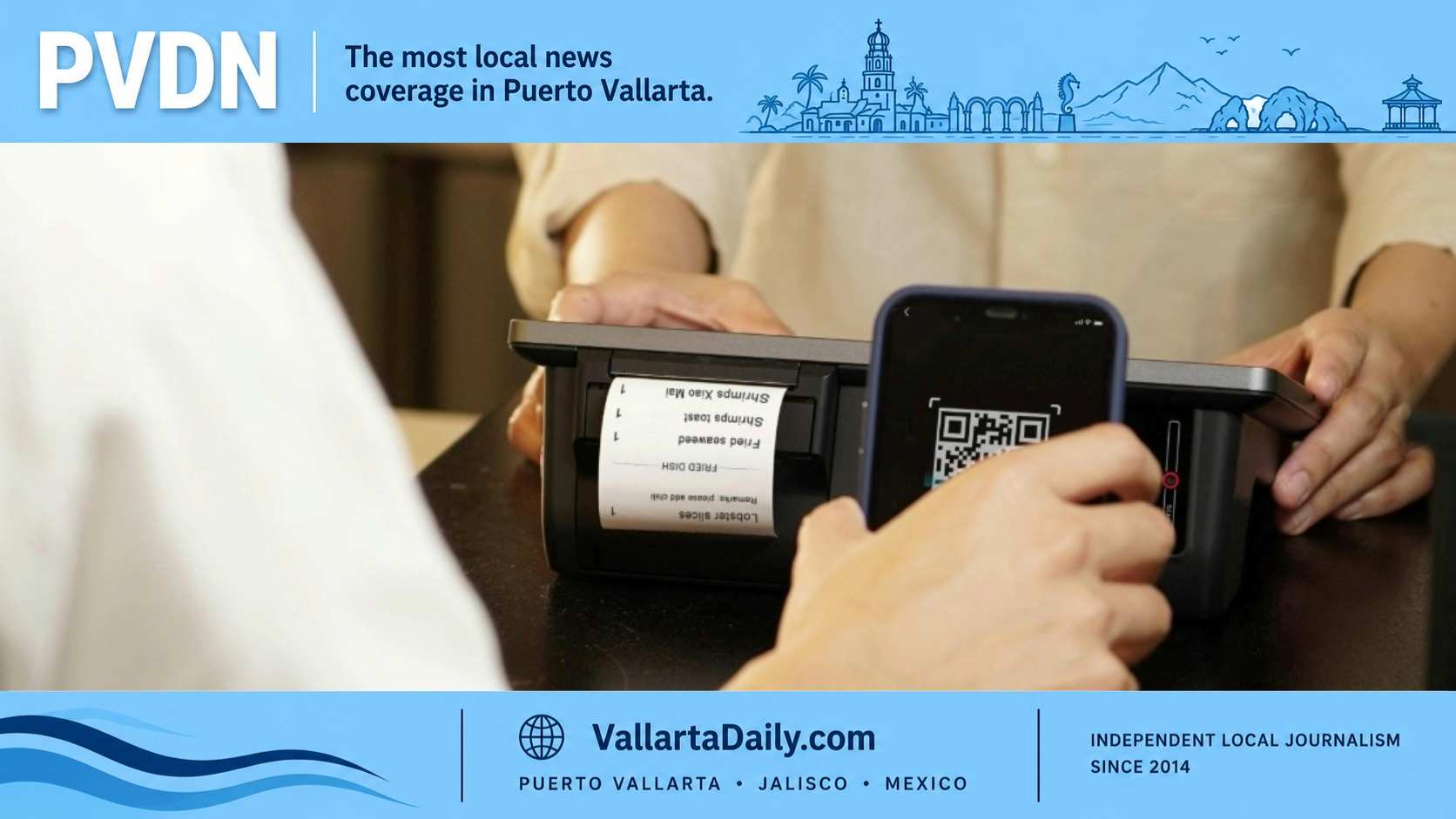
Castro Rubio’s argument is that the difference becomes an economic issue when a visitor wants to pay electronically but the business cannot accept that payment. He said smaller companies need access to payment terminals, collection platforms and other digital tools without being excluded by the cost of adopting them.
Mexico has expanded access to formal financial services. The percentage of adults ages 18 to 70 with at least one formal account increased from 49% in 2021 to 63% in 2024, according to the national financial inclusion data.
But having a bank account and using electronic payments are not the same thing. The survey found cash remained the preferred payment for 85% of purchases of 500 pesos or less and 73% of purchases above 500 pesos.
Among people with debit cards who preferred cash, 46% cited habit. Another 15% said the businesses where they shop accept only cash, while 13% cited distrust of cards, according to the survey.
North American payment habits sharpen the contrast
Castro Rubio’s description of foreign customers arriving with different payment habits is consistent with consumer data from Canada and the United States.
The Bank of Canada’s 2025 payment survey found contactless card payments accounted for more than 60% of Canadian in-person transactions by both number and value. Mobile-payment use was also increasing.
In the United States, Federal Reserve data for 2024 showed credit cards represented about 32% of consumer payments and debit cards another 30%. Cash accounted for about 16%. Federal Reserve research on U.S. payment behavior found cards remained the dominant retail payment method.
Those figures do not mean every U.S. or Canadian visitor expects cashless service. They do show that travelers from Puerto Vallarta’s major North American markets come from economies where electronic payments are used far more frequently.
Puerto Vallarta’s official tourism information currently lists direct air connections with more than 24 U.S. destinations and 15 Canadian destinations, reinforcing the importance of those markets to the local tourism economy.
Card acceptance carries a cost
Digital payment acceptance is not free for the merchant, which complicates the transition for small businesses.
Banco de México’s July 2026 data show restaurants paid an average merchant discount rate of 2.53% on credit-card transactions. The average for retail businesses was 2.94%. Current credit-card merchant rates are published by the central bank.
Debit transactions were cheaper on average, but still carried costs. Restaurants averaged 2.17%, while retail businesses averaged 2.77%, according to Banco de México’s debit-card figures.
Those are national rates rather than Puerto Vallarta-specific figures. Actual merchant costs vary by provider and contract. Banco de México reported restaurant credit-card rates ranging from 1.76% to 5.39% and retail rates from 1.53% to 4.50% in July.
That cost helps explain why expanding electronic payments cannot be reduced to simply telling merchants to install a terminal. Businesses must weigh transaction fees along with equipment, banking arrangements and the administrative requirements of processing electronic sales.
Castro Rubio said digitalization policies should account for the circumstances of micro, small and medium-sized businesses rather than creating a system affordable only to larger operators. He argued that easier access to payment technology could help businesses serve international customers while bringing more commercial activity into formal financial channels.
The debate comes during weaker international traffic
The payment discussion is also occurring during a difficult year for Puerto Vallarta’s international air market.
Grupo Aeroportuario del Pacífico reported that international passenger traffic at Puerto Vallarta International Airport fell 26.3% in August compared with August 2025. International traffic was down 19.7% during the first eight months of 2026.
PVDN reported on the August decline earlier this month as local tourism businesses entered the final months before the winter high season. The airport figures measure passenger traffic rather than spending, so they do not establish that cash-only businesses are losing sales because of payment restrictions.
The underlying payment divide, however, is supported by national data: cash remains dominant for everyday Mexican purchases while cards dominate a much larger share of transactions in Canada and the United States.
Castro Rubio said he expects cash to retain a significant role in Mexico in the near term. His proposal is not to eliminate it, but to make electronic payment tools more accessible to smaller businesses operating in tourism-dependent communities such as Puerto Vallarta and Bahía de Banderas.