On November 20, 2025, Puerto Vallarta’s city council put one of its smallest neighbors on the agenda. In open session, councilwoman María Magdalena Urbina Martínez presented an initiative to create a conservation sanctuary for the Vallarta casquito turtle at Laguna Tami, a wetland better known to older residents as Laguna Tomasa.
The proposal invites public servants, the general public, the business sector, and the university community to join the effort with voluntary financial contributions in whatever amount each person chooses. Those funds would be directed to the full rescue and restoration of the environment where the species lives, with the stated goal of consolidating a formal Conservation Sanctuary at Laguna Tami and helping the turtle’s population recover.
For now, the initiative has been entered into the council’s committee system for technical analysis and an official opinion. From there, councillors will decide how to structure the donation mechanism and what legal figure the future sanctuary should adopt, but the political message is clear: this small turtle is being treated as an emblem of the city’s biodiversity.
Community donations for a fragile lagoon
The new initiative does not appear in a vacuum. Earlier this week, municipal authorities announced that rehabilitating Laguna Tomasa as an ecological park dedicated to the casquito turtle will be one of Puerto Vallarta’s priority environmental projects for 2026. The plan, designed with the group Estudiantes Conservando la Naturaleza and local residents, aims to restore the lagoon as a protected green space and to safeguard remaining patches of native habitat around it.
During a recent visit to the site, officials took part in the release of six casquito turtles into the lagoon and outlined a package of actions that includes declaring a municipal “Day of the Casquito Turtle,” continuing controlled releases, and maintaining permanent staff to watch over the wetland. The city has already earmarked investment starting in January 2026, framing the rehab of Laguna Tomasa as a flagship action for local biodiversity.
The councilwoman’s proposal adds a civic layer to that plan. Instead of relying only on the municipal budget, it opens the door for city workers, businesses, students, and residents to contribute directly to the lagoon’s recovery. By keeping the contributions voluntary and without a fixed minimum, the scheme is being pitched as a way for people to “adopt” the sanctuary project financially without turning it into a new tax burden.
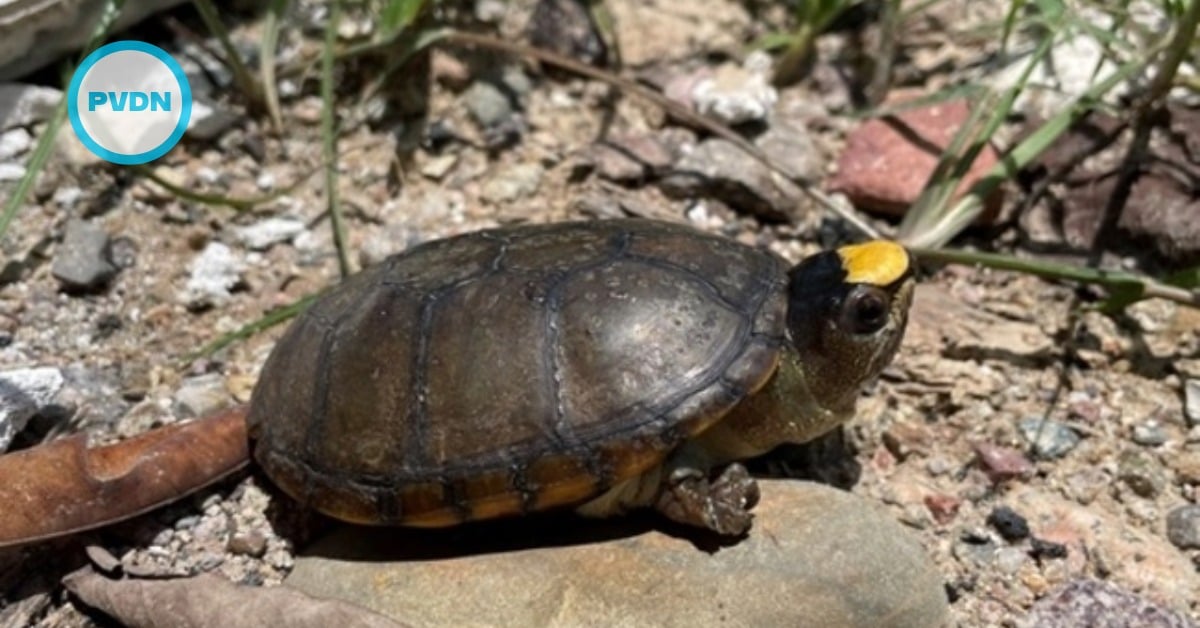
Behind these moves is a species with an unusually small range and an unusually big conservation challenge. The Vallarta casquito turtle, described by researchers in 2018 under the scientific name Kinosternon vogti, is a freshwater mud turtle that barely reaches ten centimetres in shell length as an adult. Specialists describe it as the smallest turtle in the world. It lives only in a handful of freshwater lagoons and seasonally flooded areas around Bahía de Banderas, in Puerto Vallarta, and southern Nayarit. Surveys by conservation biologists suggest it now survives in roughly eight small lagoons covering less than twenty hectares in total, with an estimated wild population below 500 individuals.
Vallarta casquito turtle
Because the species is confined to urban and peri-urban wetlands, almost every change around it is human-driven. Researchers and conservation groups point to several overlapping threats: rapid urbanization that fills or channels wetlands, pollution and dumping in the remaining lagoons, dry-season fires set to clear vegetation, and the introduction of exotic turtles such as the red-eared slider that compete for food and space. On top of that, when casquito turtles move between shrinking ponds in search of water, they risk being run over on nearby roads or picked up for the pet trade.
Those risks are not theoretical. In 2024 and early 2025, more than fifty casquito turtles were stolen from facilities at the University of Guadalajara’s coastal campus in Puerto Vallarta, where they formed part of an assurance colony meant to safeguard the species. In February 2025, federal authorities at Mexico City’s international airport seized 120 freshwater turtles and 16 live frogs that were being shipped abroad; conservationists who reviewed the images believe some of the animals were also Vallarta casquito turtles.
Given its tiny numbers and pressure from collectors, the casquito is now formally listed as “in danger of extinction” under Mexico’s NOM-059 environmental standard, and it appears in Appendix I of the CITES treaty, the category reserved for species under the greatest trade pressure. That status means any international commercial trade in the turtle is effectively banned, and that local extraction without permits is illegal. For a population counted in the hundreds, a single seizure or theft can set back years of fieldwork.
In that context, turning Laguna Tami into a sanctuary is about more than one pond on the city’s edge. Conservation groups working with the municipal government have identified a small set of wetlands that still hold casquito turtles, and they argue that at least some of them must be formally protected and restored if the species is to survive in the wild. Laguna Tomasa has emerged as one of the best candidates because it already belongs to the city and still supports free-living turtles, even after years of neglect.
The donation-based sanctuary proposal is still only a draft, and the council committees now reviewing it will have to define how the money is handled and what concrete work it can fund. What is already visible, though, is a shift in how Puerto Vallarta talks about a wetland next to its booming tourist corridors. Instead of treating Laguna Tomasa as an empty lot or future building site, city officials are presenting it as a living habitat whose fate is tied to an animal found nowhere else on Earth.
If the initiative advances, Laguna Tami could become a place where residents and visitors see the Vallarta casquito turtle in its natural environment, while also seeing the city as an active partner in its protection. The outcome will depend on budgets, politics, and follow-through, but the stakes have already been spelled out by biologists: without strong action on the ground, this species could disappear from the wild within a few years. The sanctuary proposal is one attempt to keep that warning from becoming reality.