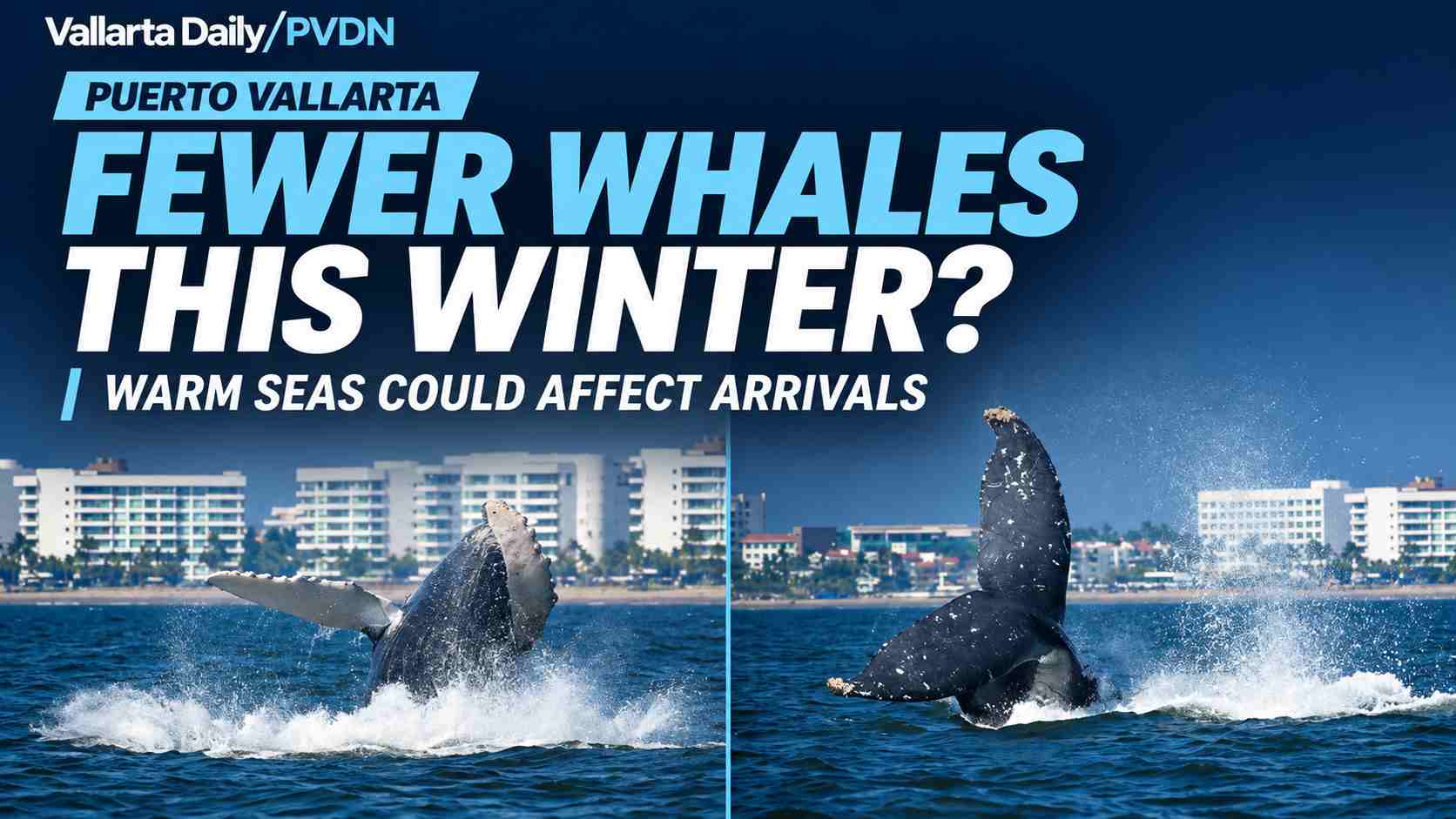
Unusually warm seas could delay the humpbacks or even reduce their numbers in Banderas Bay during the 2026–27 season, warns ECOBAC’s Astrid Frisch Jordán.
“We don’t know what will happen,” Frisch Jordán said. Warm conditions could mean fewer whales or a later arrival, though the group has already received reports of whales in the area.
Her warning comes before the official whale-watching season and includes no forecast of how many whales will be in the bay this season. The early sightings do confirm that some whales are indeed on their way; they can’t yet tell us how many will be in the bay over the winter.
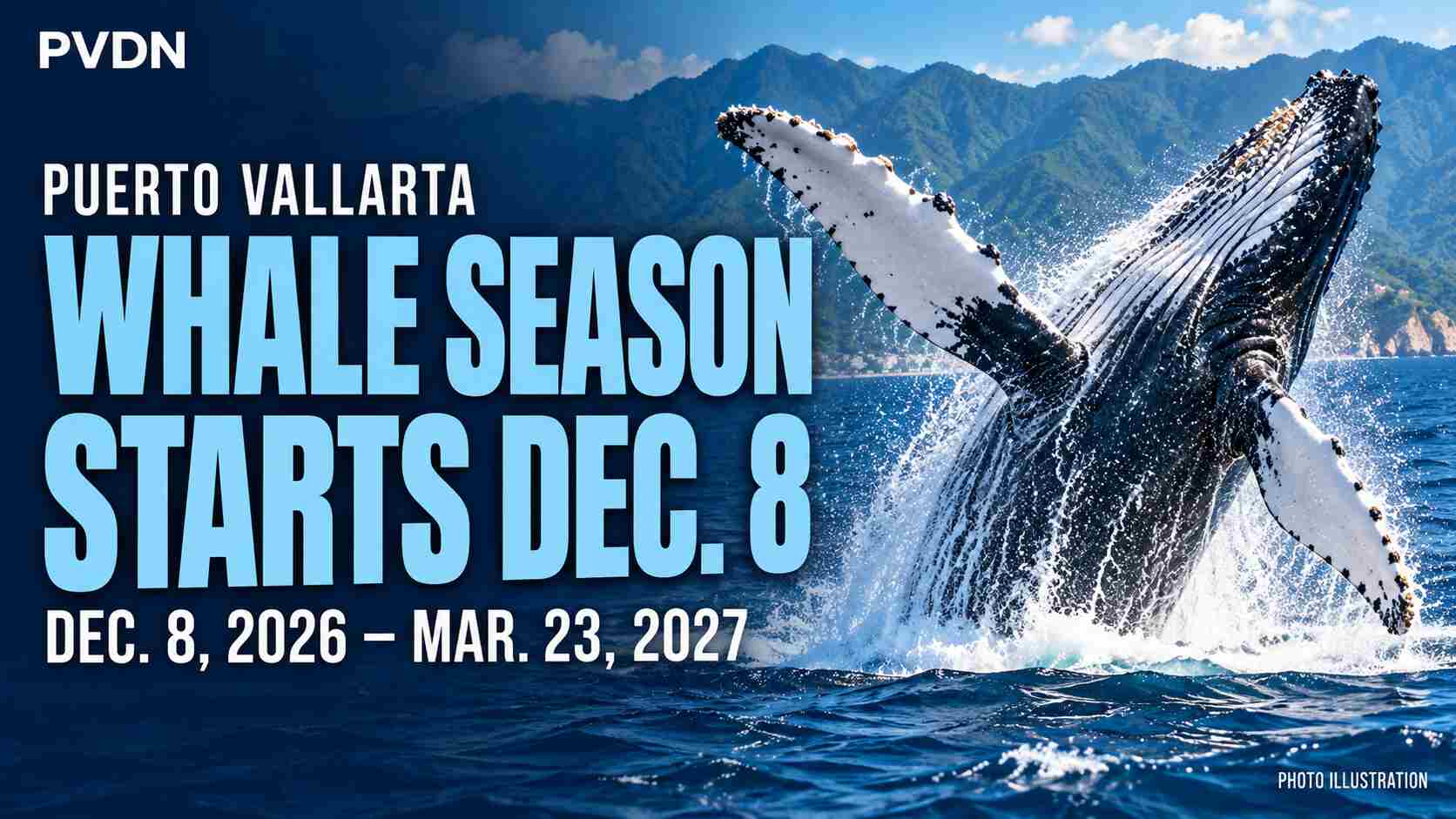
The local whale watching season runs from Dec 8th 2026 to March 23rd 2027. SEMARNAT set that date range in its October 30th federal notice, which covers Puerto Vallarta, Cabo Corrientes, and the Nayarit side of Banderas Bay.
Could warm seas change this winter’s whale watching?
For residents going to be out with visiting family, the question is: will the whales be there when their guests are here? For scientists, the answer requires looking at conditions across the Pacific and then what actually occurs in the bay.
A well-established climate signal underlies the concern. The CPC’s October 8 assessment notes a strengthening El Niño and an over 83% chance of strong to very strong conditions persisting through January–March 2027.
The report has the Niño-3.4 sea surface temperature index at 2.1c above average. That’s the index for the equatorial Pacific, not the water off Puerto Vallarta. It provides the broader climate context for ECOBAC’s concern.
Local research explains why it’s so hard to translate that into a whale count. A 2021 study co-authored by Frisch Jordán examined 14 breeding seasons in Banderas Bay (2004-2017) and used 8,013 whale sightings from about 1,395 hours of boat time.
They recorded a seasonal average of 5.7 whales per hour, ranging from 4 in 2016 to 7.5 in 2013, and found no statistically significant correlation between sea surface temperature and relative abundance across the dataset.
Those findings provide useful context: warmer water on its own isn’t a reliable predictor of this winter’s sightings. The study looked at the number of whales seen per hour, a measure of local presence rather than a census of the whole population.
The bay is part of a much longer journey
Banderas Bay is a breeding and transit area for the North Pacific humpback. Their winter movements are linked to feeding grounds farther north, so the research also examines food availability and behavior along that entire route.
A 2024 study of feeding in Banderas Bay documented 76 feeding events on 201 individually identified humpbacks over five wintering seasons (2013-2020).
Humpbacks normally fast for months in their tropical breeding grounds. In this study, researchers consistently observed feeding in the bay during cooler winters, with sea surface temperatures below 25 degrees C, associated with La Niña. The authors concluded that the scale of the feeding events they observed likely resulted from North Pacific marine heatwaves.
That study links the local season to both sea surface temperature and feeding behavior and explains why the number of whales seen off Vallarta can’t be accounted for by the bay being warmer or cooler alone.
Repeated surveys will give a clearer picture
ECOBAC’s own update on the 2025–26 season describes an abundance of whales with an average of eight per hour during their monitoring. That figure applies to the observations covered by that update, not necessarily the rate you’d see on a tourist trip.
The org also reported that its photo-identification catalog had 3,830 distinct whales and over 13,233 photos. Researchers identify individual humpbacks by the markings on their flukes, which lets them recognize individuals as they return.
Together, repeated surveys and individual identification provide a way to pick up changes in local presence over time. A quiet boat trip in itself won’t establish a seasonal decline.
For anyone arranging a trip, it comes down to checking that the operator has the required SEMARNAT authorization and asking about recent sightings. Under Mexico’s whale-watching standard, strict rules govern distance and crowding: small boats must stay at least 60m from humpbacks, and medium and large boats at 80m.
For instance, if several tours come across the same group of whales, no more than four boats can be around the group. A fifth boat would have to wait at least 240m away.