Insider Subscription Exclusive – Unpaid condo fees in Puerto Vallarta can lead to higher dues, delayed repairs and legal disputes. Learn what Jalisco law means for property owners.
You pay your condominium maintenance fees every month. Your account is up to date, your property taxes are paid, and you’ve put money aside for your own household expenses. As far as you’re concerned, you’ve done everything required of you as a property owner.
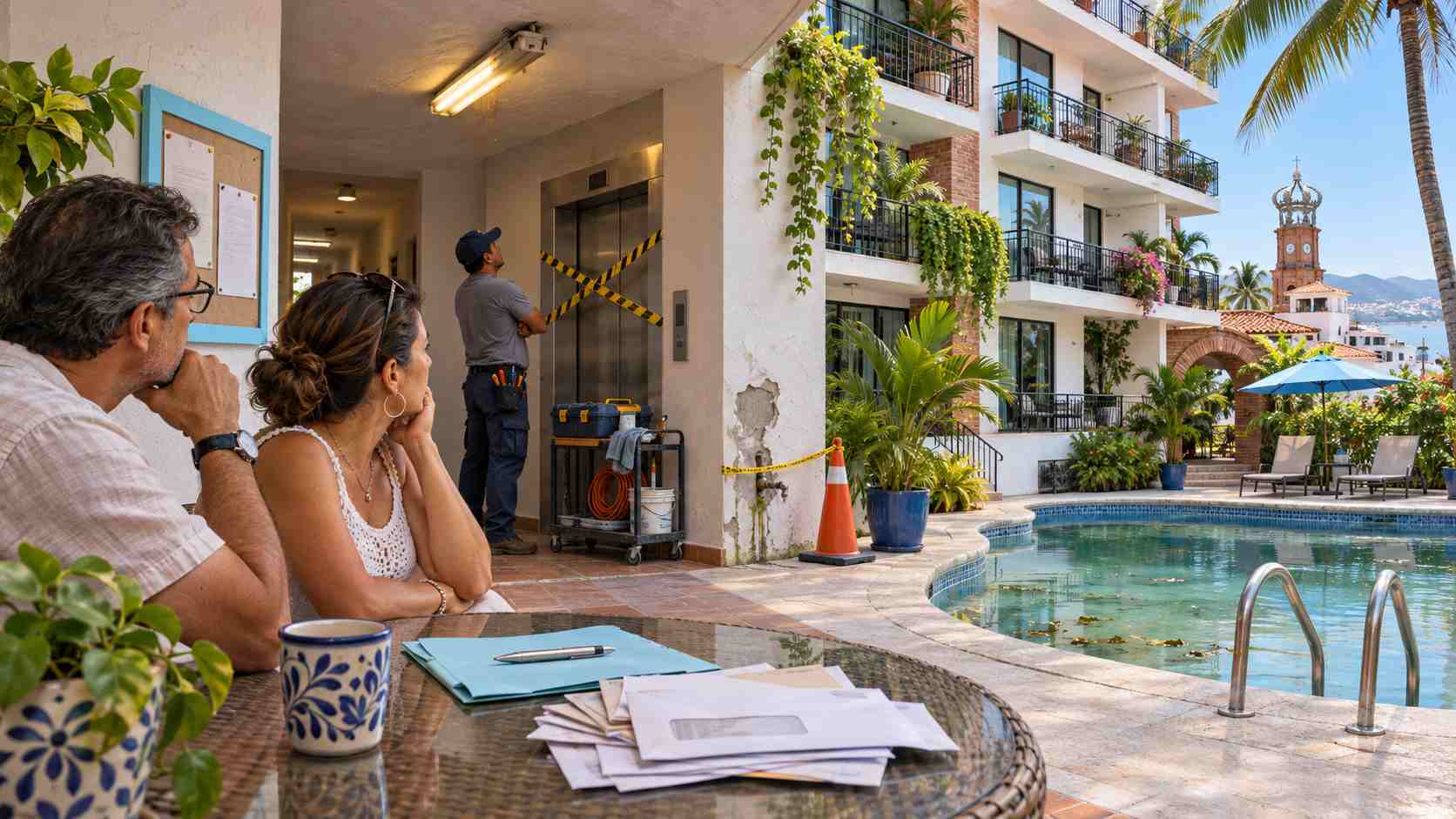
Then an email arrives from the building administrator. Maintenance fees are going up, the elevator needs an expensive repair, and the building doesn’t have enough money in its accounts.
Meanwhile, several of your neighbors haven’t paid their fees in months.
It’s one of the less pleasant realities of condominium ownership in Puerto Vallarta. You can manage your own finances exceptionally well and still find yourself financially exposed because of decisions made by other property owners.
And under Jalisco law, that exposure goes beyond the inconvenience of a poorly maintained swimming pool.
The state’s condominium legislation establishes circumstances in which owners may have to contribute more money when the condominium’s common funds aren’t sufficient to meet its financial obligations.
Understanding how your building manages its money is nearly as important as managing your own.
When someone else’s unpaid fees become your problem
Whether you own a beachfront condo in Marina Vallarta, an apartment near Calle Basilio Badillo in the Zona Romántica, or a unit in one of the newer residential developments in Versalles, the financial arrangement is broadly similar.
You own your individual property and share responsibility for maintaining certain parts of the building.
Depending on the development, your maintenance fees, known in Mexico as cuotas de mantenimiento, can cover security personnel, cleaning, gardening, swimming pools, elevators, common-area electricity, insurance, water pumps, administration and contributions toward future repairs.
Some of those expenses can be reduced when money gets tight. Others can’t easily be avoided.
Security employees still need to be paid. The Comisión Federal de Electricidad (CFE) still expects payment for electricity consumed in common areas. Elevators need servicing, and water pumps don’t stop wearing out because several owners are behind on their accounts.
Water infrastructure is a particularly relevant concern in Puerto Vallarta. Earlier this month, scheduled work by SEAPAL Vallarta along Avenida Francisco Villa affected water service in 16 neighborhoods.
For buildings equipped with cisterns and functioning water pumps, stored water can help residents get through temporary interruptions. But those systems also require cleaning, electricity, servicing and eventual replacement.
A condominium with financial problems may struggle to maintain the very equipment that makes living here more comfortable when municipal services are interrupted.
For an older resident living on the eighth floor, a broken elevator isn’t simply an inconvenience. It can affect whether that person can leave home independently.
How quickly a condominium can run short of money
Consider a hypothetical condominium in Puerto Vallarta with 40 equally assessed units, each paying MXN 4,000 a month in maintenance fees.
Under normal circumstances, the building collects MXN 160,000 every month.
Now imagine eight owners stop paying.
Monthly collections fall to MXN 128,000, leaving a shortfall of MXN 32,000 against the original budget.
After six months, the building is missing MXN 192,000 in expected income. After a year, that figure reaches MXN 384,000, before any applicable late-payment charges.
That’s a 20% reduction in income without necessarily reducing the cost of running the building.
An administrator facing that situation has limited options. Money can be taken from available reserves where permitted, certain expenses can be postponed, additional contributions can be proposed, or the condominium can pursue collection of the outstanding debts.
None of those options immediately replaces the missing money.
Even if legal action eventually results in payment, the building must continue operating in the meantime.
Can you legally be made to pay more?
This is where condominium ownership in Mexico can surprise foreign buyers.
Condominiums in Puerto Vallarta are governed primarily by the condominium provisions within the Código Civil del Estado de Jalisco, alongside their registered governing documents and internal regulations.
Article 1026 requires owners to contribute toward the operation and maintenance of their condominium and its reserve funds, generally according to the ownership percentage assigned to each unit. Certain facilities reserved exclusively for particular owners may be treated differently.
Article 1030 goes a step further. It establishes that the condominium’s common assets are used to meet its obligations. If those funds are insufficient, owners must cover the remaining amount proportionally to their ownership interests.
That doesn’t mean your neighbor’s unpaid maintenance bill automatically becomes a personal debt in your name.
It does mean that the condominium’s own financial obligations can require additional contributions from its owners.
If the building cannot pay an essential contractor or fund a necessary repair, owners may find themselves facing a properly authorized extraordinary assessment, known as a cuota extraordinaria.
You may have paid every maintenance bill on time for the past 15 years and still be required to contribute.
The original unpaid fees remain a separate collection issue.
When the reserve fund becomes the emergency fund
A well-funded condominium should have money set aside for expenses that don’t occur every month.
Roofs need waterproofing. Elevator equipment reaches the end of its useful life. Pumps fail, exterior walls require repairs, and swimming pool equipment eventually needs replacing.
Living near the ocean adds another layer of expense.
Buildings along Playa Los Muertos or the coastline toward Conchas Chinas are exposed to moisture, salt and coastal weather. Metal fixtures, railings, electrical components and mechanical equipment can deteriorate under those conditions.
Then there’s the rainy season.
Waterproofing that might appear unnecessary in February can become a much more expensive problem in August.
When condominium income falls short, using available reserves to cover immediate expenses may seem like the easiest solution. It can also conceal the seriousness of the building’s financial position.
Residents might continue seeing clean hallways, functioning elevators and security personnel at the entrance, unaware that the money intended for future repairs is being spent on everyday operations.
By the time a substantial repair becomes necessary, there may be little left.
A condominium can look financially healthy from the swimming pool while its bank accounts tell a very different story.
Empty condominiums still have bills
Puerto Vallarta’s property market includes permanent residents, snowbirds, second-home owners and investors who depend on vacation rental income to cover ownership expenses.
Their financial circumstances aren’t always the same.
An owner who rents out a condominium may experience several months of disappointing bookings. Someone living abroad might face unfavorable exchange rates, unexpected medical expenses or problems managing payments from another country.
Our recent examination of whether Vallarta vacation rentals can cover their expenses at lower occupancy levels looked at the financial pressures that can arise when rental income falls short of expectations.
Maintenance fees, however, don’t disappear when guests stop arriving.
Article 1008 of Jalisco’s Civil Code makes clear that owners aren’t relieved of their condominium obligations simply because they don’t use their property or certain common facilities.
Leaving your apartment empty for eight months doesn’t eliminate your share of the elevator maintenance. Never swimming in the pool doesn’t ordinarily exempt you from its upkeep.
The same principle matters in newer developments with unsold units. Owners should establish who holds legal ownership of those units, when their payment obligations begin, and whether the applicable contributions are actually being collected.
A financial report that separates occupied units from unoccupied units doesn’t necessarily tell you who is meeting their obligations.
What can the administrator do about owners who refuse to pay?
Jalisco law provides mechanisms for collecting overdue condominium fees.
Under Article 1028, late payments can result in interest-based charges, subject to the statutory limit and applicable condominium regulations.
Article 1029 provides a more substantial collection mechanism.
Once 90 days have passed since a payment became overdue, a properly prepared account statement signed by the administrator and approved by the president of the condominium board can qualify as a título ejecutivo.
In simpler terms, it can serve as the basis for an enforcement proceeding to collect the debt through the courts.
The statement must clearly establish how much is owed and where the debt originated.
There is no requirement to wait 90 days before sending payment reminders or attempting to resolve an outstanding balance. That period relates to the particular enforcement mechanism established in Article 1029.
For residents frustrated by years of unpaid fees, the law offers a potentially stronger remedy.
Under Article 1032, a condominium can pursue a court-ordered public auction of the condominium ownership rights of someone who repeatedly fails to meet their obligations.
Such action requires a properly approved extraordinary owners’ meeting, supporting legal documents and judicial proceedings.
It isn’t an automatic foreclosure after three missed payments. Nor can an administrator simply take possession of someone’s condominium.
Legal remedies exist, but they require documentation, time and money to pursue.
Can the condominium shut off an owner’s water or electricity?
This question can generate considerable disagreement among condominium owners.
Some may argue that anyone refusing to pay maintenance fees shouldn’t continue enjoying the facilities funded by everyone else.
There is an important distinction, however, between access to recreational amenities and access to essential services or one’s own home.
A condominium’s internal rules don’t automatically authorize administrators to disconnect utilities, prevent residents from entering their property or impose any punishment they consider appropriate.
Restrictions involving water, electricity, elevators, parking and other common facilities can raise separate legal questions concerning property rights, service contracts and residents’ access to their homes.
Administrators considering such measures should obtain legal advice specific to the building and the proposed restriction.
An aggressive collection tactic that results in a legal claim against the condominium could create yet another expense for the owners who are already paying their bills.
Renters aren’t necessarily outside the dispute
If you’re renting a condominium in Puerto Vallarta and your lease says that maintenance fees are included in your rent, you may reasonably assume that the building’s finances are your landlord’s responsibility.
But Jalisco’s condominium provisions deserve a closer look.
Article 1029 establishes joint and several responsibility between condominium owners and occupants or users for ordinary and extraordinary contributions.
How that provision applies in a specific rental arrangement requires careful legal review, particularly when a tenant has already paid the landlord everything required under the lease.
Renters should establish who is responsible for remitting condominium fees and what happens if those payments aren’t made.
It’s also worth keeping copies of rental payments and any correspondence confirming that maintenance fees are included.
Even when a dispute is resolved in the renter’s favor, living in a building with unpaid contractors, reduced services or neglected repairs can still affect everyday life.
You have a right to know how much other owners owe
You don’t have to rely entirely on conversations around the swimming pool to understand the condominium’s financial health.
Jalisco’s Civil Code sets out financial reporting duties for condominium administrators.
Under Article 1012, quarterly statements must be provided upon an owner’s request or made available at the administration office during the first 15 days of January, April, July and October.
Those reports must include:
- Expenses incurred during the quarter.
- Income and overdue maintenance contributions.
- A general list of debtors and the origin of their debts.
- Outstanding obligations to creditors.
- Available cash balances.
That gives owners considerably more information than a simple monthly announcement that the building is running short of money.
There is a difference between making financial records available to condominium owners and publicly shaming individual debtors. Administrators should handle personal information appropriately.
Owners should also ask for a breakdown of overdue accounts according to how long the balances have been outstanding.
One owner who is two weeks late because of a banking problem presents a very different situation from five owners who haven’t paid in two years.
The total amount owed matters. So does the age of the debt and whether management is actively pursuing it.
Not every unpaid bill means an owner is acting irresponsibly
Financial hardship is real. So are legitimate disputes over condominium administration.
Some owners may question charges that weren’t properly approved, unexplained expenses, inconsistent billing or a lack of access to financial records.
An administrator should be able to explain how an assessment was calculated, when it was authorized and what the money is being used for.
But withholding maintenance fees as a form of protest can expose an owner to interest charges and collection proceedings while reducing the money available to maintain the building.
An owner who believes a charge is improper should document the disagreement, request the relevant records and seek advice about the appropriate way to contest it rather than assume that refusing payment is legally protected.
Written payment arrangements may also offer a way to resolve genuine financial difficulties, provided the administration has the authority to enter into them and the terms are properly documented.
Resolving an outstanding balance through installments can be less costly than pursuing a lengthy dispute. It depends on the circumstances and whether the agreement is honored.
Low maintenance fees aren’t always good news
When shopping for a condominium in Puerto Vallarta, it’s tempting to compare monthly maintenance fees as though you’re comparing electricity rates or internet packages.
One building charges MXN 3,500 a month. Another charges MXN 6,000. Assuming everything else looks similar, the cheaper building may appear to offer better value.
But what are those fees actually buying?
One condominium might be setting aside money every month for major equipment replacement, maintaining adequate insurance and paying for preventive maintenance.
Another might be collecting just enough to cover immediate expenses, with little money allocated for future repairs.
Both buildings can have equally attractive lobbies.
As our Puerto Vallarta real estate coverage has examined, assessing a property involves more than looking at its location, finishes and asking price.
A condominium with higher monthly fees and strong reserves may carry less financial risk than a cheaper building with years of deferred maintenance and unpaid accounts.
The only way to meaningfully compare the two is to examine their finances alongside the physical condition of the buildings.
What happens when you want to sell your condominium?
Financial problems within a building can follow owners into the real estate market.
A prospective buyer may discover substantial outstanding condominium fees, depleted reserves, pending litigation or an upcoming extraordinary assessment while reviewing the property’s documents.
That information could influence an offer, delay a transaction or cause a buyer to look elsewhere.
There is also a specific legal requirement concerning the seller’s own outstanding fees.
Under Article 1029 Bis of Jalisco’s Civil Code, the notario público preparing a property transfer must require the seller to provide a certificate of no outstanding condominium debt issued by the administrator.
This document is generally known as a constancia de no adeudo.
For buyers, it’s a document worth discussing with their notario and independent attorney well before closing.
However, a certificate confirming that an individual unit has no outstanding fees doesn’t establish that the condominium as a whole is financially sound.
You could buy a property with a completely clean individual account in a building that owes substantial amounts to contractors.
Those are two different financial questions, and both deserve attention before money changes hands.
What to ask at your next condominium meeting
Jalisco law requires an ordinary condominium owners’ meeting at least once a year, within the first three months of the calendar year. The building’s financial condition and budget are among the matters that must be addressed.
With the end of 2026 approaching, this is a good time to begin reviewing those finances ahead of next year’s meetings.
If I were reviewing a condominium’s financial position, these are the questions I would start with:
- How much money should the condominium collect each month, and how much does it actually collect?
- How many units have outstanding balances?
- How much of that debt is more than 90 days overdue?
- How much money is currently available in the operating and reserve accounts?
- Have reserves been used to cover routine operating expenses?
- Are there unpaid invoices from contractors or utility providers?
- What collection action has been taken?
- Are any major repairs or extraordinary assessments expected?
- Are contributions from developer-owned units properly accounted for?
Requesting the answers in writing can help owners compare the building’s financial position from one quarter to the next.
For owners living outside Mexico, it may also be worth establishing whether the condominium permits remote participation in meetings or representation through an authorized proxy.
Missing a meeting doesn’t necessarily exempt an owner from properly adopted decisions, including financial contributions.
The expense you didn’t include in your retirement budget
Many people move to Puerto Vallarta after calculating what they can comfortably afford on a pension, retirement savings or another relatively fixed income.
Their monthly budget includes groceries, medical care, electricity, property taxes, maintenance fees and perhaps the occasional dinner out.
An unexpected condominium assessment of MXN 50,000, MXN 100,000 or more may be considerably harder to absorb. The amounts will depend on the building, its financial position and the work required.
This is why the financial health of a condominium belongs in the same conversation as its location, construction quality and monthly ownership costs.
You don’t need to know the personal financial circumstances of every neighbor in your building. You do need to understand whether the condominium is collecting enough money, maintaining sufficient reserves and taking reasonable steps to recover unpaid contributions.
The next time your administrator sends out a quarterly financial statement, look beyond the balance on your own account.
Check the outstanding debts. Look at the cash reserves. Find out which major expenses are coming.
Your maintenance account may show a zero balance, but if the condominium cannot afford to replace a failed elevator motor next summer, that zero balance won’t necessarily protect you from another bill.