Puerto Vallarta’s council approved neighborhood regularization and named a comptroller, but key questions about city finances remain unanswered.
Puerto Vallarta, Jalisco, November 27, 2026 – After more than two months without an ordinary City Council meeting, Puerto Vallarta’s municipal government finally got back to business Thursday night. Four neighborhoods moved closer to legal property ownership, a new municipal comptroller was appointed against the mayor’s original preference, and council members began clearing a backlog of unfinished business.
But some of the biggest questions facing Puerto Vallarta, particularly how the city intends to pay its bills and maintain basic public services, remain unanswered this morning.
The meeting came after eight members of the municipal government formally pressured Mayor Luis Ernesto Munguía González to convene the City Council after months of inactivity.
Thursday’s session also offered residents their first look at how the council might operate following the departure of several elected officials from the mayor’s Green Party bloc.
It didn’t take long for those political differences to surface.
A meeting that was long overdue
The session started approximately 30 minutes behind schedule, with council members spending another half hour debating changes to the agenda.
Among their first actions was the approval of minutes from five previous meetings, paperwork that had accumulated while the council was not holding ordinary sessions.
The political makeup of the council has changed considerably since September. Four council members and municipal trustee José Francisco Sánchez Peña have left the Green Party bloc to operate as independents.
Together with three members of Movimiento Ciudadano, they have pressed the mayor for answers about municipal spending, staffing decisions, public services and the city’s financial obligations.
Thursday’s meeting demonstrated that Munguía can no longer necessarily count on the same political support he enjoyed earlier in his administration.
Four neighborhoods celebrate after years of waiting
Away from the political disagreements, Thursday brought some genuinely good news for families living in northern Puerto Vallarta.
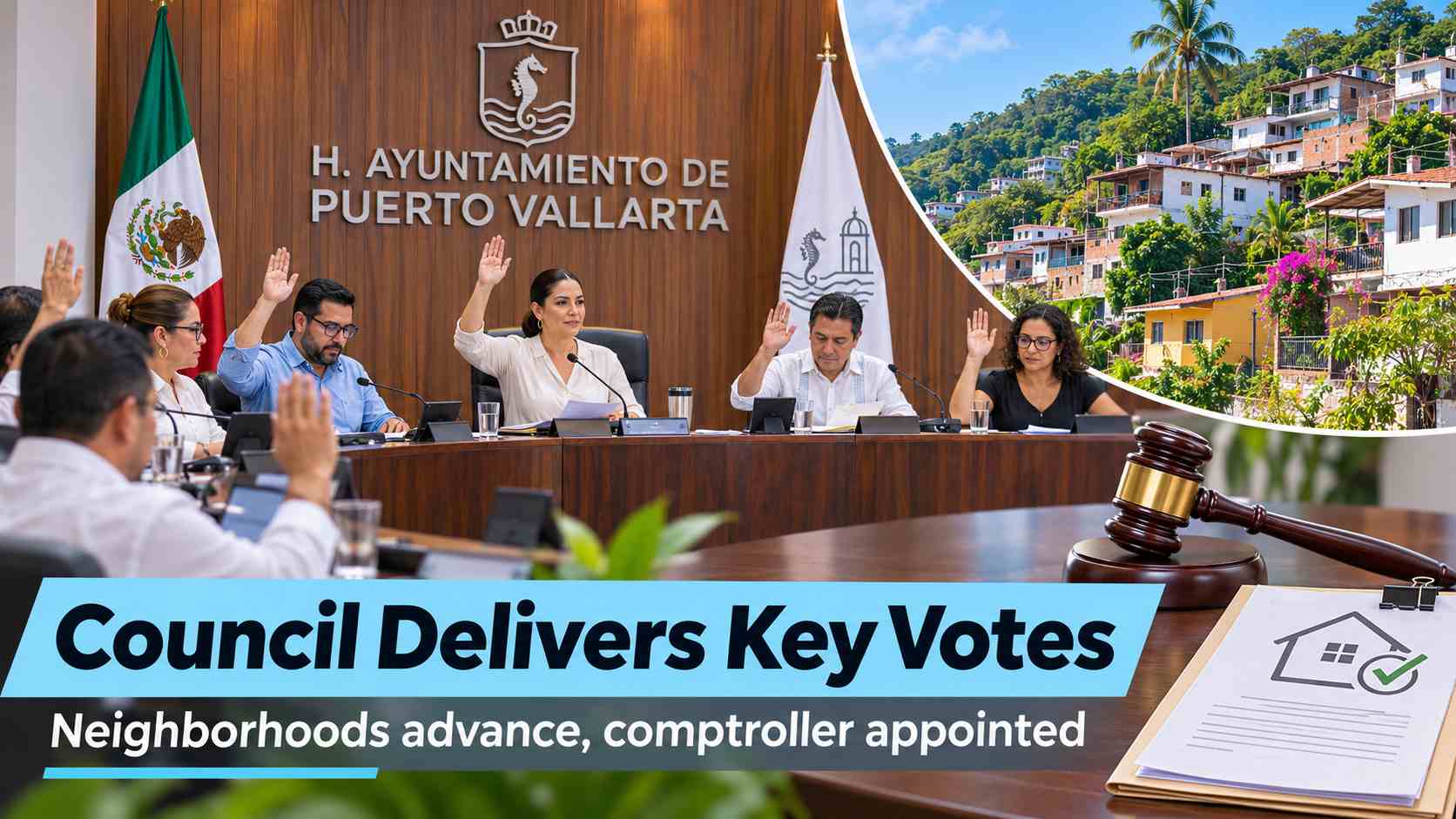
The council approved the regularization of four neighborhoods:
- El Mirador
- Colinas del Bosque
- Ampliación Colinas del Bosque
- Colinas del Bosque II
The approvals came from initiatives presented by Munguía and reviewed through the municipal planning and urban development commission.
For some residents, the decision represents the culmination of years spent trying to establish legal certainty over the land where they live.
Residents attended the session carrying signs thanking municipal authorities. Martha Meza, a resident of El Mirador, addressed the council on behalf of her neighbors, explaining that they had spent 13 years pursuing regularization.
Her remarks were met with applause.
The process falls under Jalisco’s law governing the regularization and titling of urban properties, which provides a legal mechanism for recognizing eligible property claims and bringing irregular settlements into the formal urban framework.
That does not mean every resident automatically received a property title Thursday night. Individual properties may still require documentation, recognition of ownership and registration.
Nevertheless, the approval represents an important step toward giving families greater security over their homes and the investments they have made in them.
Council members challenge the mayor over financial oversight
The night’s most significant political confrontation came over the appointment of a new municipal comptroller.
The position is particularly important given Puerto Vallarta’s current financial difficulties. The comptroller’s office is responsible for monitoring public spending, conducting internal audits and overseeing compliance within the municipal administration.
The office had been operating without a permanent leader following the departure of its previous comptroller.
An application process for a replacement opened in October, but the lack of ordinary council meetings delayed the appointment.
Municipal trustee Sánchez Peña raised concerns Thursday about leaving such an important oversight position without a permanent head, particularly while personnel changes were taking place across the government.
What followed was a lengthy debate over the legality of the selection process, the qualifications of applicants and the mayor’s proposed shortlist.
Munguía initially presented three male candidates. Council members challenged the exclusion of a female applicant who, according to information presented during the meeting, had satisfied the requirements.
After considerable resistance and discussion, the mayor agreed to modify his shortlist.
The council ultimately appointed Norma Gabriela Contreras Rodríguez as municipal comptroller, and she subsequently appeared before the council to take her oath of office.
Contreras Rodríguez is not new to municipal government. Official municipal procurement records from March 2025 identify her as a deputy director of auditing within the comptroller’s office.
Her appointment fills an important administrative vacancy. It also demonstrates that the reorganized council is prepared to challenge the mayor’s decisions and insist on changes.
Whether that translates into stronger financial oversight will depend on the work of the office in the months ahead.
The money problem hasn’t gone away
For municipal employees waiting for their salaries and year-end bonuses, Thursday’s political disagreements were secondary to a much more immediate concern.
Where is the money coming from?
As Vallarta Daily reported Thursday, approximately 300 municipal workers have been removed from the city’s payroll as the administration struggles to meet its financial obligations.
Munguía has been seeking an advance on government revenue allocations to cover salaries and mandatory year-end bonuses, known in Mexico as aguinaldos.
Before Thursday’s meeting, the mayor reportedly discussed an advance of between 100 million and 120 million pesos with the Jalisco state government.
Some council members have questioned whether additional resources should be authorized without a clearer explanation of the city’s current financial position.
Even if the council authorizes the request, that does not mean the money has arrived or that Puerto Vallarta’s broader financial difficulties have been resolved.
An advance would provide immediate cash, but it would also mean receiving money now that would otherwise be available to the municipality later.
As of Friday morning, the final vote, approved amount and conditions attached to the proposed advance could not be independently confirmed.
Other financial pressures remain
The municipal administration is not the only part of local government struggling to make it through December.
The Municipal Sports Council has requested nearly 7.7 million pesos to cover employee compensation and tax obligations. The municipal family services agency, DIF, is also seeking additional funding for 2027.
Meanwhile, residents continue to report unresolved water leaks and unreliable garbage collection, adding to concerns about the government’s ability to maintain everyday services.
Thursday’s meeting has not yet produced a confirmed resolution to those problems.
There is still a need for a clear accounting of outstanding municipal obligations, available funds, staffing costs and the resources necessary to keep public services operating.
What happens next at City Hall?
Thursday’s meeting accomplished several important things. It advanced housing regularization, restored permanent leadership to the municipal comptroller’s office and allowed elected officials to resume some of the work that had accumulated during the lengthy break between ordinary sessions.
It also provided an early indication of how the mayor and the reorganized council will have to work together.
Political disagreements are a normal part of municipal government. The more immediate concern for Puerto Vallarta is whether those disagreements prevent decisions from being made on issues affecting residents and municipal employees.
The formal resolutions and voting records from Thursday’s session were not yet available through the city’s public council records portal when this article was prepared.
With December only days away, municipal employees are still looking for assurances that their year-end payments will arrive, residents are waiting for improvements to basic services, and the council must still address the city’s spending plans for 2027.
Thursday was a return to work. There is plenty of work left.