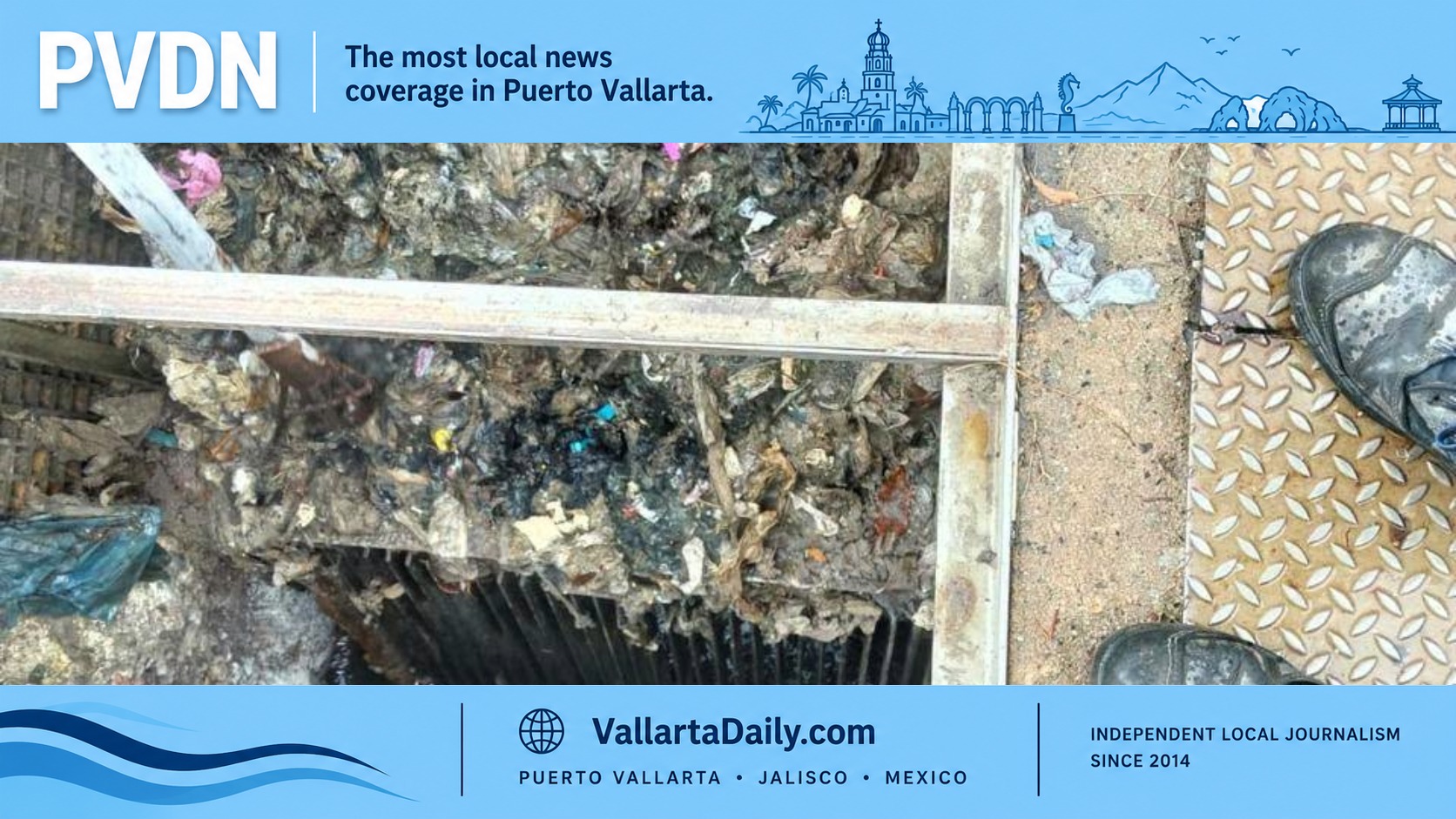
Puerto Vallarta, Jalisco, August 5, 2026 — SEAPAL crews were clearing blocked sanitary lines, cleaning pumping stations, and replacing a rain-damaged pump at North I this week after storms overnight August 2 and early August 3 disrupted part of the system. The work reached Las Glorias, where wastewater levels rose at a pumping station on Francisco Medina Ascencio and street sanitation was needed.
That is the immediate aftermath of a problem that repeats every rainy season. Puerto Vallarta does not flood because of one bad pipe or one dirty grate. Rain falls on steep hills and a dense urban plain before reaching the bay. It then meets street inlets, culverts, arroyos, river channels and, at times, a sanitary network already under stress.
The distinction is important when another storm is in the forecast. A road can fill even while nearby rivers remain below concern level. A separate wastewater spill can occur when pumps, pipes, or blocked grates restrict sanitary flow, even after the rain itself has moved on.
Rain has several routes
A published state risk atlas and a federal coastal vulnerability study describe a city shaped by water moving downhill toward the coast. Under extreme rainfall, the study identified the Río Pitillal and Río Cuale as watercourses with very high overflow vulnerability. Arroyo Vena de Santa Marta and Arroyo Los Camarones were rated medium-high.
That does not mean every flooded street is a river flood. Fast surface runoff can collect in a low block or a shallow intersection long before a river reaches its banks. Water can also back up where a culvert, inlet, or channel is partly blocked. The recent storm damage across the city included both flooded streets and obstructions in canals.
Sanitary overflows are another problem. They pose a different public health risk and require a different response. SEAPAL said its current crews found solid waste and trash blocking sanitary infrastructure, then used Vactor trucks at pumping stations and inspection wells. North I also lost a pump during the storm, while the Las Glorias pumping station needed work to bring wastewater levels down. That is why standing water with a sewage smell or visible wastewater should not be treated like ordinary rainwater.
Where repeat problems concentrate
The most useful way to judge a location is to look at its place in the water system, not a social-media list of streets. The lower stretches near the Pitillal and Cuale, and ground linked to the Vena de Santa Marta and Los Camarones drainage paths, deserve closer attention during sustained rain. The same federal study identified low terrain near Marina Vallarta, El Salado and the lower Pitillal area as especially exposed during storm surge. That coastal risk is different from a routine afternoon cloudburst, though a tropical system can combine both dangers.
Las Mojoneras, Ixtapa and Las Juntas sit within the north-side drainage conversation because runoff, canals and major road corridors meet there. The Avenida México project includes a central drainage channel in an area long associated with congestion and rainy-season disruption. Recent reports of standing water in Las Mojoneras are a reminder that a project in one corridor cannot resolve every nearby low point or blocked inlet.
Elsewhere, the issue can be much more local. Drainage complaints in Zona Romántica and Versalles have involved wastewater appearing on streets after even brief rain. A building’s grade, its nearest storm inlet, upstream construction and maintenance on a nearby pipe can change the outcome from one block to the next.
No public map should be read as a complete street-by-street prediction during an ordinary storm. A risk atlas is a good starting point, especially near rivers, arroyos, and the coast. Actual conditions still depend on how hard rain falls, where it falls upstream, and whether water has a clear path away.
A capacity problem as well as a weather problem
Desazolve work matters because it restores space inside channels, inlets and pipes. It cannot remove the force of a concentrated downpour. Municipal records list major cleaning and protection work on the Río Pitillal, along with cleaning of rivers, arroyos and canals across the city. SEAPAL’s August response shows how quickly that maintenance load can shift from prevention to emergency work.
There is also no single system that controls every kind of water. Street drainage moves rainfall. River and canal work keeps natural channels open. The sanitary network carries wastewater. They intersect on the ground during a severe storm, yet a failure in one should not be mistaken for a failure in all three.
That is also why a dry street after one storm is not proof that its risk has disappeared. Rainfall can arrive from another direction, collect in a different upstream basin or meet a blocked drain that was clear the day before. The system is tested by timing and volume as much as by its condition.
Planning around the next downpour
Move a vehicle away from a habitual low-lying parking spot before the first hard rain, if that option is available. Choose the route home before streets begin to fill, especially near river crossings, open channels and known north-side bottlenecks. Do not drive or walk into moving water, and keep clear of fallen cables, unstable trees and open drains. National Civil Protection rain guidance gives the same basic warning about street drains, rivers and exposed areas.
At home or in a business, keep paper records, electronics, and stored supplies above ground level if the property has flooded before. Do not lift manhole covers or try to clear a public drain during a storm. After the water recedes, avoid contact with any pooled water that smells of sewage until the area has been cleaned and is safe.
A blocked sewer, wastewater spill or recurring drainage problem can be reported through SEAPAL’s service channels, including 073, 322 226 9191, 322 226 9190 and WhatsApp at 322 105 8226.
The latest clean-up work will restore capacity at specific points. The larger pattern will return with the next hard rain. Choosing parking and a route before the storm arrives remains the most practical protection against a short, disruptive flood.