U.S. officials offer up to $10 million for information on cartel money networks, from fuel theft to shell companies and exchange houses in Mexico.
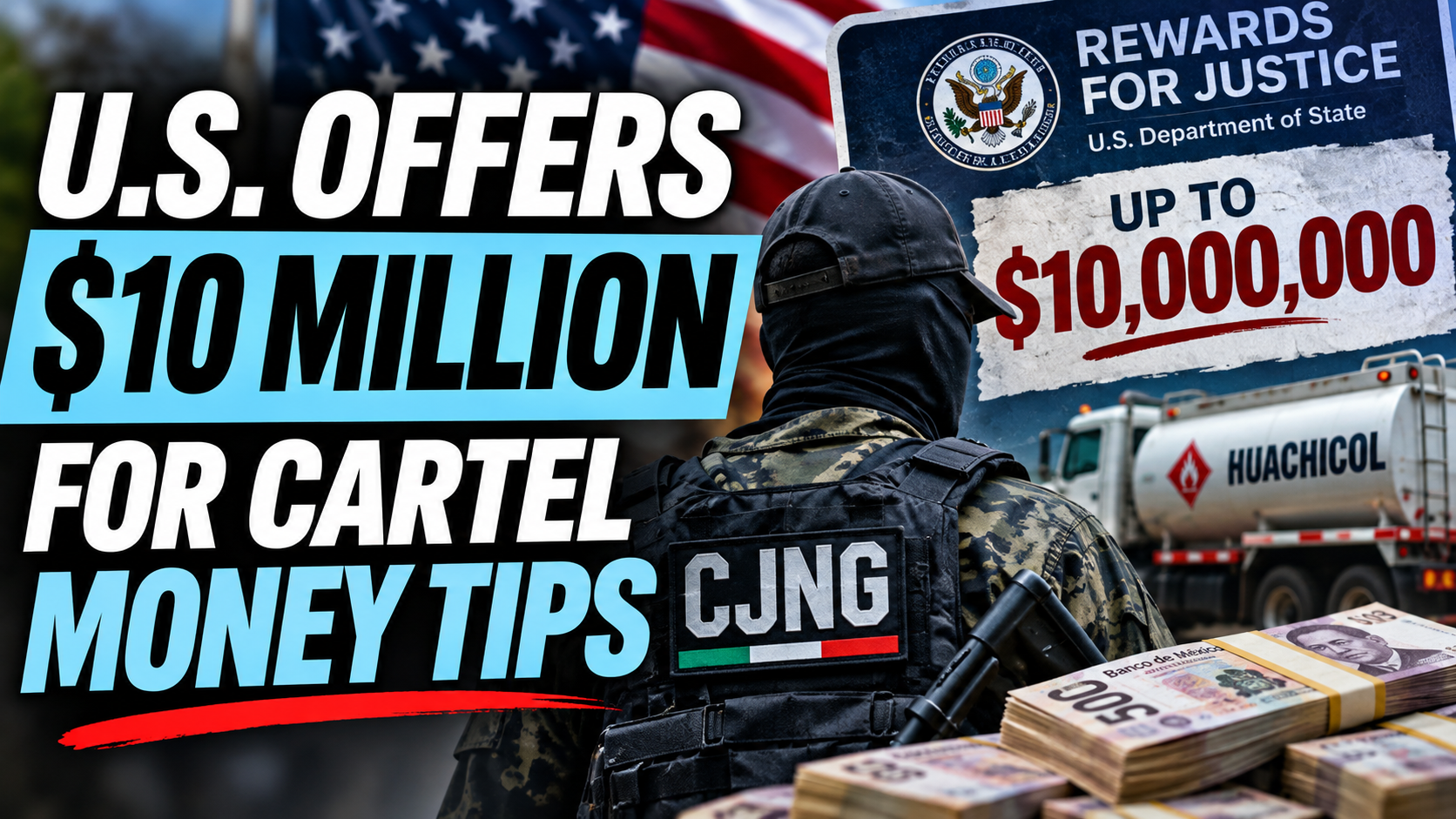
Mexico City, Mexico, November 19, 2026 – The United States is offering rewards of up to $10 million for information that helps disrupt the financial networks of Mexican drug cartels, widening attention beyond the people who traffic drugs to the businesses, bank accounts and money transfers that keep criminal organizations operating.
The U.S. State Department’s Rewards for Justice program identifies fuel theft, money laundering, real estate transactions and companies operating on behalf of criminal organizations as areas where investigators want information.
The U.S. Consulate in Tijuana renewed publicity for the reward offer on November 17, encouraging people with information about cartel finances to contact American authorities through confidential reporting channels.
The announcement drew new attention in Mexican media this week, although the underlying reward program predates November’s publicity campaign.
The offer covers information that could help authorities disrupt financing tied to organizations the United States has designated as Foreign Terrorist Organizations. Among them are the Cártel Jalisco Nueva Generación (CJNG), Cártel de Sinaloa, Cártel del Golfo, Cártel del Noreste, Cárteles Unidos and La Nueva Familia Michoacana.
For Jalisco, the inclusion of CJNG is particularly significant. American authorities have spent years investigating the organization’s financial operations, including networks connected to businesses, stolen fuel and international transactions.
Now Washington is encouraging people who know how those networks work to provide information that could help dismantle them.
The money behind the cartels
The reward program is aimed at something that receives less public attention than drug seizures and arrests: the financial systems that allow criminal organizations to continue operating.
A cartel can lose a shipment of drugs or have members arrested and still retain the money, businesses and connections needed to rebuild its operations.
Those financial arrangements can be complicated.
Money obtained through illegal activities may move through legitimate-looking companies, purchases of property, bank accounts or businesses that hide who actually controls the funds. In some cases, investigators say, the goal is to make money from criminal activity appear to come from ordinary commercial transactions.
The State Department identifies several types of information it wants, including transactions involving banks and currency exchange businesses, investments controlled by cartels, companies used to conceal ownership and transfers that benefit criminal organizations.
Investigators are also interested in people who knowingly help move or manage cartel money.
That doesn’t mean ordinary banking, exchanging dollars or investing in Mexican real estate is suspicious. The issue is whether a transaction or business is being used to support a designated criminal organization.
The reward offer is built around that distinction.
The U.S. government is looking for information that connects financial activity to cartel operations, rather than simply identifying people who work in industries where money laundering can occur.
Why fuel theft has become a major target
One of the most important parts of the American investigation concerns huachicol, the Mexican term commonly used for stolen or illegally traded fuel.
Drug trafficking remains a major source of cartel income, but American authorities say fuel theft and smuggling have become substantial businesses for some criminal groups.
In June, the U.S. Treasury Department announced sanctions against two Mexican nationals and nine companies accused of participating in a fuel-smuggling network connected to CJNG.
According to Treasury investigators, the operation involved fuel moving across the U.S.-Mexico border, false customs documentation and companies used to conceal the transactions.
The department said the scheme generated tens of millions of dollars annually for the cartel.
One company named in the investigation was Jomadi Logistics and Cargo, S.A. de C.V., a Mexican business involved in hydrocarbon import and export logistics.
American authorities accuse Jomadi of using false declarations and improperly classifying fuel shipments to avoid Mexican taxes while generating money for CJNG.
The State Department now has a specific reward listing for information about Jomadi, also offering up to $10 million for information that disrupts cartel financial networks.
Investigators want information about bank accounts, investments, companies and transactions connected to the business.
Treasury sanctions have already blocked the company’s property and financial interests under U.S. jurisdiction. American individuals and companies are generally prohibited from transactions involving those blocked interests unless an exemption or authorization applies.
Those sanctions are government administrative actions based on the Treasury Department’s findings. They shouldn’t be confused with criminal convictions against every person or business mentioned in an investigation.
The crackdown was already underway
The latest publicity campaign is part of a longer American effort to pursue the financial operations of Mexican criminal organizations.
On February 20, 2025, the State Department designated several Mexican cartels as Foreign Terrorist Organizations and Specially Designated Global Terrorists.
Those designations gave American authorities an expanded legal basis for targeting people and businesses accused of providing financial or other support to designated groups.
Since then, investigators have pursued cases involving fuel smuggling, drug proceeds, international banking transactions and companies accused of helping conceal criminal revenue.
The enforcement effort has reached beyond Mexico.
On November 13, the U.S. Department of Justice announced that Héctor Páez García had been sentenced to 41 months in federal prison for his role in a money-laundering organization serving the Cártel de Sinaloa.
According to prosecutors, Páez García helped launder approximately $52 million in illegal drug proceeds between 2020 and his arrest in 2023.
The organization used couriers to collect drug money in the United States. Funds then moved through bank accounts belonging to fictitious companies, Mexican accounts and cryptocurrency transactions.
American prosecutors said the wider investigation had led to charges against 51 defendants.
That case shows why financial investigations can remain active long after the original crimes occurred. Authorities can follow payments, accounts and transfers across several countries to identify people who helped handle the money.
The government has also offered separate rewards for information leading to the arrest or conviction of individual cartel leaders. In August 2026, American authorities announced reward offers totaling more than $100 million involving eight CJNG figures.
Those individual offers are different from the broader $10 million program seeking information about financial networks.
Why this matters in Puerto Vallarta and Jalisco
CJNG’s presence in Jalisco makes the financial investigation especially relevant to the region, although the latest general reward notice does not identify a new money-laundering operation in Puerto Vallarta.
The area has appeared in previous American investigations involving cartel financing and associated criminal activity.
In November 2024, Vallarta Daily reported on U.S. sanctions targeting a financial network associated with CJNG collaborators in Nayarit. The Treasury Department identified individuals accused of helping support the organization through financial arrangements.
More recently, Vallarta Daily examined how CJNG maintained its operations following the deaths and arrests of senior figures, including the importance of its financial networks and territorial relationships.
The current American reward effort fits into that broader pattern.
It also explains why investigators pay attention to industries that can handle substantial amounts of money, including property transactions, commercial investments and international payments.
Puerto Vallarta has an active real estate market, considerable international business activity and many residents who regularly exchange currencies or move money between countries.
None of those characteristics establishes wrongdoing. The reward notice makes no allegation that ordinary foreign property purchases, local exchange businesses or legitimate tourism investments are connected to criminal activity.
What investigators want are transactions that can be tied to organizations already identified under American terrorism and sanctions laws.
For legitimate businesses, the distinction matters because a company involved in a sanctioned network may face restrictions that affect financial institutions and customers beyond Mexico.
What the $10 million reward actually means
The advertised amount is a maximum, not a payment promised to anyone who submits information.
The official Rewards for Justice rules explain that rewards depend on the value of information and its contribution to an investigation or disruption of criminal activity.
A U.S. investigative agency or embassy must nominate a person for consideration. An interagency review follows, and the Secretary of State has the final authority to approve a payment and determine its amount.
The program also says it protects informants’ identities and may arrange relocation in certain circumstances.
Submitting information doesn’t automatically qualify someone for money, and American authorities have not announced a payment connected to this week’s renewed publicity.
The State Department accepts information through channels listed on its official Rewards for Justice website, including encrypted communications.
There is no requirement for an informant to personally investigate a cartel, confront suspected members or attempt to recover money. The program is designed to receive information that government investigators can examine.
For the six Mexican cartels included in the offer, the financial investigation can reach well beyond the individuals carrying out drug trafficking or other crimes.
It can extend to businesses, financial intermediaries, assets and transactions that authorities can establish are helping the organizations earn, conceal or move their money.
The government’s current offer remains up to $10 million for information that leads to the disruption of those financial operations, with any payment subject to the State Department’s review and approval.