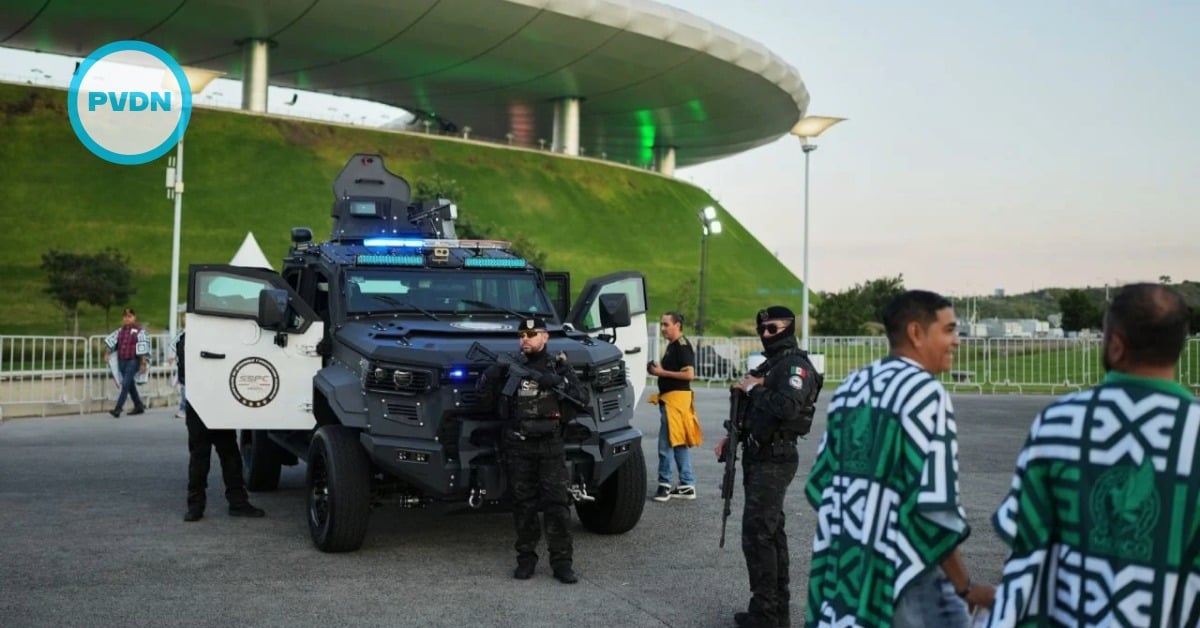
Mexico will host 13 World Cup matches and a wave of visitors. That’s the promise. The tension is that Jalisco—home to Guadalajara’s stadium—keeps surfacing in headlines about road blockades, arson and cartel turf wars. Officials say plans are in motion and stadium days feel safe. Yet recent reporting and travel guidance tell a more complicated story about routes, rural corridors and reputational risk. If Mexico wants the tournament’s glow, it must prove its security plan can handle the gaps between matchday calm and the rest of the week.
World Cup security Mexico
Mexico will share the 2026 tournament with the United States and Canada, with matches in Mexico City, Monterrey and Guadalajara. FIFA bills the event as a 48-team celebration that will draw unprecedented crowds and scrutiny. That spotlight lands squarely on Jalisco, where fans will travel through highways, airports, and neighborhoods that don’t always mirror the stadium bubble.
A new report highlights how organized-crime violence threatens the image Mexico wants to project in 2026, pointing to recent cases and patterns in Jalisco. The message isn’t that matches are unsafe by default; it’s that the broader ecosystem—roads, logistics, policing—can wobble when cartels flex.
Authorities have reasons to sound confident. Tournament days concentrate security resources, and Guadalajara’s airport and road network have invested heavily ahead of 2026. But confidence meets a stubborn backdrop: waves of blockades and arson across several states earlier this year showed how fast the Jalisco New Generation Cartel can disrupt daily life, even beyond its core turf. Those shocks weren’t aimed at soccer, yet they tell visitors what pressure can look like.
Jalisco is the stress test
Jalisco’s capital will host marquee matches and fan zones. Inside the Akron Stadium perimeter, police and stewards control the environment. Outside it, a different map applies. U.S. travel guidance still urges caution in parts of the state and restricts specific corridors for its personnel, a reminder that risk is uneven and route-specific, not uniform. That gap—stadium certainty versus regional variability—is where the World Cup plan must convince.
Recent on-the-ground reporting from Guadalajara captures that split screen: festive friendlies and visible patrols near the stadium. At the same time, security agencies fine-tune crowd control amid cartel headlines that never fully recede. The optics matter. Tourists reading about torchings or highway closures—months before kickoff—file those impressions away, fair or not.
Mexico’s federal and state governments say coordination is deepening with their North American partners, building playbooks for venue perimeters, transit hubs and cross-border intelligence. That track makes sense: the 2026 World Cup is a tricontinental operation, and Mexico’s piece will be judged on the seamlessness between arrivals, city movement, and matchday exits—not just on what happens inside the stadium bowl.
The next question is whether officials translate planning into street-level predictability. The metrics aren’t abstract: fewer last-minute road disruptions on key approaches to Guadalajara; clear, multilingual guidance for fans; consistent police presence along established fan routes; and rapid, credible communication when incidents occur elsewhere so rumors don’t dominate. Tournament hosts often win this game with transparency.
Mexico has pulled off big events before. It also knows reputations travel as fast as viral clips. With eight months until kickoff windows open, the country still has time to make the safer story the louder one—on the highways, at the terminals, and in the neighborhoods fans will discover between matches. World Cup security Mexico won’t be judged on a press conference, but on the week-to-week normal that surrounds the spectacle.