Public services in Puerto Vallarta are not handled by a single office, a single phone number, or a single level of government. That is the first thing to understand if you are moving here, renting long-term, buying property, or trying to solve a basic problem without getting bounced from one counter to another.
Some services are handled by the municipal government. Others are handled by SEAPAL, CFE, the state government, or private companies. A landlord, property manager, condo administrator, or neighborhood WhatsApp group may help point you in the right direction, but they are usually not the actual authority.
Once you understand who is responsible for what, Puerto Vallarta becomes much easier to manage.
The city handles the visible stuff
The municipal government of Puerto Vallarta is responsible for many of the public services residents notice first: trash collection, street cleaning, parks, public lighting, local roads, municipal markets, cemeteries, local permits, civil registry services, and public safety coordination.
That does not mean every issue gets solved quickly. Puerto Vallarta is a fast-growing coastal city with older neighborhoods, hillside streets, tourist zones, informal settlements, new subdivisions, and heavy seasonal pressure. Service quality can feel very different from one colonia to another.
In a central neighborhood, you may see trash pickup several times a week and municipal crews working around tourist corridors. In a more residential or outlying area, missed pickups, dark streetlights, potholes, water pressure problems, or drainage complaints may take more follow-up.
For everyday life, the important habit is simple: keep records. If you report a broken streetlight, missed garbage route, blocked drain, or damaged sidewalk, write down the date, location, nearby cross streets, and any report number you are given. A photo helps. So does the nearest landmark, because not every street address is easy for crews to locate.
Trash collection depends on your colonia
Garbage collection is one of the services newcomers ask about almost immediately, especially renters coming from places where trash bins, recycling carts, and fixed municipal calendars are standard.
Puerto Vallarta does not work that neatly in every neighborhood.
In many areas, residents put trash out shortly before the truck usually passes. In some buildings, the condo or property manager has a designated collection point. Along older streets, bags may be placed outside the door. In some colonias, neighbors know the schedule better than any website does.
That local knowledge matters. Putting trash out too early can attract dogs, cats, birds, insects, and street mess. Leaving large items on the curb without checking local rules can also create problems for neighbors and collection crews.
For a new rental, ask directly:
What days does garbage pickup usually happen?
Where should trash be placed?
Is there a separate system for cardboard, glass, yard waste, or bulky items?
Does the building have its own collection area?
Who handles complaints if pickup is missed?
Puerto Vallarta has had periods when garbage collection became a public frustration, so it is worth treating trash service as a real quality-of-life issue when choosing where to live. A beautiful apartment can become annoying fast if the street has constant waste problems or the building has no clear system.
Water and drainage are handled by SEAPAL
SEAPAL Vallarta is the local water, drainage, and sewer utility. This is the office residents usually deal with for water bills, water service, drainage problems, leaks, account changes, and no-debt certificates connected to a property.
For renters, the water bill may be in the owner’s name. Some landlords include water in the rent. Others ask the tenant to pay the bill directly. In a condo, water may be metered individually, included in maintenance fees, or handled through the building administration.
Do not assume. Ask before signing.
The water situation in Puerto Vallarta also varies by season and zone. During hotter, drier months, some neighborhoods may deal with lower pressure, scheduled work, or service interruptions. Hillside homes and upper-floor apartments can feel this more sharply than units closer to the main infrastructure.
A practical rental question is: Does the property have a tinaco, cistern, or water pressure system? A tinaco is the rooftop water tank common in Mexico. A cistern is a large storage tank, often at ground level or underground. These systems can make a big difference during low-pressure periods.
For buyers, SEAPAL paperwork matters during closing. A property may need proof that water service has no outstanding balance. Buyers should also confirm whether the property has legal water and drainage connections, especially with hillside homes, older construction, or properties outside the urban core.
Electricity is CFE, not the city
Electricity in Puerto Vallarta is handled by CFE, Mexico’s federal electricity provider. The city government does not manage your home power bill, home meter, reconnection requests, account issues, or power outage reports.
CFE bills are usually issued every two months for residential service. Many people pay through the CFE app, online, at CFE offices, or at authorized payment locations. Renters should ask whether the bill stays in the landlord’s name or whether they are expected to manage payment.
Air conditioning changes everything. A small apartment with moderate fan use may have a manageable bill. A larger unit running mini-splits every night in the humid season can be a very different story. Before renting, ask to see recent CFE bills from the hottest months, not only a mild-season bill.
For outages or electrical hazards, residents usually report through CFE’s official channels. If a power line is down, sparking, or creating immediate danger, treat it as an emergency and keep your distance.
Streetlights are different. A broken street light is generally a municipal issue. A power outage inside your home or building is usually handled by CFE, an electrician, the landlord, or the condo administration, depending on where the fault is.
Gas, internet, and private services are separate
Some services feel public because everyone needs them, but they are usually private.
Gas may come from a stationary tank, portable cylinders, or an all-electric setup. If the property uses a stationary tank, ask who orders gas, who has access to the tank, and how billing is measured. In condos, gas may be individual or shared through building systems.
Internet is handled by private providers. Service quality can change block by block. Fiber may be available in one building and not across the street. If you work from home, do not rely on a landlord saying, “There is internet.” Ask which company serves the address, what speed is installed, whether the router is inside the unit, and whether you can contract your own service.
Cable, mobile phone service, private security, bottled water delivery, private trash hauling, pest control, and building maintenance are also separate from municipal public services.
This is where many newcomers get confused. The city may be responsible for the street, but not your building gate. SEAPAL may handle the water main, but not the pump inside your condo. CFE may handle the meter, but not faulty wiring inside the apartment. A good landlord or property manager should know where each responsibility begins and ends.
Public safety and emergencies
For emergencies, 911 is the number to know. That applies to police, ambulance, fire, and urgent safety situations.
Puerto Vallarta also has local public safety, traffic, civil protection, and fire services. Protección Civil y Bomberos is especially important during storms, flooding, fires, landslides, hazardous trees, and other risk situations.
Foreign residents should also keep their consulate information saved. That is not a replacement for local emergency services, but it can help after an arrest, a death, a missing-person situation, a lost passport, a serious accident, or another consular matter.
For everyday safety issues, there is a difference between an emergency and a municipal complaint. For a crime in progress, fire, medical emergency, or immediate danger, call 911. A recurring noise problem, an abandoned vehicle, a broken streetlight, a blocked sidewalk, or a nuisance business may require municipal follow-up, neighborhood mediation, or a formal complaint.
For more information, visit the Puerto Vallarta Safety Guide.
Roads, potholes, sidewalks, and traffic
Puerto Vallarta’s roads take a beating. Rain, humidity, heavy buses, hillside runoff, construction, and constant traffic all play a role.
The municipality handles many local street issues, including potholes, street maintenance, sidewalks, signage, and traffic coordination, though not every road falls under the same jurisdiction. Larger highways, regional roads, and some infrastructure may involve state or federal authorities.
For residents, the practical issue is documentation. When reporting a pothole, damaged sidewalk, open manhole, or drainage hazard, include the colonia, street name, cross streets, direction of travel, and a photo. “There is a hole near the Oxxo” may work in casual conversation, but a better report is more likely to reach the right crew.
Traffic enforcement is handled locally through municipal transit authorities. For minor accidents, parking issues, blocked driveways, or traffic disputes, local police or tránsito may become involved. If you drive in Puerto Vallarta, keep your license, registration, insurance information, and vehicle documents accessible.
Public transportation is useful, but local
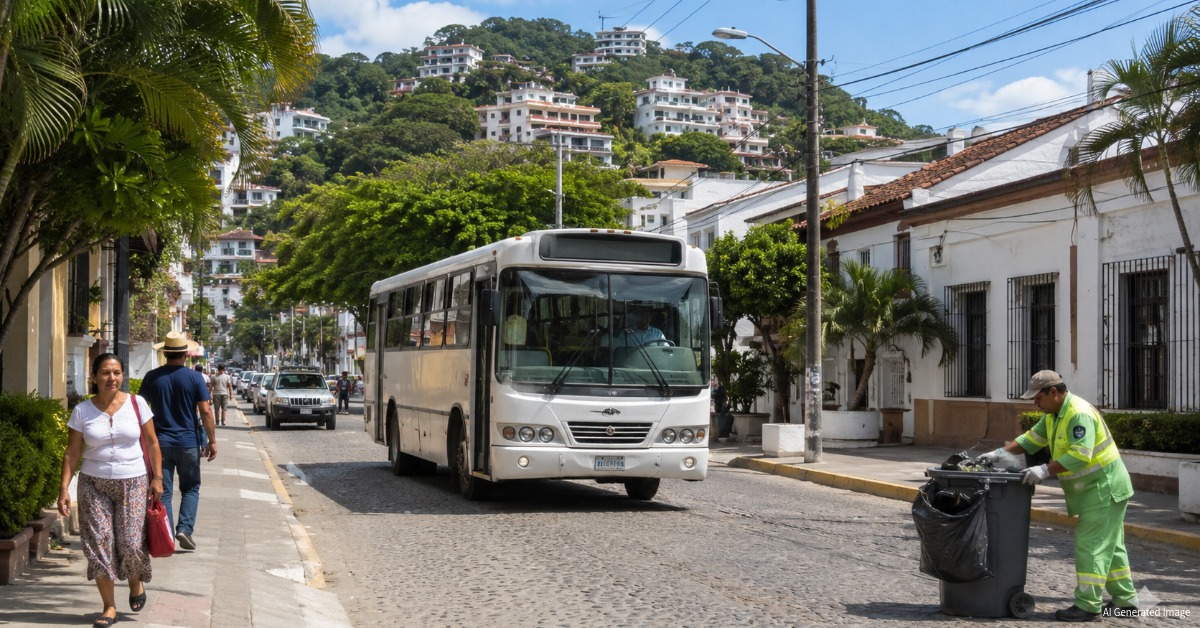
Puerto Vallarta has public buses that connect much of the city, including Centro, the Hotel Zone, Marina Vallarta, Pitillal, Ixtapa, Mismaloya, and Boca de Tomatlán, as well as routes toward parts of Bahía de Banderas.
The bus system is useful, cheap, and often the easiest way to get to know the city. It is also local in the truest sense. Routes are commonly identified by windshield signs, destination names, color patterns, and habit. Apps and route websites can help, but regular riders often learn by asking drivers or neighbors.
If you are living here without a car, choose housing with transportation in mind. A cheaper apartment can become less attractive if every grocery run, doctor visit, or evening out requires a taxi or ride-hailing trip.
Taxis and app-based rides are private transportation, not public services. They fill a real gap, especially at night or in areas with limited bus frequency, but they should not be confused with municipal transit.
Property taxes, permits, and city offices
Homeowners deal with the municipality through predial, the local property tax. This is usually paid annually, often with early-payment discounts. If you buy property, your notary, attorney, or closing team should verify tax status and related municipal documents.
The municipal government also handles many local procedures through its Trámites y Servicios system. These can include construction-related permits, business licenses, civil registry services, land-use matters, certificates, and other local paperwork.
Foreign residents are most likely to encounter municipal offices for:
Property tax payments
Construction or remodeling questions
Business licenses
Civil registry matters
Local certificates or records
Complaints connected to public space or neighborhood issues
Bring identification, copies, patience, and proof of address when dealing with offices. Requirements vary by trámite, and they can change. For anything involving property, construction, marriage, business activity, or legal status, get the requirement list before making assumptions.
What renters should confirm before moving in
Public services should be part of the rental conversation, not an afterthought.
Before signing a lease, ask how each service is handled. Get the answers in writing when possible.
Electricity: Who pays CFE? Is the bill current? Can you see recent bills from the hot months?
Water: Is SEAPAL included, separate, or handled by the building?
Internet: Which company provides the service, and is the account active?
Gas: Is it a cylinder, a stationary tank, shared, or electric only?
Trash: Where does it go, and when is pickup?
Maintenance: Who handles pumps, leaks, drains, air conditioning, and electrical problems inside the unit?
Condo fees: Are water, garbage handling, security, pool maintenance, or common-area electricity included?
These details are not small. They shape the real cost of living in Puerto Vallarta and the amount of daily friction you will deal with.
A landlord who cannot explain the utilities clearly may still have a good property, but it is a warning sign. At a minimum, it means you need more documentation before paying deposits.
What buyers should verify
Buying property adds another layer.
A buyer should confirm that municipal taxes, water bills, condo fees, and utility accounts are current. They should also understand whether the property has proper access to water, drainage, electricity, and street access, and whether it has permits for any construction or remodeling.
This is especially important with older homes, hillside properties, ejido-related histories, informal additions, or buildings that have been remodeled over time.
A polished listing does not answer these questions. Documentation does.
Buyers should ask their closing team to verify the property status, SEAPAL status, permits, property boundaries, land-use issues, and any municipal restrictions. A good real estate agent may help coordinate, but the legal and technical review should not depend only on the agent.
How to report problems without wasting days
The best reports are specific, polite, and documented.
Use the correct authority when you can. SEAPAL for water leaks and drainage problems. CFE for power outages or meter issues. The municipality for trash, streetlights, potholes, parks, sidewalks, and local public-space problems. Emergency services for immediate danger.
Include the basics:
Exact location
Colonia
Cross streets
Photo or video
Date and time
Brief description
Contact number
Report number, if provided
Follow up without starting from zero each time. “I reported this on Tuesday at 9 a.m. and was given report number X” is stronger than repeating the complaint as if it is new.
For condo residents, the administrator may need to report building-related problems. In the case of renters, the landlord should handle issues inside the property unless the lease says otherwise. For neighborhood-wide problems, several residents reporting the same issue can help show that the problem is not isolated.
The public service reality in Puerto Vallarta
Puerto Vallarta works, but it does not always work in the way newcomers expect.
The city has real public infrastructure, official agencies, emergency services, public offices, and utility systems. It also has uneven service, seasonal pressure, rapid growth, aging infrastructure, and a local problem-solving style that often relies on persistence.
The people who adapt best are not the ones who expect everything to function as it did back home. They are the ones who learn the local map: who handles water, who handles electricity, who fixes the street, who manages the building, who collects the trash, and who needs the report number.