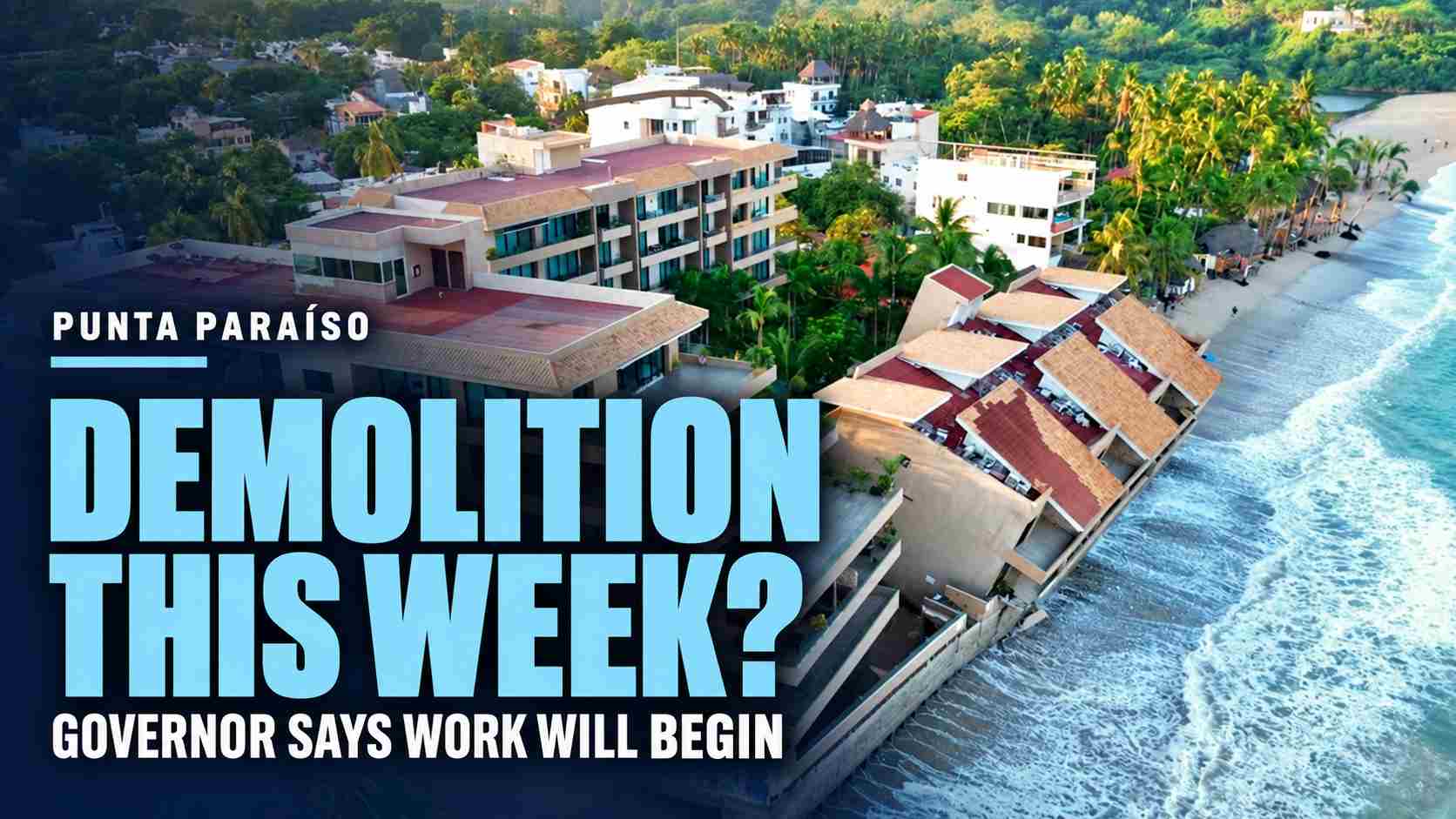
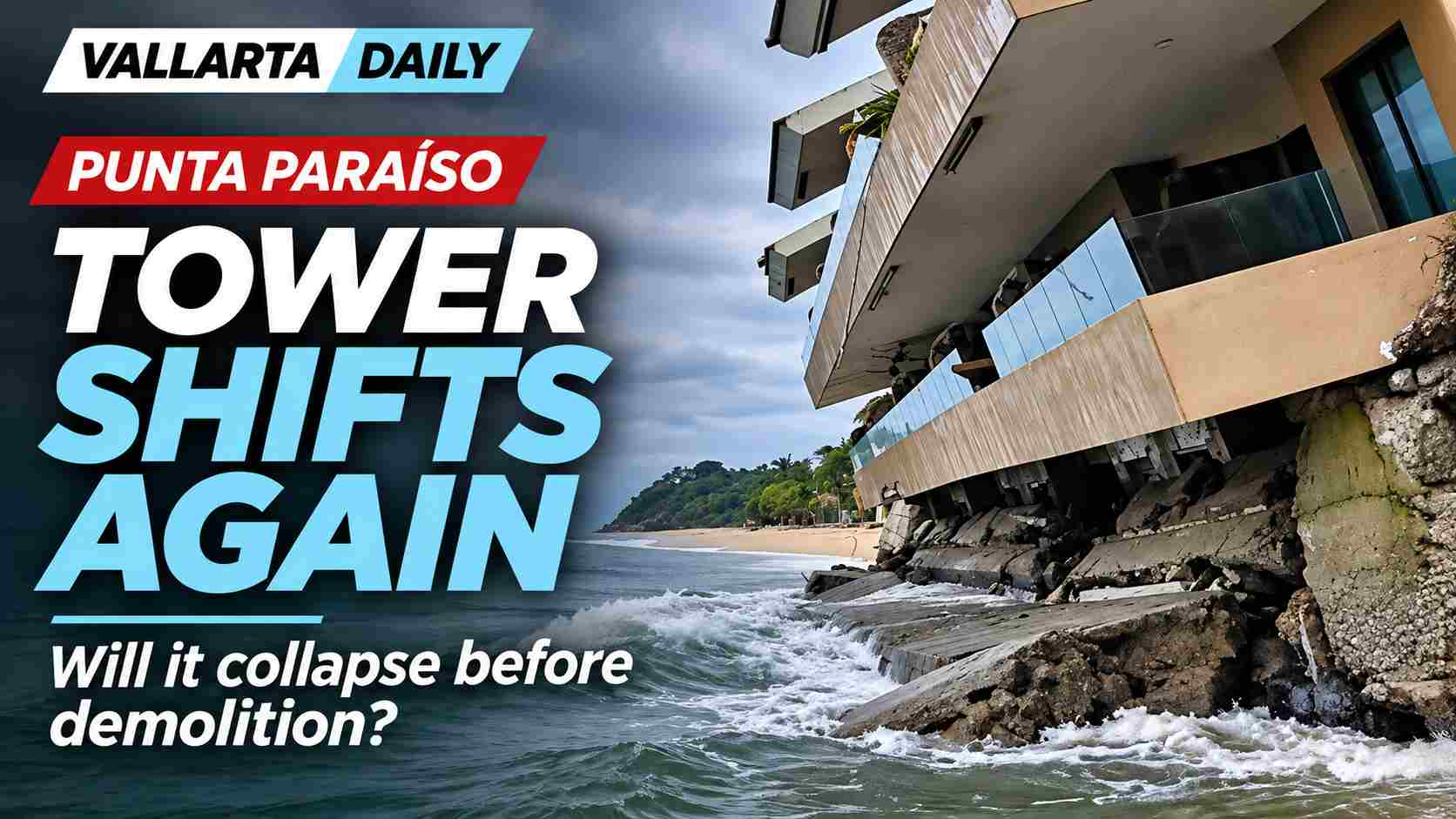
San Pancho, Nayarit, November 3, 2026 — Punta Paraíso’s first condominium tower reportedly shifted again on Monday as waves battered its foundations, while authorities continued preparing to demolish it.
The latest movement raises an increasingly urgent question for authorities in Bahía de Banderas. Can the damaged building remain standing long enough for demolition crews to bring it down safely?
Photographs published Monday show extensive deterioration around the tower’s foundations and an increasingly pronounced lean toward the Pacific Ocean. The retaining wall and concrete surrounding its base have developed fractures, while sections of damaged material lie scattered around the building.
The first-floor balconies are now approximately two meters above the water, according to Tribuna de la Bahía. Waves have continued striking the weakened foundation for more than a month.
The images document worsening conditions, but they do not establish how much longer the structure can remain standing. That determination would require a current engineering assessment.
The danger is not new. The complex was evacuated and closed in early October after powerful surf associated with Hurricanes Polo and Rachel undermined its foundations. Vallarta Daily reported additional structural damage and a partial collapse on October 21.
The development contains three towers. The first is considered the most seriously compromised, the second has also sustained significant damage, and the third has been described as less severely affected.
Demolition has been approved, but work cannot begin immediately
On October 30, the Bahía de Banderas municipal council approved a proposal from Mayor Héctor Santana García to move forward with demolishing tower one.
The estimated cost is MXN 8,932,000, approximately 8.93 million pesos. The measure passed with 11 votes in favor, none against, and one abstention.
The approval represents an important step, but it does not mean contractors can immediately begin dismantling the building.
According to reporting on the council session, municipal legal director Marcos Parra Becerra explained that interested parties must first receive formal notification and an opportunity to respond within the applicable legal deadlines.
The municipality must also complete the necessary technical, contracting and administrative procedures before carrying out the demolition.
Municipal trustee Daniela Sahagún Flores, who abstained from the vote, questioned the decision to combine authorization of demolition, contractor selection, public spending and possible cost recovery into one measure.
She argued that the municipality should first establish that the necessary notifications, technical documentation, permits and budget provisions were properly supported. She did not oppose protective measures or a legally justified demolition.
Santana defended the combined proposal, arguing that the actions followed agreements reached with federal authorities and the Municipal Civil Protection Council.
The mayor has also acknowledged how little time may remain.
Speaking about the structural assessments, Santana said the building was “practically on the verge of collapse.”
He expressed hope that demolition could take place during the following week. However, that was an anticipated schedule, not a confirmed start date.
The federal government has already authorized emergency work
One significant obstacle has already been addressed.
Mexico’s Environment Ministry, Semarnat, issued an emergency authorization dated October 23 permitting the Bahía de Banderas government to demolish and remove structures at Punta Paraíso.
The federal authorization cites severe erosion, undermined foundations, damaged retaining walls, and other structural failures associated with extraordinary waves and storm conditions.
The authorization also requires the municipality to remove demolition debris promptly, prevent waste from contaminating the beach and ocean, and comply with applicable Civil Protection and environmental requirements.
The document provides federal permission for the intervention, but it does not eliminate the remaining municipal procedures.
The development has also been the subject of a lengthy dispute involving construction on federal coastal land. As Vallarta Daily previously reported, a federal court upheld the demolition of two towers in October following years of legal and environmental challenges.
That creates an important distinction between the broader legal dispute and the current emergency response.
Although the court ruling concerns two towers, the municipal council’s October 30 authorization specifically addresses the immediate demolition of tower one.
Meanwhile, Nayarit Governor Miguel Ángel Navarro Quintero announced on October 28 that demolition would begin that week. Latest reports show that administrative preparations are still underway.
A controlled demolition also carries risks for San Pancho
Bringing down a heavily damaged condominium building immediately beside the ocean is considerably more complicated than demolishing a structure on an ordinary urban lot.
Crews must establish a safe working area, arrange access for heavy machinery, and prevent falling materials from creating additional hazards along the shoreline.
Roberto Rodríguez Medrano, the Nayarit representative of Mexico’s Federal Environmental Protection Agency, Profepa, has explained that the demolition requires coordination among municipal, state, and federal authorities.
Rodríguez Medrano acknowledged that the building’s size and proximity to the water make it impossible to guarantee that no debris will enter the ocean.
Authorities are considering containment barriers to reduce that risk. Cleanup and restoration of affected beach areas would follow the demolition.
The environmental concern is particularly significant because the development occupies a sensitive coastal area associated with sea turtle nesting.
The consequences also affect surrounding businesses and beach users.
Rodríguez Medrano said a nearby restaurant would need to suspend operations because of its proximity to the demolition site. Authorities must also determine how trucks and machinery will reach the beachfront work area.
Those preparations are intended to protect workers, neighboring properties, and the coastline during a controlled removal.
An uncontrolled collapse would leave authorities without the same opportunity to manage how concrete, glass, construction materials and potentially household contents enter the surrounding environment.
Who will pay for the demolition?
The estimated 8.93 million peso cost adds another layer to the municipal government’s decision.
Officials have indicated that Bahía de Banderas and the Nayarit state government will initially cover the emergency work rather than wait for the developer or property owners to finance the intervention.
Authorities intend to pursue reimbursement through subsequent legal and fiscal procedures against responsible parties.
That means the government is preparing to spend public resources immediately, with the possibility of recovering those funds later. Whether the full amount can ultimately be recovered remains uncertain.
For the municipality, delaying intervention until those financial disputes are resolved could leave an already unstable structure exposed to further wave damage.
The authorities must therefore manage two separate processes: addressing the immediate safety emergency and determining who ultimately bears the financial and legal responsibility.
The second can continue after demolition. The first depends on how quickly authorities can complete the remaining preparations.
For residents and visitors in San Pancho, the immediate concern remains the building’s condition. The condominium complex is closed to occupants, and authorities continue to treat the damaged structures as a safety hazard.
As of November 3, no confirmed demolition start date has been announced. Tower One remains standing, its foundations visibly damaged and its lowest balconies only a short distance above the surface.
The municipal council has authorized the intervention, and federal environmental permission has been granted. What remains unresolved is whether the crews can reach the building before the next major structural failure.