
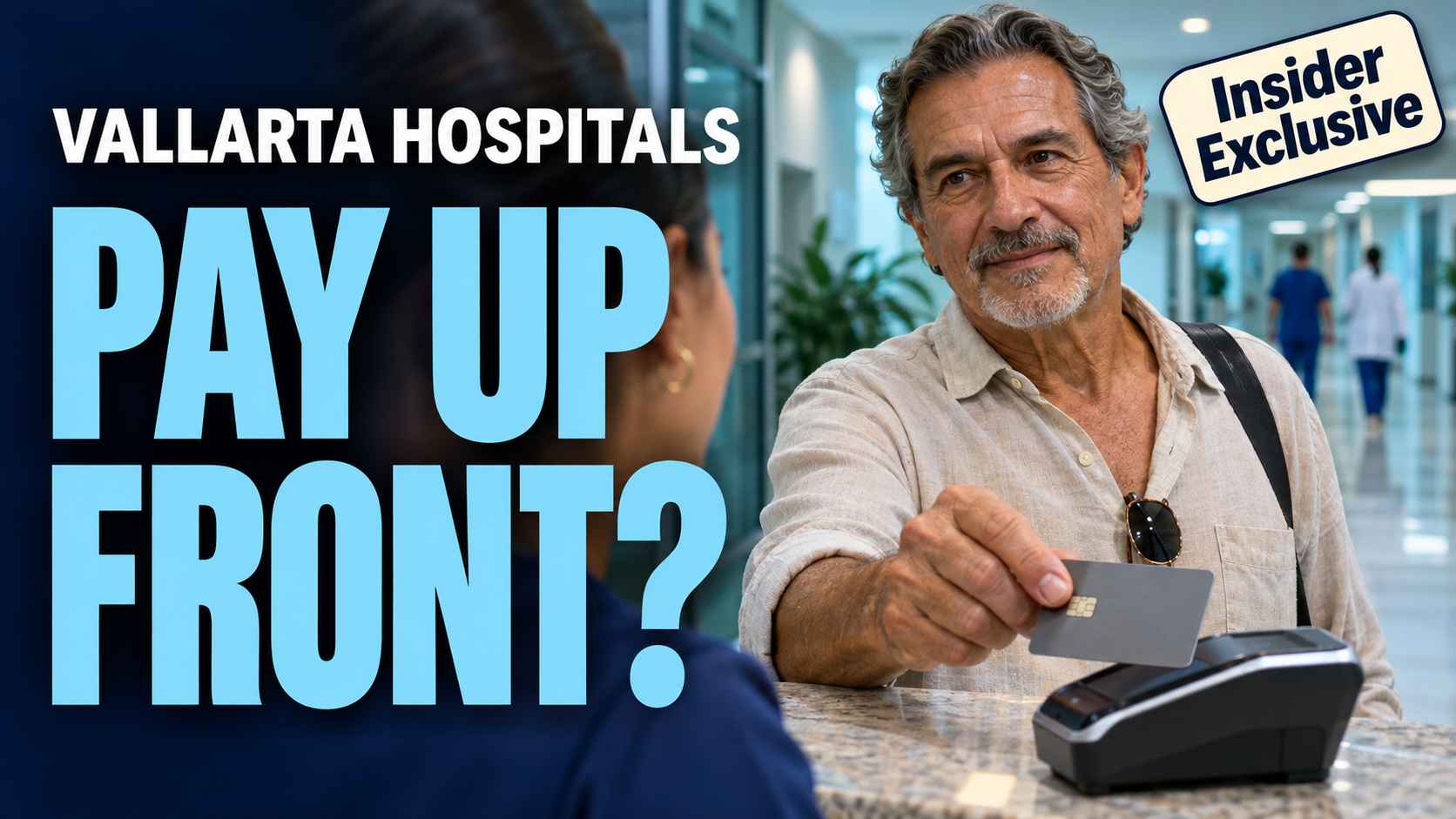
Private hospitals in Puerto Vallarta may ask for a deposit or card hold. Learn when emergency care must start and how insurance changes what you pay.
A private hospital in Puerto Vallarta may ask for a deposit or put a hold on your card when you’re admitted, even if you have health insurance. Hospital CMQ’s guide for patients with Mexican insurance says the amount depends on your condition and the terms of your policy. Its public guidance gives no flat peso amount to budget for.
Mexico’s emergency-care rules put the medical assessment first. If you need immediate care, the hospital has to assess you and treat the emergency or stabilize you for transfer. The deposit comes into play with the paperwork for your stay.
What this means if you live here
If you spend the winter in Vallarta or live here year-round, ask your insurer how much you might have to pay on the day you go to the hospital. A policy can cover the treatment and still require you to pay first, then file for reimbursement. The U.S. State Department’s Mexico advisory warns that some insurers may have nobody available to authorize payment at night or on weekends. Ask who answers after hours and save that number with your policy details.
Confirm the hospital by name and location. CMQ Centro is at Basilio Badillo 365 in Emiliano Zapata. CMQ Premiere is at Avenida Francisco Villa 1749 in Vallarta Villas. Hospital Joya Marina Vallarta is at Boulevard Francisco Medina Ascencio 2760 in Zona Hotelera Norte. If your insurer says it works with a hospital group, ask it to confirm the specific location and whether it can pay that hospital directly under your plan.
In September, PVDN checked three private hospital operators and found that none published a complete cash-price schedule online for an emergency room visit. For a planned admission, ask the hospital’s billing office for the amount in pesos and what it covers. That gives you a figure you can use before the day you go in.
When emergency care has to start
Under Articles 71 through 74 of Mexico’s federal health regulations, public and private hospitals that take inpatients must provide immediate care for nearby emergencies. The rule covers an acute condition that threatens a life, an organ, or a bodily function and needs immediate attention. The emergency department must arrange a medical assessment, treat the emergency, or stabilize the patient for transfer. If the hospital lacks the resources to complete treatment, the regulation requires transfer to a facility that can provide it.
For a medical emergency in Vallarta, call 911. A companion can deal with the insurer while you’re being seen. “For emergencies, we begin care immediately and handle authorization in parallel,” CMQ says in its guide for international patients. The hospital can still bill for the care it provides.
A deposit and a card hold work differently
At the admissions desk, you might hear anticipo, an advance payment, or garantía, a payment guarantee. CMQ’s Mexican insurance guide says the guarantee can take the form of a deposit or a card authorization. An advance payment goes toward the bill. A credit card hold temporarily reduces how much credit you can use while the transaction is pending. That matters if you’re counting on the same card to pay a separate doctor’s bill or cover the balance at discharge.
One question clears it up at the desk. ¿Es un cargo o una preautorización? Is it a charge or a hold? If it’s a charge, ask how it will show up on your bill and how the hospital handles any remaining amount. If it’s a hold, ask when the hospital expects to release it and get a copy of the authorization slip.
What your insurance may pay directly
With direct billing, the insurer pays the hospital for the charges it approves. With reimbursement, you pay the hospital and submit a claim to the insurer for eligible expenses. Even with direct billing, you may owe a deductible and coinsurance, your share of covered costs after the deductible. Ask whether the insurer’s approval covers the doctors’ fees as well as the hospital’s charges.
CMQ says it can bill some U.S., Canadian and international plans directly, depending on the policy. Hospitales Joya says it works with Mexican and international insurers, and Hospital Medassist says its insurance staff help with authorizations for emergencies and planned surgery. Ask whether your insurer has actually authorized direct payment for your visit and what the hospital expects you to cover while it waits.
For U.S. retirees, Original Medicare rarely covers care outside the United States. Some Medigap plans cover foreign travel emergencies that begin within the first 60 days of a trip. Medicare Advantage benefits can vary by plan. If you’re here for several months, check whether your coverage lasts through your return date.
Canada’s travel insurance guidance says provincial or territorial plans may pay little or nothing for care abroad and won’t pay up front. If you use a separate travel policy, check how long it covers, what it says about pre-existing conditions, and who arranges payment if you’re admitted.
Before a planned stay, get the amount in writing
Mexico’s 2008 standard for directly billed medical care requires providers to make a price list available. When an advance payment applies, the list must show the amount and how the provider refunds or credits it. The standard also requires providers to spell out what’s included in a package. The federal government revised its 2026 work program, and the Economy Ministry still lists the 2008 standard as in force. For a scheduled procedure, ask for the hospital’s estimate and find out whether the surgeon or anesthesiologist will bill you separately.
If you’re admitted without a package price, ask the billing office for the running statement. The same standard calls for a daily statement when the provider uses a standard-form contract. Use it to check whether the deposit appears on the account while there’s still time to ask about it.
What to take home from the billing desk
Ask for an itemized bill, proof of payment, and the resumen clínico, the medical summary your insurer may ask for. Federal health regulations require the hospital to provide that summary on request after an inpatient stay. If someone is handling the paperwork for you, PVDN’s guide to hospital consent and records when a partner speaks little Spanish covers what they may be asked to sign or show.
The hospital can ask you to settle the bill. Article 85 of the federal regulation bars it from holding a patient to secure payment. If you dispute a charge, ask the billing office to show where it came from on the itemized statement. Profeco’s consumer line can explain the complaint process at 800 128 8722. Keep the estimate, receipts, and any written approval from your insurer together.
If the hospital says it released a card hold, ask for the cancellation slip or reference number before you leave. That’s the number you can give your card issuer if the hold is still tying up your credit after you get home.