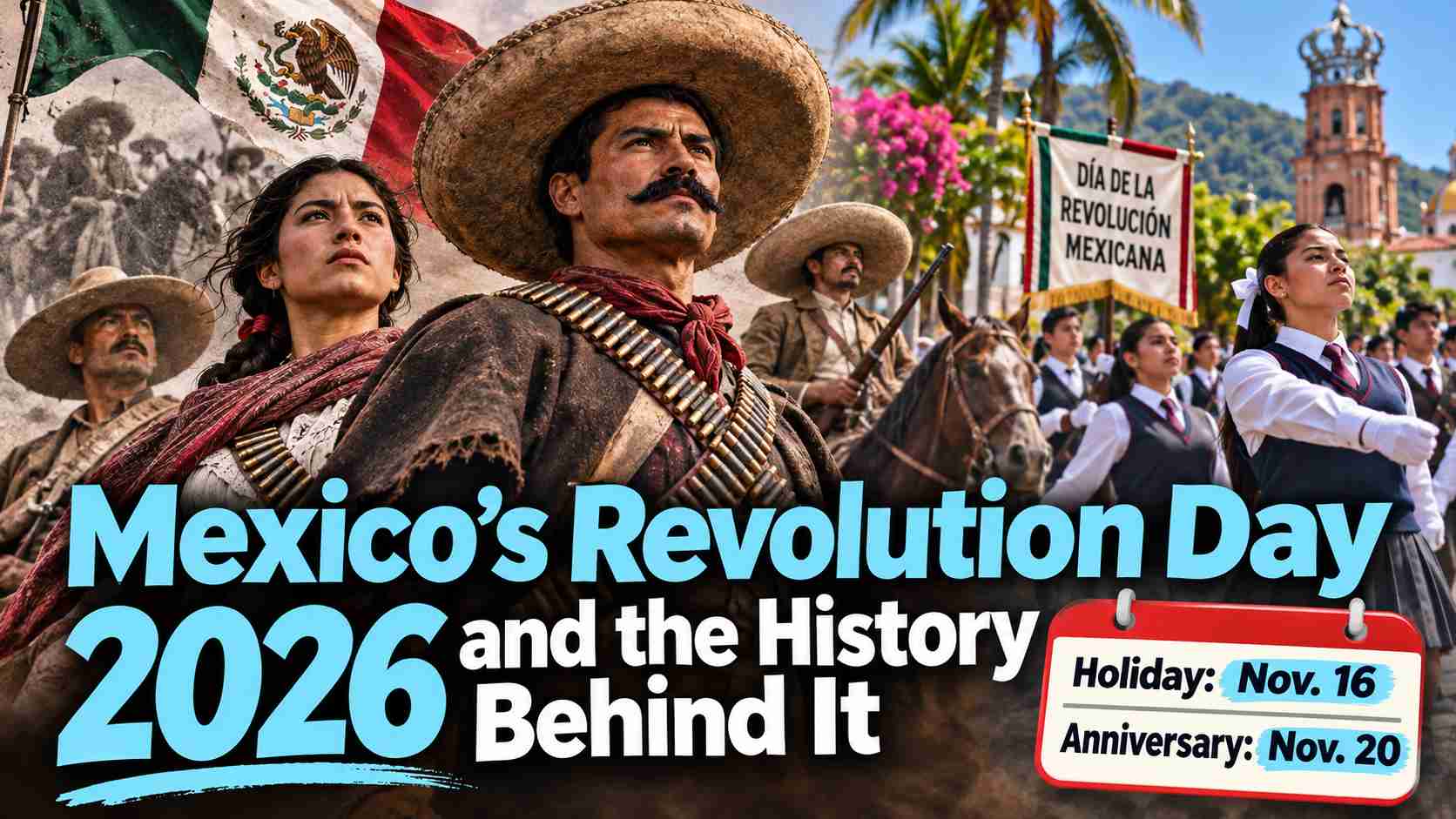
Mexico’s Revolution Day holiday is November 16 in 2026. Here’s the history behind the November 20 anniversary and Puerto Vallarta’s parade plans.
Mexico will observe Revolution Day as a national public holiday on Monday, November 16, even though the anniversary of the Mexican Revolution falls on Friday, November 20. This year marks 116 years since Francisco I. Madero called on Mexicans to take up arms against President Porfirio Díaz, starting a conflict that would change the country’s government, its Constitution, and the rights of millions of people.
Here in Puerto Vallarta, the two dates have different purposes. Monday is the official day off for workers and students covered by the national holiday rules. Friday is when the city plans to hold its traditional Revolution Day parade, bringing school groups into the streets for the anniversary itself.
The Mexican Revolution is one of those historical events that almost everyone in Mexico knows by name. Its leaders appear on street signs, monuments, school walls, and currency. Yet the history behind November 20 is considerably more complicated than the familiar pictures of men on horseback wearing ammunition belts.
It began as a campaign against a president who wouldn’t leave office. Within a few years, the man who led that campaign had been assassinated, the people who helped him win were fighting one another, and Mexico was trying to decide what kind of country would emerge from the violence.
The story also reaches Puerto Vallarta. When the revolution began, the city didn’t yet have its current name. It was a small coastal settlement called Las Peñas, and the fighting eventually reached its streets.
Why November 16 is the holiday, but November 20 is the anniversary
Revolution Day is observed on the third Monday of November rather than automatically on November 20.
In 2026, that Monday is November 16.
For workers covered by the federal labor law, it’s a mandatory paid day of rest. Those required to work must generally receive their regular day’s pay plus double pay for the work performed. That’s three times the ordinary daily wage.
The 2026–2027 school calendar also suspends classes on November 16 for public and incorporated private schools covered by the national calendar.
Federal government offices will observe the holiday, and banks will close their regular branches, with some exceptions for branches operating inside stores.
Restaurants, hotels, shops, and other private businesses may remain open. November 20 itself is not a second mandatory national holiday. Schools and institutions may still organize ceremonies that Friday, but the anniversary does not automatically give workers another paid day off.
In Puerto Vallarta, the bigger traffic consideration comes later in the week. The municipal government has announced a civic-sports parade for Friday, November 20, beginning at 9 a.m. in colonia Emiliano Zapata and proceeding north. A full street-by-street route and closure schedule were not included in the initial announcement.
Before the revolution, Mexico had spent decades under one president
To understand why people went to war in 1910, we need to go back to Porfirio Díaz.
Díaz was a military leader who first became president in 1876. With a four-year interruption between 1880 and 1884, he remained Mexico’s dominant political figure until 1911.
His long period in power became known as the Porfiriato.
Mexico changed enormously during those years. Railroads connected regions that had previously been difficult to reach. Mining expanded, factories opened, foreign investment increased, and the government promoted an image of stability and economic progress.
But the benefits were uneven.
Large landowners controlled enormous estates, while many rural communities lost access to land they had used for generations. Agricultural workers often faced low wages and difficult conditions. Industrial workers struggled with long hours, limited protections, and employers who held considerable power over their lives.
Díaz also maintained political control through loyal officials, restrictions on opposition, and elections that offered little chance of removing him.
His government delivered economic growth without creating a political system that allowed people to replace those in power.
By the early 1900s, the discontent was becoming harder to contain.
In 1906, copper miners in Cananea, Sonora, went on strike over wages and working conditions. The following year, textile workers at Río Blanco, Veracruz, faced violent repression after a labor dispute.
These conflicts became part of the early history of the revolutionary movement. They showed that demands for change went well beyond presidential elections.
Some Mexicans wanted democracy. Others wanted land, better wages, or protection from local political bosses. Many wanted several of those things at once.
They weren’t all fighting for the same outcome, which would become a major problem after Díaz was removed.
Francisco I. Madero and the call to arms on November 20
Francisco I. Madero came from a wealthy family in Coahuila. He wasn’t a poor farmer or a factory worker, and he didn’t begin his political campaign by calling for a complete restructuring of Mexican society.
His central demand was democratic government.
Madero believed Mexico needed genuine elections and an end to presidential reelection. His political movement became closely associated with the phrase “Sufragio efectivo, no reelección,” meaning effective suffrage and no reelection.
There appeared to be an opening.
In an interview published in 1908, Díaz suggested Mexico was ready for democracy and that he would welcome political opposition. Madero entered the 1910 presidential race, but authorities arrested him during the campaign.
Díaz was declared the winner.
Madero escaped to the United States and issued the Plan de San Luis, rejecting the election results and calling for armed rebellion.
The document set a remarkably specific starting time.
According to the original call to revolution preserved in Mexico’s historical archives, the uprising was supposed to begin at 6 p.m. on Sunday, November 20, 1910. Gob.mx
That’s why November 20 became the anniversary.
It wasn’t the date of a single decisive battle or the day Díaz surrendered. It was the date Madero designated for the beginning of a national rebellion.
In fact, violence broke out before the scheduled uprising.
On November 18, authorities in Puebla discovered preparations for rebellion involving Aquiles Serdán and his family. A confrontation followed at their home. Aquiles and his brother Máximo were killed, while their sister Carmen survived and was imprisoned.
Two days later, armed groups began answering Madero’s call in different parts of Mexico.
The early resistance was especially strong in the north, where figures such as Pascual Orozco and Francisco Villa became important military leaders.
In Morelos, Emiliano Zapata emerged as a leader of rural communities demanding the return of land.
Madero had called for a political revolution. The people who joined him were bringing much larger demands.
Díaz was gone by 1911, but the revolution was just getting started
The first major victory came quickly.
Revolutionary forces captured Ciudad Juárez in May 1911. Facing military defeats and growing political pressure, Porfirio Díaz resigned on May 25 and left Mexico.
After more than three decades of political dominance, his government was finished.
Madero won the presidential election later that year and took office in November 1911.
For those who had fought mainly to remove Díaz and establish competitive elections, the change was substantial.
For others, it wasn’t nearly enough.
Many farmers expected the new president to return land taken from their communities. Workers wanted improvements in employment conditions. Revolutionary commanders expected their role in defeating Díaz to give them influence over the country’s future.
Madero faced pressure from all directions.
He was trying to establish a constitutional government while relying on many institutions inherited from the old regime, including parts of the federal army. At the same time, armed revolutionary groups were demanding reforms faster than his administration could or would deliver.
Emiliano Zapata became one of Madero’s most important opponents.
In November 1911, Zapata and his supporters issued the Plan de Ayala, accusing Madero of abandoning the revolution’s promises and placing land restitution at the center of their struggle.
The Plan de Ayala demanded the return of land taken from villages and challenged the power of the large estates that dominated much of rural Mexico.
This was a major split.
Madero wanted to build a democratic political system. Zapata wanted a political system that would also change who controlled the land.
They had fought against the same president. That didn’t make them permanent allies.
The murder of Madero changed everything
Madero’s presidency lasted only about 15 months.
In February 1913, a military uprising broke out in Mexico City. The fighting became known as the Decena Trágica, or Ten Tragic Days.
General Victoriano Huerta, who had been entrusted with defending Madero’s government, joined the conspiracy against him.
The United States also became involved through its ambassador to Mexico, Henry Lane Wilson, who supported the conspirators and helped bring Huerta and Félix Díaz together in an agreement against the president.
Madero and Vice President José María Pino Suárez were arrested and forced from office.
Both men were murdered on February 22, 1913.
The historical record of the Decena Trágica describes how the coup developed through military rebellion, political betrayal, and foreign diplomatic involvement. Gob.mx
Huerta took power, but his government immediately faced armed resistance.
Venustiano Carranza, governor of Coahuila, refused to recognize Huerta and organized a movement to restore constitutional government.
Francisco Villa fought in the north. Emiliano Zapata continued his struggle in the south. Álvaro Obregón emerged as another important commander in the constitutionalist forces.
Mexico had already overthrown Díaz, elected Madero, and watched him die in a coup.
Now the country was fighting another president.
Villa, Zapata, Carranza, and the fight over Mexico’s future
By 1914, the revolutionary forces had made major gains against Huerta.
Villa’s División del Norte won important victories, including the capture of Zacatecas in June. Huerta resigned in July and fled the country.
Removing him solved one problem and exposed another.
The revolutionary commanders disagreed over who should govern Mexico and what the new government should do.
Carranza wanted to restore constitutional authority under his leadership. Zapata continued to demand land reform and local control over land. Villa had his own military and political following, especially in northern Mexico.
Their differences led to the Convención de Aguascalientes in 1914, an effort to find a common political settlement.
It failed to hold the competing factions together.
Villa and Zapata formed an alliance and entered Mexico City in December 1914. Their forces temporarily occupied the capital, but they couldn’t establish a lasting national government.
The fighting continued between former revolutionary allies.
In 1915, forces commanded by Álvaro Obregón defeated Villa in major battles at Celaya, weakening the División del Norte.
Carranza’s constitutionalists gained the advantage.
The conflict also crossed Mexico’s borders. United States forces occupied Veracruz in 1914 during the struggle against Huerta. In March 1916, Villa attacked Columbus, New Mexico, prompting a U.S. military expedition into Chihuahua.
The Americans failed to capture Villa.
These events are documented in the historical chronology of Francisco Villa, which follows his military campaigns and disputes with other revolutionary leaders. Francisco Villa
By this point, the revolution had become several overlapping conflicts.
There was a struggle to determine who held national power, another over land ownership, and a continuing fight over the political and economic rights of ordinary Mexicans.
The same country could contain armies that had started as allies and were now fighting each other.
That helps explain why the Mexican Revolution cannot be reduced to one leader, one ideology, or one victory.
The Constitution of 1917 changed Mexico’s future
One of the revolution’s most lasting achievements came on February 5, 1917.
That day, Mexico promulgated a new Constitution.
Carranza had called a constitutional convention in Querétaro. The delegates debated how to rebuild the country and establish rules that addressed some of the grievances behind the revolution.
Three articles became especially important.
Article 3 dealt with education. It established principles of secular education and limits on religious control of schooling. Education would become a central responsibility of the Mexican state.
Article 27 dealt with land and natural resources. It recognized the nation’s original ownership of land and resources and created a legal foundation for land redistribution and agrarian reform.
Article 123 dealt with workers’ rights. It established constitutional protections covering working hours, wages, rest periods, unions, strikes, and workplace conditions.
The new Constitution also recognized the principle of municipal self-government through Article 115.
These provisions made Mexico’s 1917 Constitution an early example of a national charter that expressly protected social and labor rights.
Not everything changed immediately.
A constitutional right doesn’t automatically give a farmer land or guarantee that an employer follows labor rules. Governments still had to pass laws, build institutions, and enforce the protections written into the document.
Land redistribution, in particular, continued for decades.
President Lázaro Cárdenas, who governed from 1934 to 1940, carried out extensive agrarian reform. His administration redistributed large areas of land and strengthened the ejido system of communal landholding.
Cárdenas also nationalized the oil industry in 1938, drawing on the constitutional framework established after the revolution.
These developments took place long after the principal battles of the revolution. They were part of the political and social changes that followed it.
The Constitution itself remains in force today, although it has been amended many times since 1917.
The federal labor protections that make November 16 a paid holiday are part of a legal system whose modern foundations were shaped by that revolutionary period.
The women who helped fight the revolution
Pictures of the Mexican Revolution often show men with rifles, enormous sombreros, and ammunition belts across their chests.
Women appear too, frequently dressed as Adelitas.
That familiar image tells only part of their history.
Thousands of women participated in the revolution. Some traveled with military forces, preparing food, caring for children, transporting supplies, and treating wounded soldiers.
Others carried messages, gathered information, organized political activity, or fought in armed units.
The historical accounts of women in the revolution include figures such as Petra Herrera, who organized women fighters, and Ángela Jiménez, who served with Villista forces and specialized in explosives. Gob.mx
Carmen Serdán had already been involved in organizing resistance against Díaz before the November 20 uprising began.
Political activists and writers, including Hermila Galindo, also pushed for changes that extended beyond the battlefield.
Women faced the same wartime dangers as men, while also taking on work that kept revolutionary armies operating.
Yet the new Constitution did not grant women equal national voting rights.
Women obtained constitutional recognition of their right to vote and stand for election at the federal level in 1953. They first voted in a federal election in 1955.
That history matters when discussing what the revolution achieved and what remained unresolved. The struggle for women’s political rights continued for decades after the Constitution was written.
So when did the Mexican Revolution actually end?
The standard historical timeline often identifies 1910 to 1917 as the period of the Mexican Revolution.
Other accounts extend the principal revolutionary period through 1920, when the political struggle reached another turning point.
Both approaches have a historical basis.
The Constitution of 1917 created a new legal framework, but armed conflicts continued afterward.
Emiliano Zapata was assassinated in April 1919 at Hacienda de Chinameca in Morelos.
Venustiano Carranza was killed in May 1920 while fleeing a rebellion against his government.
Álvaro Obregón became president later that year, beginning another stage in Mexico’s political reconstruction.
Francisco Villa agreed to lay down his weapons in 1920 and retired to Hacienda de Canutillo in Durango. He was assassinated in Parral, Chihuahua, in July 1923.
The revolutionary generation had spent more than a decade fighting over who would govern and how Mexico should be organized.
Even after the major fighting ended, the political system continued changing.
The Partido Nacional Revolucionario was founded in 1929 as part of the effort to organize political succession and reduce military struggles over the presidency. It later evolved into the Partido de la Revolución Mexicana and then the Partido Revolucionario Institucional, or PRI.
The PRI would dominate Mexican politics for much of the twentieth century.
That development came out of the postrevolutionary political order, but it wasn’t what every revolutionary faction had wanted.
The revolution had produced winners and losers, governments and constitutions, land reforms and new institutions.
Its competing demands didn’t all disappear when the armies stopped fighting.
What happened in Puerto Vallarta during the revolution?
Puerto Vallarta wasn’t yet Puerto Vallarta when Francisco I. Madero called for the uprising in 1910.
The settlement was known as Las Peñas.
It had developed as a coastal community with connections to regional mining, shipping, agriculture, and trade. Its history was closely tied to the mining communities of San Sebastián del Oeste, Mascota, and the surrounding mountains.
The revolution affected that region as it disrupted established political authority and economic activity throughout Mexico.
One event appears in the municipal government’s own historical records.
According to Puerto Vallarta’s official historical chronology, armed rebels entered Las Peñas on January 11, 1914, firing rifles and shouting in support of Madero.
The account says residents fled and the town was looted.
Madero had already been assassinated by then, but his name remained associated with opposition to the government that had overthrown him.
The municipal account doesn’t establish the full identity or political allegiance of every person involved in the attack. It does record a local episode of violence during the revolutionary period.
Four years later, Las Peñas underwent an important political change.
On May 31, 1918, the Jalisco legislature approved the settlement’s elevation to the status of municipality.
The community received the name Puerto Vallarta in honor of Ignacio L. Vallarta, the Jalisco-born lawyer, former governor, and national political figure.
That wasn’t a renaming in honor of a revolutionary commander. It was a separate decision made during the period of political reconstruction following the revolution.
The municipality dates its establishment to 1918 and its elevation to city status to May 31, 1968.
Today, the revolutionary era also appears in the names of familiar streets and neighborhoods.
In and around the Zona Romántica, residents encounter Calle Francisco I. Madero, Calle Aquiles Serdán, Calle Pino Suárez, Calle Lázaro Cárdenas, and the colonia Emiliano Zapata itself.
Those names connect the neighborhood’s everyday geography with people who played very different roles in Mexico’s twentieth-century history.
And this year, that same colonia Emiliano Zapata will be the starting area for the city’s Revolution Day parade.
How Mexico celebrates Revolution Day today
Modern Revolution Day celebrations are very different from the armed conflicts they commemorate.
Across Mexico, communities hold civic ceremonies, school events, parades, performances, and sporting activities.
Students may wear clothing modeled on revolutionary-era soldiers and soldaderas. School groups prepare choreographed routines, marching formations, historical presentations, and music associated with the period.
The connection between Revolution Day and organized sports has a history of its own.
An unofficial anniversary celebration in Mexico City featured a relay race in 1928. By 1936, the sporting parade had received national recognition as part of the commemoration.
The history of the November 20 sporting parade helps explain why athletic demonstrations became associated with a holiday marking an armed rebellion. Gob.mx
Over time, civic and military commemorations, school performances, and sporting events became familiar parts of the anniversary.
Mexico City has held major national parades featuring military personnel, horses, historical representations, and government ceremonies.
Smaller municipalities generally organize events suited to their local communities, with schools playing a prominent role.
November 20 is also distinct from Independence Day on September 16.
Independence Day commemorates the beginning of the 1810 independence struggle against Spanish colonial rule. Revolution Day marks the 1910 uprising against the government of Porfirio Díaz.
A century separates those beginnings, and the two conflicts addressed different political circumstances.
Puerto Vallarta’s Revolution Day celebrations in 2026
Puerto Vallarta has scheduled its Desfile Cívico-Deportivo for Friday, November 20, 2026.
The municipal government announced the event through its Dirección de Educación Pública and Coordinación de Eventos Cívicos.
The published parade announcement confirms a 9 a.m. start in colonia Emiliano Zapata, with participants proceeding north through the city. Vallarta Hoy
The parade will mark the 116th anniversary of the beginning of the Mexican Revolution.
Public and private schools were invited to register contingents from elementary, secondary, high school, and university levels.
Each participating institution may have up to 150 people in its contingent.
The municipal guidelines call for clothing, costumes, music, choreography, and historical representations connected to the revolutionary period. Participating schools must also provide information about their institutions and the activities they plan to present.
Registration closed November 11.
The initial announcement didn’t specify the entire parade route, the time individual streets would close, or when traffic would return to normal.
For residents in colonia Emiliano Zapata, Centro, and nearby neighborhoods, those are the details worth checking as November 20 approaches.
The event follows the city’s established tradition. Puerto Vallarta’s 2025 Revolution Day parade also brought the commemoration into the downtown area.
The historical setting adds another local connection this year. More than a century after revolutionaries entered the settlement then called Las Peñas, the anniversary will again take place on streets carrying the names of revolutionary figures.
The celebrations are scheduled for the anniversary itself, not the official Monday holiday.
For now, the confirmed plan is a 9 a.m. start on Friday, November 20, in colonia Emiliano Zapata, with the parade heading north. The remaining information residents need before that morning is the municipality’s detailed route and traffic closure schedule.