
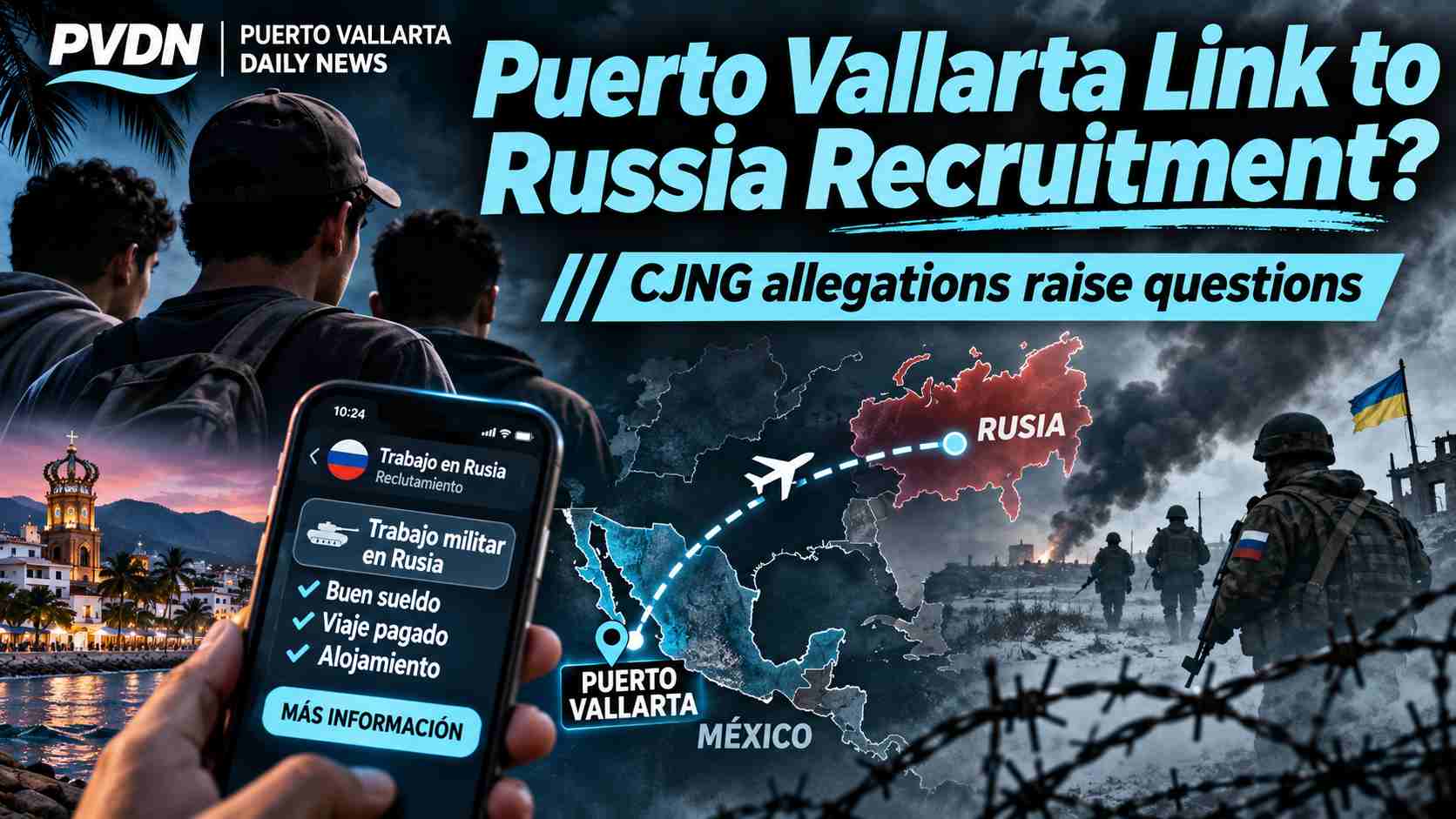
Allegations link Puerto Vallarta and CJNG to recruiting Mexicans for Russia’s war. We examine the evidence and the questions still unanswered.
What We Know About Allegations Linking Puerto Vallarta and CJNG to Russia’s Recruitment of Mexican Men
Puerto Vallarta, Jalisco, November 17, 2026 – A troubling story out of Jalisco is raising questions about whether Puerto Vallarta has become a connection point in an international recruitment operation that lures Mexican men to Russia with promises of legitimate employment, only for some to discover they’ve been recruited to support Russia’s military in its war against Ukraine.
The allegations go further. A column published Tuesday in La Crónica de Hoy points to telephone numbers associated with Puerto Vallarta that allegedly helped recruit young Mexican men, arrange payments, and get them onto airplanes headed for Russia.
And then there’s the mention of the Cártel Jalisco Nueva Generación (CJNG).
That connection is what makes this story particularly sensitive. Puerto Vallarta has a documented history of suspected cartel recruitment through deceptive job offers. But does that mean the same criminal networks are now supplying men to a foreign war?
It’s a reasonable question. So far, the available evidence doesn’t establish that connection.
What’s interesting is that parts of this story are backed by documented cases, testimony, and even warnings from Mexico’s own government. Other parts remain allegations that deserve closer examination.
And the difference between those two matters.
How Puerto Vallarta Entered the Story
The immediate allegations come from the November 17 edition of the Pepe Grillo Jalisco column in La Crónica de Hoy. La Crónica de Hoy
The columnist claims that telephone numbers associated with Puerto Vallarta were involved in recruiting Mexican men who believed they were accepting security jobs in Russia.
According to the column, those contacts helped coordinate payments and transportation to get recruits onto flights. The prospective workers were allegedly assured that their jobs had nothing to do with the war.
One young man reportedly managed to send his family a message saying there were many others in the same situation.
That is a disturbing allegation, especially when you consider what the columnist reported the previous day.
In the November 16 column, the same writer described two young Mexican men who allegedly arrived near the Russian-Ukrainian front over the weekend after accepting what they believed were security positions.
According to that account, the men signed contracts written in Russian, received limited weapons instruction, and were taken to military facilities near the fighting. Their families were reportedly seeking help after losing contact.
The column also alleged that Cuban or Venezuelan recruiters were involved in attracting applicants, while people in Mexico helped complete their travel arrangements.
But there are gaps.
The articles do not identify the two young men, publish the telephone numbers associated with Puerto Vallarta, or provide records showing who controlled those numbers.
Nor do they establish that the CJNG arranged the recruitment or received payments for sending people to Russia.
The columnist raises the possibility of a criminal network with ties to Puerto Vallarta. That is different from documenting the existence of one.
Still, the allegations didn’t appear out of nowhere.
Mexico Has Already Confirmed a Problem With Fraudulent Russian Job Offers
This is where the story becomes much more substantial.
Mexico’s own government has acknowledged that Mexican citizens have been placed at risk by deceptive employment offers connected to Russia.
The Secretaría de Relaciones Exteriores’ official travel advisory for Russia warns about fraudulent opportunities advertised through social media and websites, particularly jobs supposedly involving mechanical work and construction. Portales SRE
The warning describes misleading contracts, retention of passports, and working conditions that can leave people vulnerable to forced labor.
That’s not a rumor circulating in a Facebook group. It’s a warning published by the Mexican government.
But the government advisory doesn’t identify Puerto Vallarta as a recruitment center, and it doesn’t accuse the CJNG of operating the schemes.
There’s also something else worth examining.
On August 9, La Crónica de Hoy published a detailed investigation by Giovanna Morales Gómez into Mexican men recruited for jobs in Russia. La Crónica de Hoy
The investigation followed Daniel Contreras, a 42-year-old Mexican man who responded to an advertisement offering security work in Moscow.
The offer was attractive. A signing bonus equivalent to $28,000, a monthly salary of $3,000, housing, meals, and the possibility of other benefits.
Those are life-changing numbers for someone struggling to find decent employment in Mexico.
Contreras said recruiters handled his travel arrangements and obtained a Russian tourist visa. He departed Mexico in June, believing he was going to perform private security work.
Once he arrived in Moscow, however, he and another Mexican man were allegedly informed that their work would support the Russian military.
They refused to continue and sought help from Mexico’s embassy.
According to the investigation, the men spent approximately two weeks trying to arrange their return. Contreras eventually made it home.
The newspaper also reported something significant: Mexico’s embassy in Russia confirmed that it had handled 14 completed cases involving Mexicans who were brought to Russia through deceptive work offers connected to the Russian military, with two additional repatriation cases still open at the time.
Those figures were reported in August. They should not be treated as a current total for November.
The newspaper’s investigation provides a detailed example of how these recruitment schemes allegedly work, from the initial advertisement to the arrangements for traveling overseas.
And it raises another question: if the operation has already brought multiple Mexicans to Russia, how extensive is the network handling recruitment inside Mexico?
There Were Other Warnings Before November
Just two days before the August investigation appeared, UnoTV published a separate account of a Mexican man who nearly boarded a flight to Russia.
He described being offered more than 500,000 pesos as a bonus and around 60,000 pesos per month for what recruiters called tactical security work.
According to his account, everything moved quickly. The recruiters arranged documentation and sent flight details.
He abandoned the trip after his family warned him about similar recruitment operations involving other Latin Americans. He later reported receiving threatening messages.
The two August investigations don’t prove that a single organization controls all the recruitment attempts. They do, however, describe remarkably similar tactics.
Social media advertising. Attractive salaries. Jobs described as security or construction work. Travel costs covered by the recruiter. And assurances that applicants won’t be sent into combat.
The Mexican embassy’s warning fits that pattern.
It’s also worth noting that the August Crónica investigation described a recruitment contact using a Mexico City telephone number, not one identified as belonging to Puerto Vallarta.
That matters because phone numbers alone are a weak foundation for identifying where an organization actually operates.
Even if a number is associated with Puerto Vallarta, the person using it doesn’t necessarily have to be physically located here.
So Where Does the CJNG Fit Into This?
This is probably the question most Puerto Vallarta residents will want answered.
The city and surrounding region have already appeared in investigations involving alleged CJNG recruitment through fraudulent employment opportunities.
In March 2025, PVDN reported the accounts of three men from Colima who said they were lured to Puerto Vallarta through social media job offers.
Instead of ordinary employment, the men said they found themselves in a training environment connected to the CJNG.
More recently, on October 9, PVDN reported that two young men had been found alive in Puerto Vallarta’s Ixtapa district after an investigation involving suspected recruitment through false job offers.
The men had been missing for months before authorities located them on September 30.
Investigators were examining possible CJNG involvement and whether the men had been subjected to forced labor. El Financiero
Those cases establish that deceptive job recruitment is a genuine concern in Puerto Vallarta.
But here’s the distinction.
Neither case involved recruitment for Russia’s military, at least according to the available reporting.
There’s no public evidence connecting the recruiters in those Puerto Vallarta cases with the people arranging flights to Moscow.
Could criminal recruitment networks already operating in Jalisco be useful to a foreign organization seeking manpower? Certainly, that’s a possibility worth investigating.
Such networks may have experience identifying vulnerable applicants, making attractive offers, arranging transportation, and controlling recruits through threats or deception.
But the fact that a criminal organization has used those methods in Mexico doesn’t establish that it has contracted with, coordinated with, or supplied recruits to the Russian military.
We shouldn’t confuse a plausible theory with a documented relationship.
Mexican Cartels Have Also Been Mentioned in Reports About Fighters in Ukraine
There’s another piece of this story that could easily lead to confusion.
In October 2026, videos circulated online appearing to show Spanish-speaking men wearing Ukrainian military uniforms and referring to Mexican criminal organizations, including the CJNG and factions of the Sinaloa Cartel.
On October 8, President Claudia Sheinbaum acknowledged that the Mexican government was investigating the footage.
According to the official transcript of her morning news conference, the government was trying to determine whether the videos were authentic and, if so, how the people shown might have become involved in the conflict. Gobierno de México
The president did not confirm that the individuals belonged to Mexican cartels.
She also did not establish whether any participation was arranged by criminal groups, military organizations, or private recruiters.
More importantly, those videos concerned alleged fighters serving on the Ukrainian side of the conflict.
The November allegations describe Mexicans being deceived into traveling to Russia and potentially being forced to serve Russia’s military.
Those are opposite sides of the war.
It’s tempting to pull all these reports together and suggest that Mexican cartels are somehow involved in supplying fighters across the conflict.
That may make an attention-grabbing headline, but the evidence doesn’t support that conclusion.
At this point, they remain separate lines of inquiry.
Why Would Russia Recruit Men From Mexico?
The wider context helps explain why Mexican citizens might be targeted.
Russia has spent nearly five years fighting its full-scale war against Ukraine, which began with the invasion of February 24, 2022.
The conflict has created a sustained demand for military personnel, and investigations have documented the recruitment of foreign nationals from several regions, including Latin America.
Some foreigners have reportedly volunteered for military service. Others have described deception, coercion, and employment offers that concealed the possibility of military involvement.
In the Mexican cases reported this year, the financial incentives were particularly striking.
A monthly salary of $3,000 or a large signing bonus can sound like an extraordinary opportunity when compared with wages available to many workers in Mexico.
That doesn’t mean every applicant was unaware of the risks, or that every foreign recruitment offer is fraudulent.
But when somebody is promised an ordinary security job and discovers on arrival that the work involves the military, there’s a serious question about whether meaningful consent ever existed.
And in a foreign country, without language skills, local contacts, or control over personal documents, leaving that situation can become extremely difficult.
The experiences described in August show just how quickly an overseas job opportunity can become a problem that requires diplomatic assistance.
Does Puerto Vallarta Have an International Recruitment Problem?
There’s enough information here to justify asking that question.
But not enough to answer yes.
The November 17 column presents a specific allegation about telephone contacts associated with Puerto Vallarta. Earlier investigations establish that deceptive recruitment of Mexicans for Russia-related work has occurred. Separate local cases show that fraudulent job offers have been used in suspected cartel recruitment around Puerto Vallarta.
All three deserve attention.
What hasn’t been established is whether they form part of the same operation.
For that, investigators would need to identify the people controlling the telephone numbers, trace financial transactions, examine recruitment communications, and determine whether any of the individuals involved have documented links to the CJNG.
We also don’t know whether the two men described in the November 16 column have been identified by Mexican diplomatic officials, whether their families have filed complaints, or whether an investigation into their recruitment is underway.
Those aren’t small missing details. They’re the difference between a troubling allegation and an established criminal operation.
I also think there’s a danger in treating every suspicious activity connected to Puerto Vallarta as automatic evidence of CJNG involvement.
The cartel’s history in the region makes the question worth asking. It doesn’t make the answer automatic.
The Questions Mexican Authorities Need to Answer
The most immediate questions belong with the Fiscalía del Estado de Jalisco, the Fiscalía General de la República, and Mexico’s Secretaría de Relaciones Exteriores.
Has any formal complaint identified Puerto Vallarta-based recruiters connected to Russia?
Have investigators examined the telephone numbers described in the Crónica column?
Are Mexican authorities investigating possible links between local criminal organizations and foreign military recruitment?
And what assistance, if any, is being provided to the families of the two young men reportedly taken to the war zone this month?
There may eventually be evidence that connects these cases. There may also be several unrelated recruitment operations using similar methods.
At the moment, the public information doesn’t allow us to distinguish between those possibilities.
What we do know is that Mexican citizens have already needed help returning from Russia after accepting misleading employment offers. The Mexican embassy has acknowledged those cases and warned others about the risks.
We also know that young men have been lured to Puerto Vallarta by suspected criminal recruiters offering jobs that weren’t what they appeared to be.
Now a Jalisco columnist is alleging that telephone contacts associated with the city are involved in sending Mexicans to Russia.
The allegation deserves an investigation, particularly if families are still trying to get loved ones home.
The starting point is remarkably specific: telephone numbers allegedly connected to Puerto Vallarta, payments made to move recruits, and flights arranged to Russia.
If those records exist, they could help establish who was responsible, where the operation was managed, and whether organized crime played any role.
Until those connections can be documented, Puerto Vallarta’s involvement in recruiting men for Russia’s war remains an allegation — and the families described in this week’s reporting are still waiting for answers.