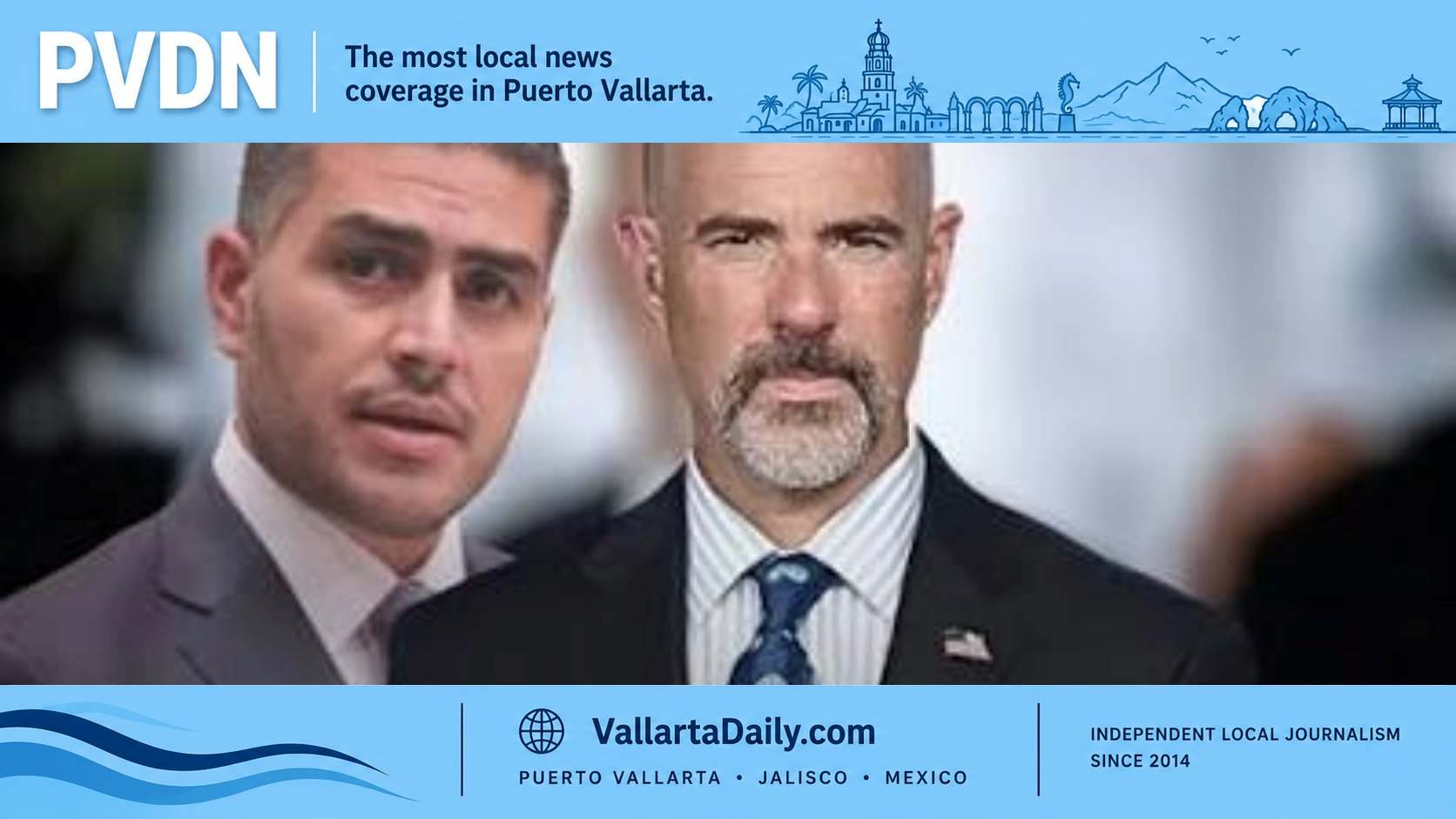
Mexico City, August 23, 2026 – U.S. Drug Enforcement Administration chief Terrance “Terry” Cole said he communicates daily with Mexican Security Secretary Omar García Harfuch and that the two governments exchange intelligence and coordinate action against the Sinaloa Cartel and the Cártel Jalisco Nueva Generación. In the same interview, Cole alleged that senior Mexican officials work with criminal organizations, but he did not name them.
Cole described Harfuch as a direct operational counterpart while maintaining Washington’s public pressure on unnamed officeholders accused of protecting trafficking networks.
Cole said the DEA and Mexico share information on targets tied to the Sinaloa Cartel and CJNG, both designated by the United States as foreign terrorist organizations. He also said the agency supports operations in Mexico and described the work as a bilateral effort.
Harfuch said cooperation consists of intelligence exchanges and jointly constructed cases, with each country’s agencies acting inside their own territory. Mexican law does not permit foreign forces to operate in the country, he said, and no foreign agents have joined operations conducted by the federal security cabinet.
Cole did not give an unconditional assurance when asked whether Washington would refrain from unilateral action on Mexican soil. He said the DEA would continue working closely with Mexican counterparts, then referred the question to President Donald Trump and said the agency would follow the president’s orders.
Harfuch cited the February military operation that led to the death of CJNG founder Nemesio Oseguera Cervantes, known as El Mencho, as an example of the limit. He said the Mexican Army planned and carried out that mission.
Cole’s corruption allegation was broader than the operational details he disclosed. He said a public indictment demonstrated that high-level Mexican officials had worked directly with cartels. He then alleged that government officials currently collaborate with CJNG and said the DEA had recently warned them. He did not identify a person, office, agency or state in connection with the CJNG accusation.
The indictment was not named during that exchange. A federal case unsealed April 29 charges Sinaloa Governor Rubén Rocha Moya and nine other current or former state and municipal officials with drug trafficking and weapons offenses. U.S. prosecutors allege that the defendants helped the Sinaloa Cartel through an arrangement involving bribes and political support. The case concerns the Sinaloa Cartel, not CJNG, and every defendant is presumed innocent unless proven guilty.
The DEA renewed its separate CJNG corruption claim in official remarks published August 5. Cole alleged that members of the Mexican government shield cartel leaders and facilitate drug trafficking, money laundering and violence. The agency did not identify those alleged collaborators in the statement.
A Justice Department action announced the same day made criminal charges public against five alleged CJNG leaders and listed rewards exceeding $100 million across eight cartel suspects. The announcement did not list a Mexican officeholder among the newly charged defendants.
The language continues a dispute that predates this weekend’s interview. Vallarta Daily reported in July that Cole had described Mexican government and cartel networks as effectively indistinguishable. President Claudia Sheinbaum rejected that claim as unsupported and political.
Harfuch used the interview to present Mexico’s answer through arrests. He said federal authorities have detained more than 85 public servants, including municipal presidents affiliated with Morena, PAN and PRI. He said investigations proceed when authorities receive a complaint and open a case file, regardless of party membership.
The interviews followed the 40th International Drug Enforcement Conference in Buenos Aires. Mexico’s official account of the meeting said the country has 155 arrest warrants with extradition purposes linked to investigations by U.S. agencies. Harfuch also reported that Mexico’s Financial Intelligence Unit had blocked more than 24,600 accounts and immobilized more than 8.6 billion pesos.
CJNG’s leadership makes the dispute directly relevant to Jalisco and the Puerto Vallarta region. Cole identified Juan Carlos Valencia González, also known as El Pelón or El 03, as the DEA’s leading CJNG target. Earlier Vallarta Daily reporting detailed the U.S. assessment that Valencia assumed command after El Mencho’s death. The State Department has raised the reward tied to Valencia’s arrest or conviction to as much as $25 million.
Another man included in the August rewards action has a Puerto Vallarta connection. Carlos Andrés Rivera Varela now carries a reward of as much as $10 million. U.S. prosecutors allege that Rivera Varela helped lead CJNG’s Grupo Elite enforcement arm.
The 155 extradition-related warrants cited by Harfuch are the clearest public measure of where the daily contact can lead. Mexican authorities would execute any arrest in Mexico, while U.S. prosecutors would pursue the related case through U.S. courts.