
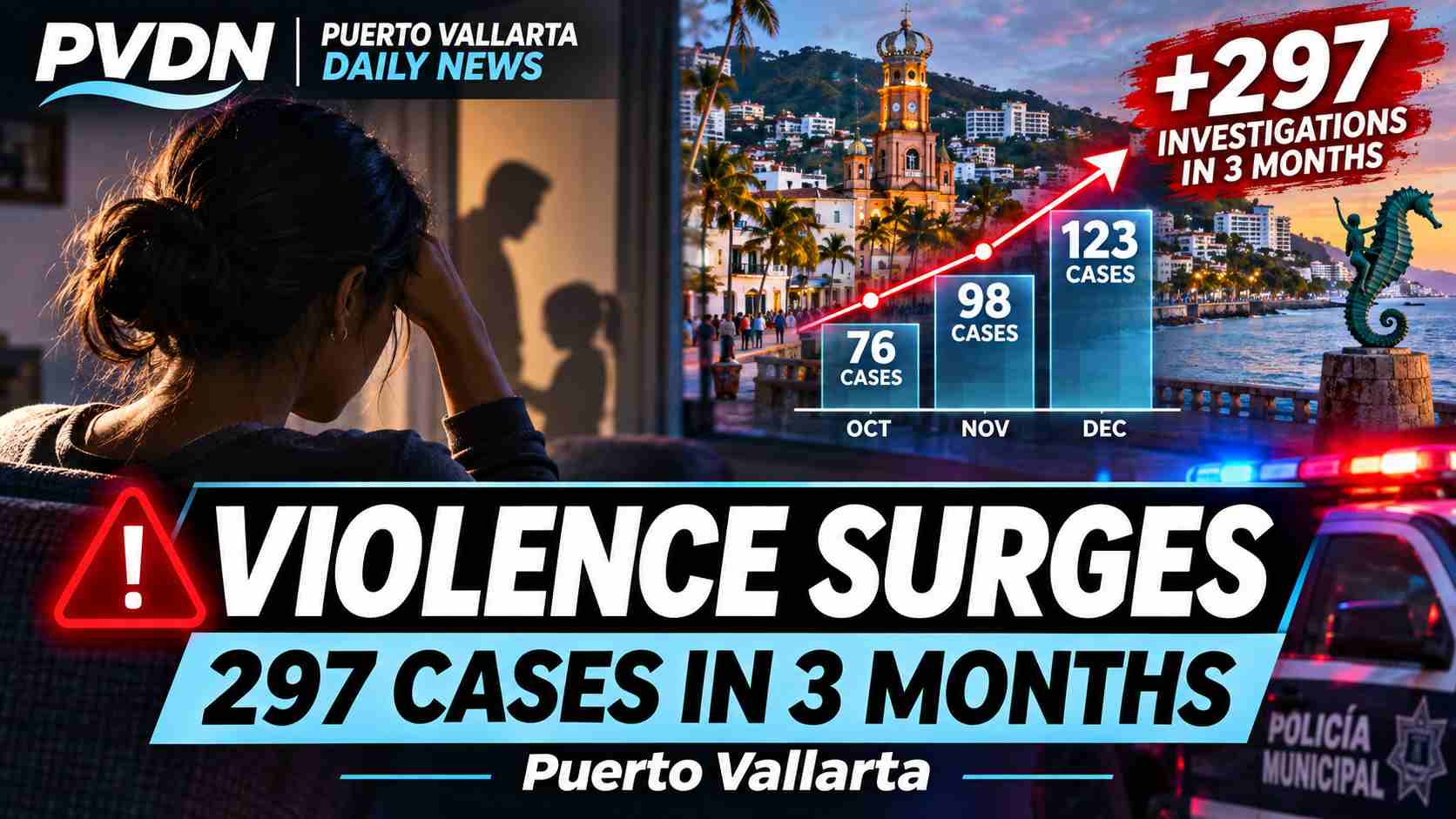
Domestic violence investigations in Puerto Vallarta rose from 169 to 297 in a year. Jalisco officials face questions over prevention and support.
Puerto Vallarta, Jalisco, November 19, 2026 – Domestic violence investigations in Puerto Vallarta jumped by nearly 76% in the third quarter of 2026 compared with the same period last year, bringing renewed scrutiny to the city’s efforts to protect women and raising questions about whether government prevention programs are working.
Authorities opened 297 investigation files for family violence between July and September, compared with 169 during those months in 2025. That’s 128 additional investigations in just three months, according to figures from the citizen watchdog Jalisco Cómo Vamos.
Investigations involving rape also increased, from six to 16 during the same periods.
The numbers became the center of a heated exchange in the Jalisco Congress on Wednesday, November 18, when Puerto Vallarta legislator Yussara Canales González questioned state officials about the growing violence and demanded evidence that existing prevention programs are making a difference.
Fabiola Loya Hernández, Jalisco’s secretary of Igualdad Sustantiva entre Mujeres y Hombres, acknowledged the increase and confirmed that five women had been killed in Puerto Vallarta so far this year, including three during May.
The exchange took place during the congressional review of Governor Pablo Lemus Navarro’s second government report.
What began as a discussion of crime statistics quickly became a broader examination of how Jalisco and Puerto Vallarta are responding to violence against women, how much money they’re spending and what results those programs have produced.
Puerto Vallarta’s increase stands out across Jalisco
The figures come from the third-quarter crime report published by Jalisco Cómo Vamos, an independent citizen organization that examines official crime records.
The increase in Puerto Vallarta was far greater than the overall rise reported across Jalisco.
Statewide, family violence investigations increased from 3,036 in the third quarter of 2025 to 3,402 during the same period this year, according to reporting on the observatory’s latest findings.
That’s an increase of roughly 12% in the number of investigation files statewide, compared with approximately 76% in Puerto Vallarta.
The observatory’s report also placed Puerto Vallarta among the municipalities with the highest numbers of reported family violence investigations in Jalisco.
The difference is substantial.
While Jalisco recorded an increase in complaints across the state, Puerto Vallarta’s growth was much steeper.
There is an important distinction in what those numbers actually measure.
A carpeta de investigación is a formal investigation file opened by prosecutors. It doesn’t necessarily represent a conviction, a confirmed criminal offense or a separate victim in every instance.
The figures also don’t capture every incident of domestic violence. Abuse that goes unreported won’t appear in these records.
An increase in investigation files can reflect more violence, more people reporting abuse, changes in how authorities record complaints or some combination of those factors.
The available data doesn’t establish how much each factor contributed to Puerto Vallarta’s increase.
There is also a small discrepancy in the percentages reported locally. Several outlets cite an increase of 74.95%, while the published totals of 169 and 297 work out to approximately 75.7%. The underlying figures and their calculation basis should be checked against the original dataset before assigning greater precision.
What is clear is that prosecutors received considerably more family violence cases during the third quarter than they did a year earlier.
And the increase wasn’t limited to domestic violence investigations. The number of rape investigation files also rose, although the smaller number of reports means that percentage changes in that category need to be interpreted carefully.
A legislator wants to know what the government is accomplishing
During Wednesday’s hearing, Canales challenged the effectiveness of the programs intended to prevent violence against women in Puerto Vallarta.
The legislator, who represents the district that includes the city, questioned whether state officials had adequately reviewed the results of their prevention campaigns, agreements with the municipal government and assistance programs.
According to reports, she asked what was happening in Puerto Vallarta and said the figures suggested that something in the current strategy wasn’t working.
Canales also wanted information about the Ayuntamiento de Puerto Vallarta’s responsibilities under agreements with the state.
Specifically, she asked whether the Secretaría de Igualdad Sustantiva had reviewed compliance with those agreements, identified failures or required corrective measures.
Her questions went beyond the number of complaints.
She also raised concerns about women who experience violence but never report it because they don’t trust prosecutors or the government agencies responsible for helping them.
That creates another problem for evaluating the city’s response.
More complaints can mean people are increasingly willing to seek help. But when complaints rise this sharply, authorities also need to show whether victims are receiving protection, whether investigations are moving forward and whether people accused of repeated violence are being held accountable.
The number of campaigns held or meetings organized doesn’t answer those questions by itself.
Jalisco acknowledges the problem and promises reports
Loya did not dispute that family violence investigations have increased in Puerto Vallarta.
Instead, she acknowledged the situation and agreed to provide Canales with written information about the programs, resources and measures currently being used in the municipality.
The secretary also committed to providing continuing reports on those efforts.
Canales is expected to be included in meetings involving families affected by femicide and discussions connected to the Alerta de Violencia de Género.
The secretary also raised the need for stronger coordination between agencies responsible for preventing violence and those investigating crimes.
Those are commitments made during the hearing. The requested written report has not yet been publicly documented as delivered.
Loya’s acknowledgment that five women have been killed in Puerto Vallarta during 2026 adds a more serious dimension to the discussion.
Three of those deaths occurred in May, according to her account. The available reporting does not establish that all five deaths received the same final legal classification, such as femicide or homicide.
Across Jalisco, the secretary reported 22 victims of femicide between January and September, describing that as the state’s lowest total for the comparable period since 2017.
A declining statewide femicide count and increasing family violence investigations in Puerto Vallarta aren’t contradictory. They measure different offenses, over different periods, and cannot be used interchangeably to describe women’s safety.
The state wants more money for prosecutors and prevention programs
Wednesday’s hearing also exposed a budget problem.
Loya told legislators that Jalisco needs more prosecutors and support staff dedicated to investigating crimes against women.
She identified Puerto Vallarta among five locations needing additional personnel, along with Guadalajara, Colotlán, Tlajomulco de Zúñiga and San Pedro Tlaquepaque.
Loya requested at least 11 additional prosecutors and their supporting teams across those locations.
The request came as the state government prepares its 2027 budget.
The proposed spending plan would reduce the Secretaría de Igualdad Sustantiva’s budget from 654 million pesos in 2026 to 628.2 million pesos next year, a reduction of approximately 25.8 million pesos.
Loya asked lawmakers to reverse the proposed cut and consider providing additional money.
The budget hasn’t been finalized. Legislators must still debate and approve the spending plan for the coming year.
That leaves an important question for Puerto Vallarta: whether the agencies responsible for responding to violence against women will have enough personnel and resources to handle the increase in investigations.
More prosecutors alone won’t prevent domestic violence. Their work begins once a crime has been reported, while prevention programs are intended to identify risks, provide early assistance and reduce the likelihood of abuse.
Both parts of that system matter.
Jalisco has reported providing more than 117,000 services through its Centros de Justicia para las Mujeres during 2026, according to figures presented at the hearing.
The state also operates Pulso de Vida, which connects designated assistance points to the C5 emergency response system.
Officials reported 2,044 participating locations statewide, with 115 women seeking assistance through the system while facing immediate danger through November 12.
Those numbers show the reach of existing programs. They don’t establish how many acts of violence were prevented in Puerto Vallarta or whether local victims have received timely protection.
Puerto Vallarta already has prevention programs
The municipality isn’t starting from nothing.
Earlier this year, Puerto Vallarta renewed its participation in Barrios de Paz, a state-supported program intended to prevent violence against women, promote safer public spaces and challenge attitudes that normalize abuse.
Municipal records show an agreement to participate in the 2026 program with approximately 1.03 million pesos in state funding.
The city also has access to specialized state services for women experiencing violence.
But the latest investigation figures raise questions about the effectiveness and reach of those efforts.
How many Puerto Vallarta residents received assistance through Barrios de Paz during 2026? How many people sought protection through municipal or state services? And how many reported cases led to protective measures or criminal proceedings?
The information presented during Wednesday’s hearing didn’t provide a complete municipal accounting of those outcomes.
There has been enforcement activity.
In May, Vallarta Daily reported that Jalisco prosecutors had brought charges against 81 suspects in cases involving violence against women, including three cases in Puerto Vallarta.
Those proceedings showed that authorities were pursuing criminal cases, but the figures covered a particular enforcement period. They weren’t an annual measure of the city’s response to domestic violence.
Similarly, Vallarta Daily’s October 2026 Puerto Vallarta Safety Report examined several public safety concerns, including missing women and violent incidents.
The latest quarterly figures provide a different measure of local safety: the number of families and individuals becoming involved in formal investigations over abuse in domestic relationships.
That is a substantial part of the city’s public safety picture, even when those cases don’t make the headlines that shootings, arrests and organized-crime operations receive.
Where residents can seek help
Puerto Vallarta has a Centro de Justicia para las Mujeres, which offers free assistance to women experiencing physical, psychological, sexual, economic or other forms of violence.
The center brings together services intended to help victims obtain legal guidance, support and access to government assistance.
According to the Red de Centros de Justicia para las Mujeres, services are available 24 hours a day, throughout the year.
The Puerto Vallarta center is located at Avenida Las Palmas 315. Its published contact number is 33 3668 1880, extension 3.
People facing an immediate threat can call Mexico’s emergency number, 911.
These services are relevant whether violence occurs between spouses, partners or other family members. The government’s definition of family violence includes forms of abuse that don’t necessarily involve visible physical injuries.
The next test is what officials provide in writing
For now, the state has acknowledged the increase, promised greater scrutiny of prevention programs and asked lawmakers for more resources.
The next step is more specific.
Loya has committed to providing written information about the funding, programs and actions directed toward Puerto Vallarta, as well as continued reporting on their results.
That documentation could help establish whether the municipality is receiving the services it was promised and whether the programs are reaching people who need them.
It would also give residents a clearer way to judge the government’s response, rather than relying on announcements about meetings, campaigns or new agreements.
The comparison that prompted Wednesday’s questions remains substantial: 169 family violence investigation files during the third quarter of 2025, compared with 297 during the same three months of 2026.
Jalisco’s secretary of Igualdad Sustantiva has now promised the Puerto Vallarta legislator a written accounting of what the state is doing about those numbers.