
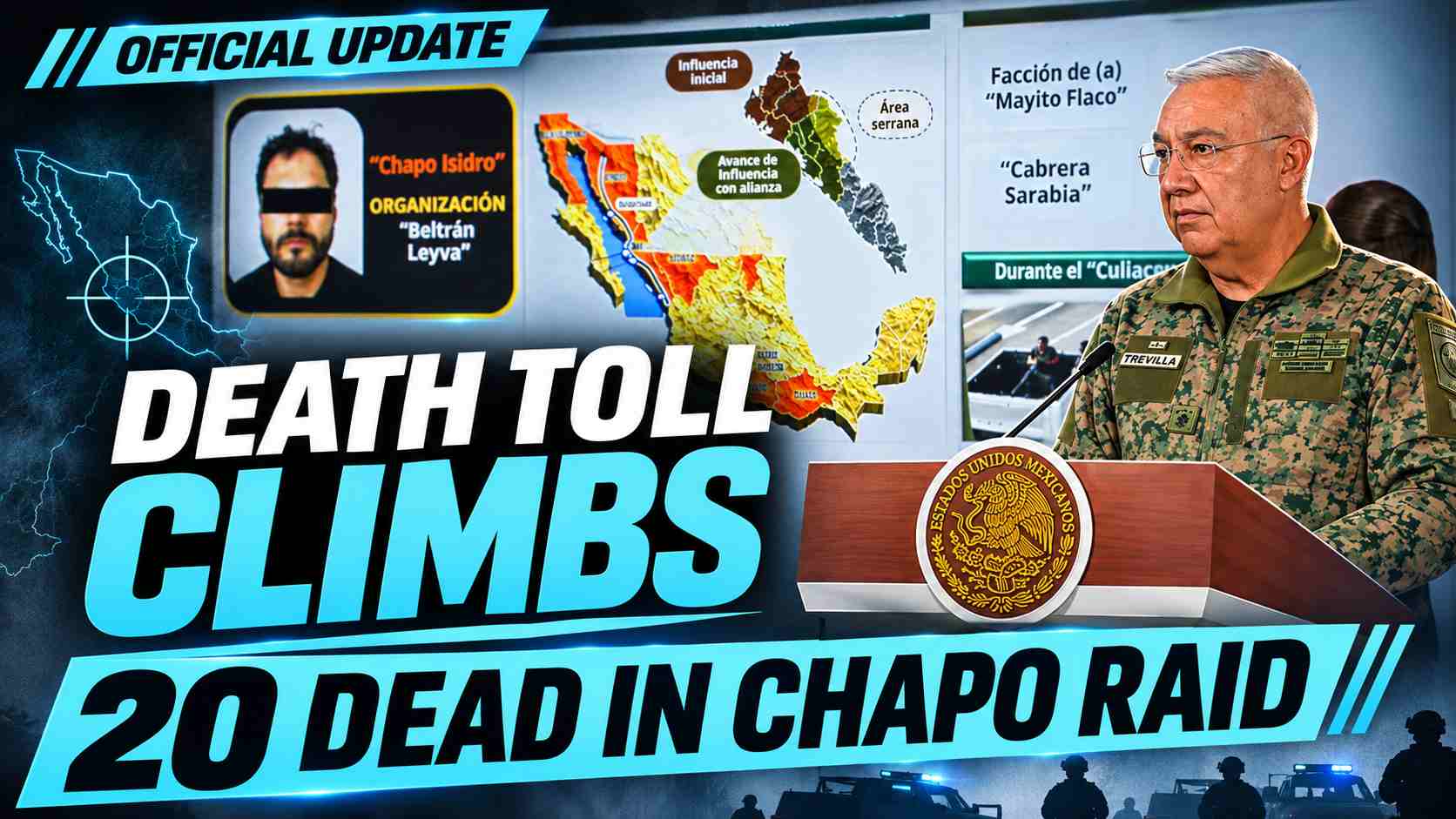
Mexico says 20 people died during the operation to capture El Chapo Isidro in Sinaloa. New details reveal the gun battles and highway chaos.
Guasave, Sinaloa, November 23, 2026 — Mexico’s military has revised the death toll from last week’s capture of one of the country’s most wanted cartel leaders, and the operation was considerably deadlier than the government first reported.
Twenty people died during the military operation and related confrontations that led to the arrest of Fausto Isidro Meza Flores, better known as El Chapo Isidro, according to new information presented by Defense Secretary Ricardo Trevilla Trejo on Monday.
The updated toll includes 16 suspected members of the criminal organization and four Mexican soldiers. Another 10 soldiers were injured.
That’s a substantial increase from the initial report of seven suspected gunmen killed and four soldiers dead.
And Monday’s briefing revealed something else about the operation. While hundreds of soldiers and military aircraft were involved in the arrest, authorities say Meza Flores himself surrendered without a fight.
Much of the deadly violence happened outside the property, where armed supporters reportedly tried to prevent his capture and later attempted to rescue him.
The new details offer a clearer picture of what happened Friday night, when Guasave and surrounding communities experienced hours of gunfire, burning vehicles, and highway blockades.
As Vallarta Daily reported Saturday, the arrest quickly turned into a major security crisis across parts of northern Sinaloa.
Now the government is explaining just how extensive the operation became.
Mexico’s original death toll was too low
During Monday’s presidential security briefing, Trevilla explained that the first military statement, issued early Saturday, reported seven suspected criminal-group members killed.
That number has now increased to 16.
According to the defense secretary, nine additional bodies were located after the initial confrontation and subsequent security operations.
The four soldiers killed in the operation remain part of the confirmed military death toll.
President Claudia Sheinbaum offered condolences to their families during Monday’s conference, recognizing the soldiers who died in the operation.
The 10 wounded military personnel received medical attention in Los Mochis and Culiacán before being transferred for specialized treatment.
The revised numbers mean that at least 20 people died in the violence connected to the arrest.
But there are still questions about the circumstances surrounding some of those deaths.
The Sinaloa-based publication Revista Espejo examined the military’s presentation and noted that it did not provide a complete accounting of where and how all 16 alleged criminal-group members died.
That’s an important distinction. The government has provided a revised total, but the publicly available explanation does not independently establish the circumstances of every death.
A massive military operation to arrest one man
The mission had a name: Operación Centella, or Operation Lightning.
And Mexico brought considerable resources to carry it out.
According to the details presented by the Defense Ministry, the operation involved 361 military personnel and 14 aircraft, including helicopters, transport planes, and an unmanned surveillance aircraft.
The participating forces included Army special operations units, paratroopers, infantry, artillery, and members of the National Guard.
Six helicopters were equipped with weapons to support the ground operation.
This wasn’t a sudden raid based on a last-minute tip.
Trevilla said Mexican intelligence agencies had been working for months to locate Meza Flores. Cooperation with U.S. intelligence agencies increased during the three months before the arrest.
By Friday, November 20, authorities had enough information to launch the mission.
Mexican forces reached the area where Meza Flores was staying at approximately 7:50 p.m.
According to Trevilla, soldiers established a security perimeter and entered the property.
Meza Flores and the people inside surrendered without resisting.
For the military, that was the critical moment. One of Mexico’s most wanted criminal suspects was in custody.
Unfortunately, the surrounding violence was far from over.
The gun battle was happening outside
According to the military’s account, armed members of the organization responded to the operation by attacking the soldiers protecting the area.
Some were reportedly attempting to rescue Meza Flores.
The attackers used high-powered weapons, including .50-caliber machine guns and Barrett rifles, against military helicopters.
The aircraft returned fire.
Trevilla said the operation required air support because of the intensity of the attacks against soldiers and aircraft.
Meanwhile, groups associated with the criminal organization began blocking roads with vehicles, including trucks that were set on fire.
For people living in Guasave, the result was frightening.
Residents reported gunfire, military aircraft flying overhead, and uncertainty about whether it was safe to leave their homes.
The violence also spread to important transportation routes connecting communities across northern and central Sinaloa.
Mexico’s military says no uninvolved civilians were killed or injured during its operation. That remains the government’s account; an independently verified, comprehensive assessment of civilian harm from the wider violence and roadblocks has not been published.
The military eventually moved the detainees out of the area and transported them toward Culiacán.
By 5:20 a.m. Saturday, Meza Flores had arrived in Mexico City, where he was placed in the custody of the federal Attorney General’s Office.
The suspect was safely transferred.
For the communities left behind, getting back to normal would take longer.
Twenty-one roadblocks and 50 vehicles
One of the most disruptive parts of the operation happened on the highways.
Authorities say criminal groups established 21 roadblocks in Sinaloa following the arrest.
The blockades affected routes that residents, commercial drivers, and travelers use to move between communities.
Among the affected highways were México 15 and the Benito Juárez highway, commonly called La Costera.
Burned trucks and other vehicles blocked traffic, leaving some motorists stranded and forcing authorities to warn residents against traveling through affected areas.
According to the federal government’s updated account reported by Reuters, security forces removed 50 vehicles used in the blockades over November 21 and 22.
Local authorities had already reported reopening the main Guasave routes on Saturday.
However, the removal of a blockade doesn’t automatically mean every road immediately returns to normal operation. Damaged vehicles, cleanup work, and additional security deployments can continue affecting traffic.
And while the federal government says it successfully completed the arrest, the scale of the roadblocks illustrates how quickly organized criminal groups can disrupt daily life.
For residents, those disruptions are often the part of a security operation that has the most immediate consequences.
The United States helped locate him, but Mexico made the arrest
Another important part of Monday’s announcement concerned the United States.
American authorities helped Mexico track down Meza Flores through intelligence sharing, including surveillance information gathered by drones.
U.S. surveillance aircraft operated over Mexican territory with authorization from Mexico.
But both governments have emphasized that the arrest itself was carried out by Mexican forces.
Trevilla said the operation was planned and executed by the Mexican Army, Air Force, and National Guard, with no U.S. military personnel participating on the ground.
That distinction matters politically.
President Sheinbaum has repeatedly opposed proposals involving direct American military operations against cartels inside Mexico.
As Vallarta Daily previously explained in its examination of Mexico’s opposition to U.S. military involvement, the issue goes beyond fighting organized crime. It involves Mexico’s constitutional authority, sovereignty, and control over security operations within its borders.
The Meza Flores arrest offers an example of the kind of cooperation both governments say they want: American intelligence supporting an operation led by Mexican authorities.
Still, the operation also demonstrates how closely the two countries are working together on major organized crime investigations.
Why was El Chapo Isidro such an important target?
Meza Flores wasn’t simply another suspected cartel operator.
He had been one of the FBI’s most wanted fugitives since February 2025.
According to the FBI’s original most-wanted announcement, American investigators accused him of overseeing an extensive drug-trafficking operation that moved cocaine, methamphetamine, heroin, fentanyl, and other drugs into the United States.
He was also accused of involvement in serious violence, including kidnappings, torture, and killings.
Mexican authorities associate his organization with the Beltrán Leyva criminal network and operations across parts of Sinaloa.
The U.S. Department of Justice confirmed his arrest in a November 21 announcement, describing him as an alleged senior cartel leader facing major federal criminal charges.
Those charges include drug trafficking, international money laundering, narcoterrorism, firearms offenses, and conspiracy to support a designated terrorist organization.
They remain allegations unless proven in court.
The FBI has since updated its records to reflect his capture.
His arrest represents a major achievement for Mexican authorities and investigators who had been pursuing him for years.
But it doesn’t necessarily mean the criminal organization he allegedly led has disappeared.
The cartel is still operating
This may be the most important part of Monday’s briefing for people living in Sinaloa.
Security Secretary Omar García Harfuch acknowledged that the criminal organization associated with Meza Flores has not been completely dismantled.
Even with its suspected leader in custody, remaining members and operational networks still exist.
That’s not particularly surprising.
Large criminal organizations often have multiple layers of leadership, financing, weapons suppliers, and people responsible for moving drugs and coordinating violence.
Arresting the person at the top can weaken an organization. It doesn’t automatically eliminate everyone working beneath that person.
The government has already detained other individuals allegedly connected to the group, and additional investigations are continuing.
But criminal organizations can also respond to the loss of senior leaders through internal power struggles or attempts by competing groups to take territory.
That possibility doesn’t mean another wave of violence is inevitable. It does mean the arrest alone cannot establish that the security situation has been resolved.
Sinaloa has been struggling with organized crime violence for years.
In September, Vallarta Daily reported that thousands of people marched in Culiacán demanding peace after two years of killings, disappearances, and insecurity.
For those residents, the question is not simply whether the government can capture another prominent criminal suspect.
It’s whether life becomes safer afterward.
What happens to Meza Flores now?
The next stage will involve prosecutors, courts, and potentially an international extradition process.
Meza Flores faces criminal accusations in Mexico, and U.S. authorities have an extradition request connected to the charges against him.
According to Monday’s Reuters report on the extradition request, Mexican officials have not announced whether or when the government will transfer him to American custody.
Extradition is not automatic.
It involves legal procedures, judicial review, and decisions by the relevant Mexican authorities.
For now, Meza Flores is in Mexican custody.
Meanwhile, the federal government says its security work in Sinaloa will continue.
Harfuch announced that Mexico’s security cabinet plans to travel to Culiacán on Tuesday, November 24, to evaluate conditions and begin delivering additional security equipment.
The planned assistance includes patrol vehicles, armored units, drones, and other technology for law enforcement agencies.
It is part of an effort to reinforce security after the arrest and address the continuing presence of armed criminal groups.
A successful arrest doesn’t erase the cost
Mexico’s government is presenting Operation Centella as a major success.
And in one sense, it is.
Authorities captured a man who had evaded law enforcement for years, who was wanted in two countries, and whose alleged organization has been accused of trafficking drugs and using extreme violence.
But there’s another side to the story.
Four Mexican soldiers died. Ten others were injured. Sixteen suspected criminal-group members were reported killed.
Residents spent hours dealing with gunfire, highway closures, burning vehicles, and the fear that comes with not knowing what is happening outside their homes.
And the government has acknowledged that the criminal organization remains active.
That’s why Monday’s revised casualty figures matter.
They provide a more complete picture of the cost of the operation, but they also raise questions about the violence that followed the capture and how much of it has been fully accounted for.
The next test for Mexican authorities will not be another announcement about how many aircraft or soldiers participated.
It will be whether the government’s continued security operations can prevent the remaining organization from producing another round of violence.
The federal security cabinet’s planned visit to Culiacán on Tuesday will offer the next opportunity to explain what comes after Operation Centella.
For residents of Sinaloa, that question matters far more than the name of the man now in custody.