
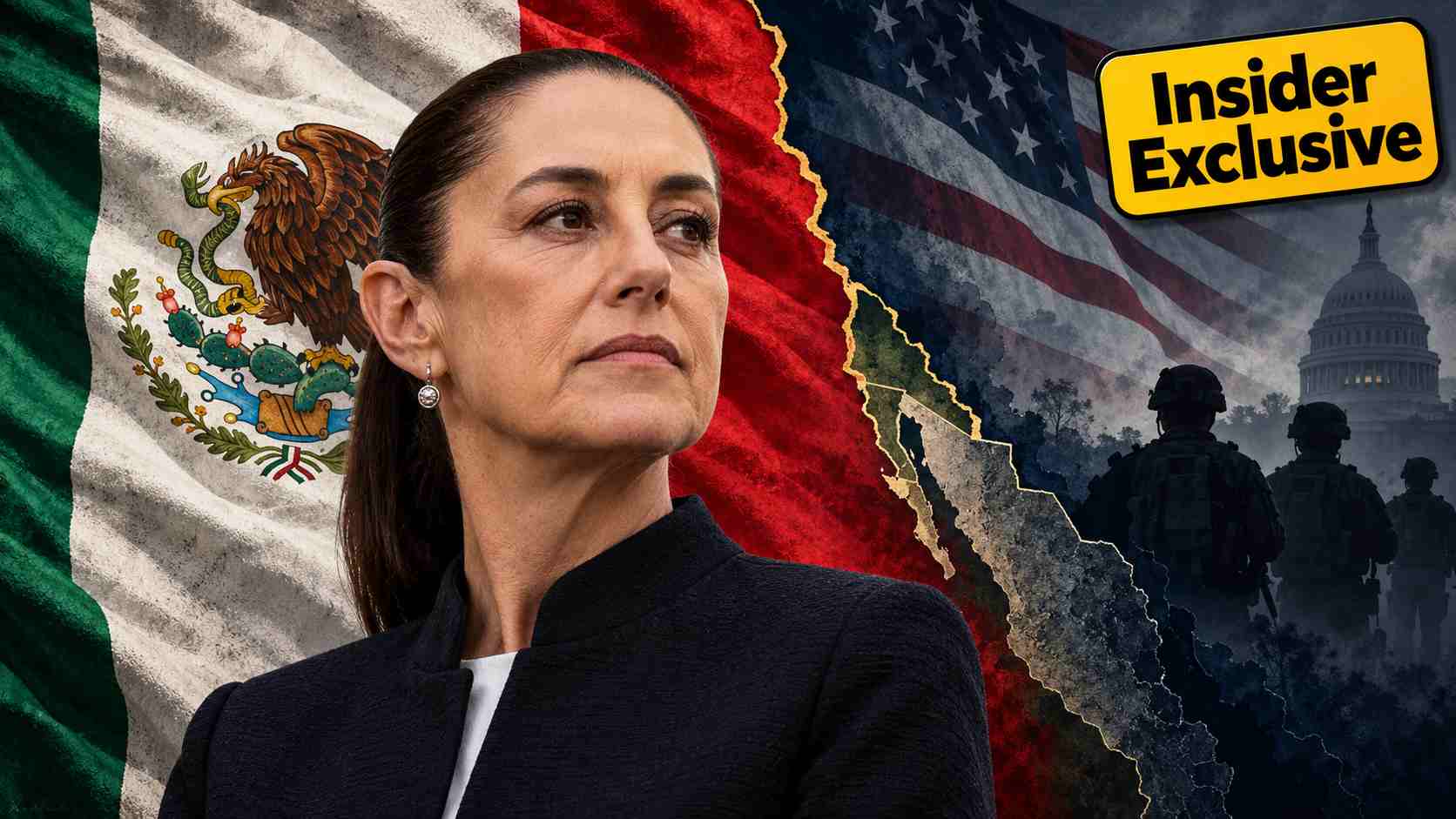
Mexico City, October 26, 2026 — President Claudia Sheinbaum said Monday that Mexico has repeatedly rejected U.S. requests to join operations against cartels inside the country.
“They have requested it on different occasions, and we have always said no,” she said in Spanish. Sheinbaum said cooperation would continue through intelligence sharing and coordination, with Mexican forces conducting operations on Mexican soil.
If you’re wondering why a government facing heavily armed criminal organizations would turn down additional help, that’s a reasonable place to start.
The explanation begins with a detail that can disappear in the headlines: Mexico already accepts consequential U.S. assistance. The disagreement concerns how far that assistance should extend, especially when American personnel would accompany an operation inside Mexico.
That brings us to the question behind the refusal: Who gets to decide when to use force here, and who answers for the consequences?
The immediate backdrop is an October 24 New York Times investigation republished by Vanguardia describing a U.S. memorandum proposing a path toward American security personnel accompanying counter-cartel operations. The newspaper linked Washington’s renewed pressure to its search for a security achievement before the U.S. midterm elections.
Sheinbaum did not confirm receiving that memorandum. Her response established that requests for joint operations have been made repeatedly and rejected.
Sovereignty becomes very practical when someone carries a gun
“Sovereignty” can sound distant from everyday life. In this debate, it concerns authority over arrests, searches, and armed operations in places where people live.
Mexico’s Constitution, including provisions added to Article 40 in 2025, rejects foreign interference harmful to national independence and territorial integrity. It also requires the Mexican state’s express authorization and collaboration for foreign involvement in investigations and law enforcement, within applicable laws.
There is room for authorized cooperation. The conditions matter.
For foreign agents, the National Security Law supplies more specific boundaries. Article 69 provides for temporary entry to exchange information under bilateral agreements. Article 71 limits agents to authorized liaison activities and bars them from exercising powers reserved for Mexican authorities or enforcing foreign laws inside Mexico.
It also prohibits them from carrying out arrests or inducing others to make arrests in violation of Mexican law.
Consider a hypothetical joint raid on a house with families living nearby. Someone must approve the operation, determine when force is justified, and preserve evidence for prosecution. Someone must also answer if the wrong person is detained or a neighbor is injured.
A joint operation would not automatically put Americans in command. But any proposal would need to establish everyone’s lawful responsibilities. That is a much larger decision than accepting intelligence or equipment.
Mexico is already accepting help that can change an operation’s outcome
We have a recent example close to home.
In the government’s account of the February operation in Tapalpa, officials acknowledged U.S. intelligence support in locating CJNG leader Nemesio Oseguera Cervantes, known as El Mencho. Mexican forces carried out the operation, which resulted in his death.
That illustrates the arrangement Sheinbaum is defending: information can come from Washington while Mexico retains operational authority.
Military training is another form of cooperation. As Vallarta Daily reported in April, the Senate approved the entry of 12 armed U.S. military personnel for training with Mexican special forces.
The published authorization specifies training at named military facilities from July 15 through December 15, 2026. It sets a defined purpose, an arrival and departure schedule, and a requirement that Mexico’s Defense Ministry report the results to the Senate.
So the presence of American military personnel and permission to participate in cartel raids are separate questions. Reading the actual authorization tells us much more than a headline announcing that U.S. troops are entering Mexico.
The sensitivity has a history, and a current court case
Mexico’s experience with American forces helps explain why these distinctions carry political weight.
The National Museum of Interventions’ historical account describes the U.S. invasion of 1846–1848, the occupation of Veracruz in 1914 and the expedition sent into Mexico to pursue Pancho Villa in 1916. That last expedition remained until 1917 and ended without capturing him.
Those events provide context for the sensitivity surrounding another American armed deployment. They do not decide whether a particular modern proposal would improve security.
The dispute also concerns federal authority over cooperation.
In the case against former Chihuahua Attorney General César Jáuregui, federal prosecutors allege that foreign agents participated in an April operation without the required notification and authorization. A judge ruled October 25 that the treason case could proceed and maintained his pretrial detention.
Jáuregui’s defense says it will challenge that ruling, arguing that no evidence identifies an order or authorization from him allowing foreign participation. The ruling is preliminary and is not a conviction.
Whatever the eventual outcome, the case shows that the boundary Sheinbaum describes is being enforced through institutions and criminal proceedings. It concerns who can authorize cooperation inside Mexico and what foreign personnel may do.
A successful raid can still leave a community less safe
This is the part I would keep in mind when reading announcements about major cartel operations: capturing or killing a leader and improving public safety are different outcomes.
A 2015 study by Gabriela Calderón, Gustavo Robles, Alberto Díaz-Cayeros and Beatriz examined the effects of removing cartel leaders in Mexico. It found evidence of increases in cartel-related violence and homicides affecting the wider population following leadership removals.
The researchers described how disrupting criminal leadership can intensify internal struggles and conflict between organizations. Some effects on the general population lasted longer than the immediate increase in cartel violence.
That research examines past Mexican operations. It cannot predict the outcome of a proposed American role. It does, however, challenge the assumption that removing a prominent criminal necessarily makes a neighborhood safer.
Here in Vallarta, the February disruptions give that distinction a concrete reference point.
In its coverage of the February 24 cleanup, Vallarta Daily documented crews removing burned vehicles from Boulevard Francisco Medina Ascencio after roadblocks and vehicle fires disrupted the city. Restoring circulation became an immediate concern for residents and businesses.
For someone trying to reach work or reopen a shop, the aftermath of an operation can become the most urgent part of the story.
Planning for retaliation and protecting communities therefore belong in any assessment of expanded security operations, regardless of which country’s personnel participate.
Saying no also leaves Mexico responsible for results
There is a strong argument for preserving national authority over armed operations. There are also serious reasons to demand that Mexican institutions use that authority effectively.
Mexican control does not guarantee honest policing. In 2024, a U.S. court sentenced former Mexican Public Security Secretary Genaro García Luna to more than 38 years in prison after his conviction for helping the Sinaloa Cartel in exchange for millions of dollars in bribes.
That case also demonstrates how American investigations and courts can contribute to accountability without American troops conducting raids in Mexican communities.
The existing bilateral security framework provides other avenues for cooperation, including investigations into illicit financial flows, fuel theft, and trafficking in drugs and weapons. These are areas where cooperation can target the systems that allow criminal organizations to keep operating.
For subscribers trying to assess the competing positions, I would keep both governments under scrutiny. Washington should explain what additional operational involvement would accomplish and how it would manage the risks. Mexico should explain how its preferred arrangement will produce investigations, prosecutions and protection for people living around criminal activity.
Sheinbaum’s answer is that Mexican forces will retain responsibility for operations here. That leaves her government responsible for the hours afterward, too: protecting access roads, responding to retaliation and keeping businesses from becoming targets.
After the next major operation, look for that part of the plan alongside the arrest announcement. In Vallarta, February’s burned vehicles still had to be cleared from Francisco Medina Ascencio before people could move through the city again.