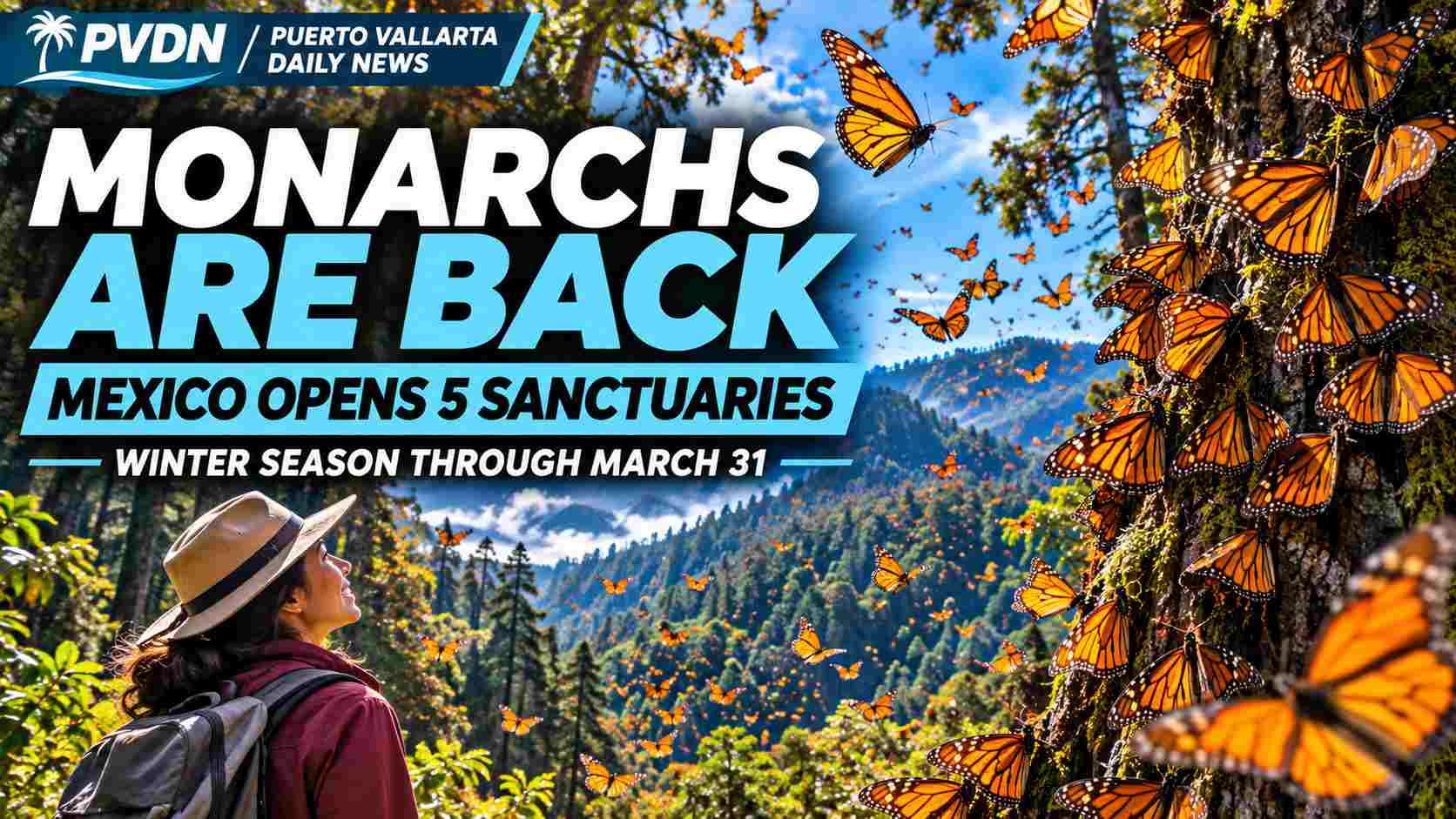
Mexico’s five monarch butterfly sanctuaries have reopened through March 31, 2027. Discover where to visit and why this winter offers renewed hope.
Temascaltepec, State of Mexico, November 24, 2026 – While thousands of Canadians and Americans are making their way to Mexico to escape the cold this winter, another group of seasonal visitors has already started arriving.
They don’t need passports, airline reservations or vacation rentals. And some of them have traveled more than 2,500 miles to get here.
Mexico’s monarch butterfly season officially opened Saturday, with five sanctuaries across Michoacán and the State of Mexico welcoming visitors through March 31, 2027.
Federal environmental authorities inaugurated the season at the Piedra Herrada sanctuary, marking the return of one of North America’s most extraordinary natural spectacles.
And after some encouraging conservation results last winter, there’s reason to be particularly excited about this year’s arrivals.
Mexico’s original snowbirds are back
It’s difficult not to appreciate the similarities between monarch butterflies and many of the foreign residents who spend their winters in Mexico.
Every autumn, monarch butterflies from southern Canada and across much of the United States begin heading south, escaping the freezing temperatures that would otherwise threaten their survival.
Their destination isn’t a tropical beach, however. It’s the mountainous forests of central Mexico, where the combination of elevation, temperature and humidity provides suitable conditions for surviving the winter.
The Monarch Butterfly Biosphere Reserve, recognized as a UNESCO World Heritage Site in 2008, encompasses more than 56,000 hectares of protected landscape and surrounding buffer areas.
During the winter, thousands of butterflies can gather on a single tree, forming enormous orange clusters along its branches.
When the weather warms enough for them to take flight, the forest comes alive with butterflies.
It’s one of those experiences that photographs rarely do justice.
Some genuinely good news for the monarchs
Earlier this year, Vallarta Daily reported on the recovery of Mexico’s monarch butterfly colonies and the challenges that remain.
The numbers were particularly encouraging.
According to WWF’s annual population monitoring report, monarch colonies occupied 2.93 hectares of forest during the 2025-2026 winter season, compared with 1.79 hectares the previous winter.
That’s an increase of 64%.
Researchers measure the amount of forest occupied by butterfly colonies rather than attempting to count every individual butterfly. The measurement provides an indication of the health and abundance of the migrating population.
But before we start celebrating a complete recovery, it’s worth putting those figures into perspective.
Approximately three decades ago, monarch colonies occupied 18.2 hectares of forest during the winter.
Last season’s improvement was welcome news, but there’s still a considerable distance between today’s numbers and historical levels.
The population figures for this winter won’t be established until researchers complete their seasonal monitoring.
Five sanctuaries you can visit this winter
The official opening of Michoacán’s sanctuaries took place Saturday, alongside the federal inauguration in the neighboring State of Mexico.
Five locations are welcoming visitors this season.
Michoacán
- El Rosario: Located in the municipality of Ocampo, this is one of Mexico’s best-known monarch butterfly sanctuaries.
- Sierra Chincua: Located in Angangueo, offering mountain trails through the monarchs’ winter habitat.
- Senguio: Located in the municipality of the same name, providing another opportunity to experience the migration.
State of Mexico
- Piedra Herrada: Located in San Mateo Almomoloa, in the municipality of Temascaltepec, near Valle de Bravo.
- La Mesa: Located in the municipality of San José del Rincón.
The sanctuaries are scheduled to operate from 8 a.m. to 5 p.m. throughout the season, which ends on March 31.
Admission fees, guided tour costs and additional services may vary between locations. Current prices for all five sanctuaries have not been independently confirmed, so visitors should check directly before traveling.
When is the best time to visit?
Just because the sanctuaries have opened doesn’t necessarily mean this weekend is the ideal time to go.
According to Mexico’s National Commission for the Knowledge and Use of Biodiversity, monarchs spend part of November locating suitable areas of the forest before establishing their winter colonies.
December and January generally offer opportunities to observe large clusters of butterflies resting in the trees.
Warmer, sunny days later in the winter can bring more visible flight activity.
January and February are generally good months to consider visiting, particularly if you’re hoping to see butterflies flying rather than simply resting on tree branches.
Weather plays an important role in the experience, however, and there’s never a guarantee that the butterflies will be particularly active on the day you arrive.
And here’s something visitors from Puerto Vallarta should keep in mind: these forests can get quite cold.
Leave the beach sandals at home. You’ll want comfortable walking shoes, warm layers and clothing suitable for mountain weather. The altitude and uphill trails can also make walking more physically demanding than some visitors might expect.
Why you’re only allowed 18 minutes with the butterflies
There’s one unusual rule that might surprise first-time visitors.
According to the visitor regulations announced for the 2026-2027 season, visitors are permitted to spend a maximum of 18 minutes in the designated butterfly observation areas.
That doesn’t mean your entire visit lasts only 18 minutes. The restriction applies to the time spent observing the colonies themselves.
The idea is to minimize disturbances while giving other visitors an opportunity to experience the butterflies.
Visitors are also expected to remain quiet, follow designated trails, avoid flash photography, refrain from touching butterflies and follow the instructions of local guides.
Pets are not permitted, and environmental authorities have also asked visitors not to use hand sanitizer near the colonies.
Remember, this isn’t a zoo or a butterfly exhibition. You’re entering the natural habitat of an animal that has traveled thousands of miles to survive the winter.
We’re the guests here.
Tourism that gives local communities a reason to protect the forest
Michoacán’s government expects approximately 800,000 visitors across the two states during this winter’s butterfly season.
That’s a projection, not a confirmed visitor count, but it illustrates the economic importance of the migration to communities surrounding the reserve.
Local families earn income by working as guides, providing transportation, operating restaurants, selling handicrafts and offering accommodations.
Many of these communities also participate directly in forest conservation and restoration efforts.
It’s an example of how tourism and environmental protection can support one another when the economic benefits reach the people responsible for looking after the natural environment.
If you’re planning a visit, consider eating at locally owned restaurants, hiring authorized local guides and purchasing products made by community residents.
The butterflies might be the reason you’re visiting, but the people protecting their habitat are an important part of the experience.
A little reminder that North America shares more than borders
There’s something particularly remarkable about an insect weighing less than a gram whose survival depends on cooperation between three countries.
Monarchs need healthy breeding grounds in Canada and the United States, suitable plants and feeding opportunities along their migration route, and protected forests when they finally reach Mexico.
Habitat loss, pesticide use, extreme weather and forest degradation continue to threaten that delicate arrangement, as WWF’s latest conservation findings make clear.
Mexico cannot protect the entire migrating population on its own, just as conservation efforts in Canada and the United States would mean considerably less without healthy wintering grounds here.
For all the headlines about disagreements between our three countries, the monarch butterfly offers a rather beautiful reminder of how interconnected we actually are.
And if you’re spending this winter in Mexico, perhaps it’s time to put something other than the beach on your travel calendar.
Some of your fellow snowbirds have traveled an extraordinary distance to be here. They’re worth going a little out of your way to see.